
Solid State LiDAR Market Report Scope & Overview:
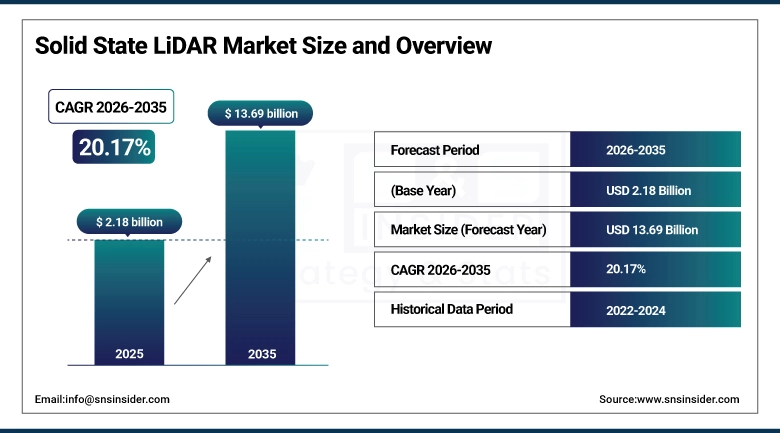
The Solid State LiDAR Market size was valued at USD 2.18 Billion in 2025 and is projected to reach USD 13.69 Billion by 2035, growing at a CAGR of 20.17% during 2026–2035.
The Solid-State LiDAR Market is gaining strong momentum owing to its increasing demand for a compact, high performance, and low-cost sensor technology across automotive, robotics, and industrial applications. Mechanical architectures are making way for fully solid-state architectures allowing for increased reliability, a smaller footprint, and simpler integration into advanced driver-assistance systems (ADAS) and autonomous vehicles. The immediate commercialization is further fueled by increasing uptake of demands for 4D sensing, silicon photonics as well as chip-scale LiDAR solutions. Wider OEM partnerships and readiness for mass-production are driving costs down and facilitating large-scale deployment. Moreover, increasing adoption of smart infrastructure, logistics, and autonomous mobility is making Solid-State LiDAR a fundamental component for the next-gen global intelligent systems.
In Jan 2026 – Seyond unveiled its Hummingbird solid-state LiDAR series and showcased mass-production readiness along with some of its automotive design wins at the OEM level. The scanning architecture that is fully digital allows for small sizes high performance sensing in vehicles and robotics platform.
To Get more information on Solid State LiDAR Market - Request Free Sample Report
Solid State LiDAR Market Trends Highlights:
-
The Solid State LiDAR Market is witnessing rapid growth due to increasing demand for autonomous vehicles, ADAS, and robotics applications.
-
Rising shift from mechanical LiDAR to solid-state systems for higher durability, lower cost, and compact design is driving adoption.
-
Strong investments in automotive safety systems and self-driving technology development are boosting market expansion.
-
Growing use in industrial automation, drones, and smart infrastructure projects is expanding application scope.
-
Advancements in MEMS, flash LiDAR, and optical phased array technologies are improving performance and accuracy.
-
Increasing focus on mass production and cost reduction is making solid-state LiDAR more commercially viable.
-
Demand for high-resolution 3D sensing and real-time environment mapping is rising across industries.
U.S. Solid State LiDAR Market Size Outlook:
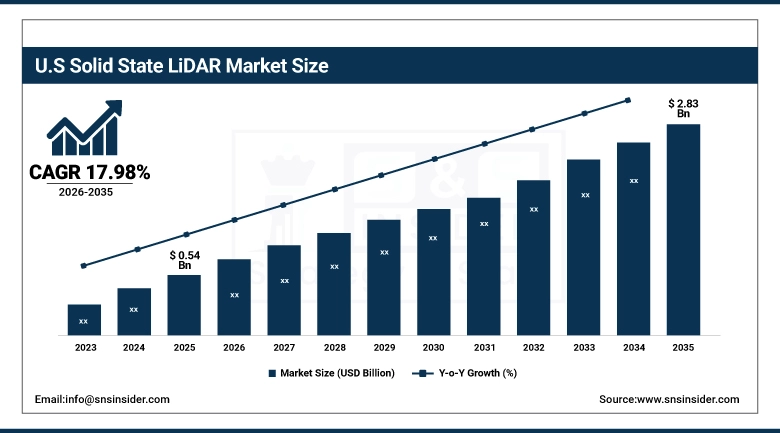
The U.S. Solid State LiDAR Market size was valued at USD 0.54 Billion in 2025 and is projected to reach USD 2.83 Billion by 2035, growing at a CAGR of 17.98% during 2026–2035, rapid adoption of autonomous driving technologies, advance driver-assistance systems (ADAS) and rising investments towards deploying smart mobility solutions. Increasing deployment in automotive, robotics, and industrial applications driving demand for minimal-size, low-cost, and high-precision complete sensing systems. Advancements with silicon photonics, 4D sensing, and chip-scale LiDAR technologies continue to improve performance and lower the cost of these systems. Apart from that, increasing collaborations between OEMs and LiDAR manufacturers, and vigorous R&D activities in semiconductor and automotive sector are creating high growth opportunities for market growth, where U.S. is a major innovation hub in this space.
Market Drivers: Silicon Photonics and High-Volume Production Driving LiDAR Scalability
The Solid-State LiDAR market is experiencing strong growth driven by the shift toward silicon photonics–based architectures and high-series production capabilities. owing to the transition towards the silicon photonics–based architecture and the availability of high-series manufacturing. Fully integrated full sensing systems on a single chip architecture, with some new developments, allow for scalable, low-cost, compact LiDAR solutions suitable for mass deployment. This is a fact, and our game-changing breakthrough is enabling a new level of performance in applications like on-the-fly velocity detection, real-time motion analysis, and 4D sensing. This trend combined with increasing adoption in robotics, industrial automation, and autonomous systems is only solidifying the demand further. The evolution of mechanical to fully solid-state designs is also simplifying operation and improving reliability, potentially establishing LiDAR as an indispensable sensing solution for next-gen intelligent machines and smart mobility ecosystems.
April 2026 – Voyant Photonics is pushing its solid-state LiDAR platforms toward high-series production, with a focus on silicon photonics-based chip-scale sensing for inexpensive, scalable deployment. The company targets its 4D FMCW LiDAR solution for robotics, industrial automation and autonomous systems.
Market Restraints: Critical Constraints Hindering Solid-State LiDAR Market Acceleration
The Solid-State LiDAR market faces several key restraints, primarily high initial development and integration costs despite ongoing price reductions, which limit adoption in cost-sensitive applications. Advances in the software and algorithms to use this data have been plentiful, however, technical challenges like less long-range detection accuracy as compared with mechanical LiDAR and degradation during adverse weather conditions have limited widespread use. They also slow commercialization due to a lack of LiDAR technology standardization and incompatibility from existing automotive and robotics systems. The supply chain limitations with advanced semiconductor components adversely influence scaling production. In addition to this, significant competition from lower-cost camera-and radar-based perception systems continues to limit the rapid penetration of solid-state LiDAR into mainstream applications.
Market Opportunities: Affordable LiDAR Revolution Driving Mass-Market Adoption
The Solid-State LiDAR market is witnessing a significant opportunity due to cost reductions taking place which will enable cost competitive solutions for mainstream automotive applications. Reduced costs are allowing integration beyond just high-end autonomous vehicles into mass market ASEAN equipped cars. This change is boosting the demand in passenger vehicles, robotics, and smart mobility segments. Furthermore, development of an adaptable solid-state architectures, higher manufacturing scalability, and focus on cost-effective, high-performance sensing capabilities are developing new growth opportunities and making Solid-State LiDAR a dominant technology for next-gen Intelligent Transportation Systems.
In February 2026 – Micro Vision launched a solid-state LiDAR sensor with a price target of less than USD 200, even though the company is targeting a promotional price of USD 100 to dramatically lower the sensor cost for ADAS.
Solid State LiDAR Market Segment Highlights:
-
By Technology: Dominant – Flash LiDAR (44.30% in 2025 → 38.70% in 2035); Fastest Growing – Scanning LiDAR (29.23% CAGR)
-
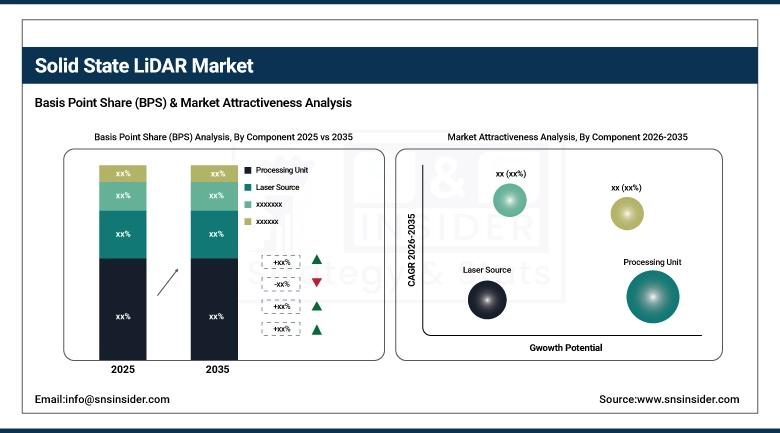
By Component: Dominant – Processing Unit (27.40% in 2025 → 38.60% in 2035); Fastest Growing – Processing Unit (24.28% CAGR)
-
By Application: Dominant – Autonomous Vehicles (43.20% in 2025 → 36.80% in 2035); Fastest Growing – Robotics (29.01% CAGR)
-
By End Use: Dominant – Automotive (48.20% in 2025 → 41.80% in 2035); Fastest Growing – Environmental Monitoring (23.26% CAGR)
By Technology: Flash LiDAR (Dominant) and Scanning LiDAR (Fastest-Growing)
Among various types of Solid-State LiDAR, Flash LiDAR is holding the largest share of the market as this technology can capture full-field images at a single point of time edge thereby ensuring a high level of reliability, compact design, and an integration go-to solution for automotive and ADAS applications. The ever expanding presence of the technology in the autonomous vehicle and industrial use cases gives it even more dominance. However, Scanning LiDAR is the fastest-growing segment as it offers better range, precision, and scalability. The market is growing with a significant rate due to rise in demand for high-performance sensing in robotics, smart infrastructure, and long-range detection applications.
By Component: Processing Unit (Dominant & Fastest-Growing)
The Solid-State LiDAR market by Processing Unit is dominated by Processing Unit as they are the central component for real time data processing, object categorizing and decision making of autonomous systems. This dominance is reinforced with the growing convergence of AI and edge computing within LiDAR. Furthermore, the Processing Unit segment is even the fastest-growing segment, which is driven by increase in demand for high-speed data processing, improved computational capabilities, and continuous improvement in semiconductor technologies to support next-generation LiDAR solutions.
By Application: Autonomous Vehicles (Dominant) and Robotics (Fastest-Growing)
The Solid-State LiDAR market is all about Autonomous Vehicles since the global adoption of ADAS (Advanced Driver Assistance Systems) and self-driving technologies have been widely adopted along with considerable investment made by automotive manufacturers. Demand for this segment is still driven by the need for accuracy of sensing and safety features. On the other hand, Robotics is the fastest-growing segment because of the growing deployment of robotics systems such as industrial automation, warehouse robotics, and service robots. LiDAR Need in Robotics Growing demand in accurately performing navigation as well as real-time mapping of environments is boosting LiDAR adoption in robotics applications.
By End Use: Automotive (Dominant) and Environmental Monitoring (Fastest-Growing)
The solid-state LiDAR market is segmented by end use into automotive, drones, and other segments such as industrial mobile robots, smart cities and homes and others. Automotive is the leading end-use segment with an expected high integration of LiDAR in vehicles for safety, navigation, and autonomous driving capabilities. Along with stable production volumes and mobility solutions, constant innovations strengthen its competitive edge. However, the Environmental Monitoring segment is experiencing the most rapid growth as the use of LiDAR has grown significantly in areas including climate analysis, pollution tracking, and disaster management. Higher emphasis on sustainability as well as environmental data collection has highly contributed to the growth of this segment.
Solid State LiDAR Market Regional Highlights:
-
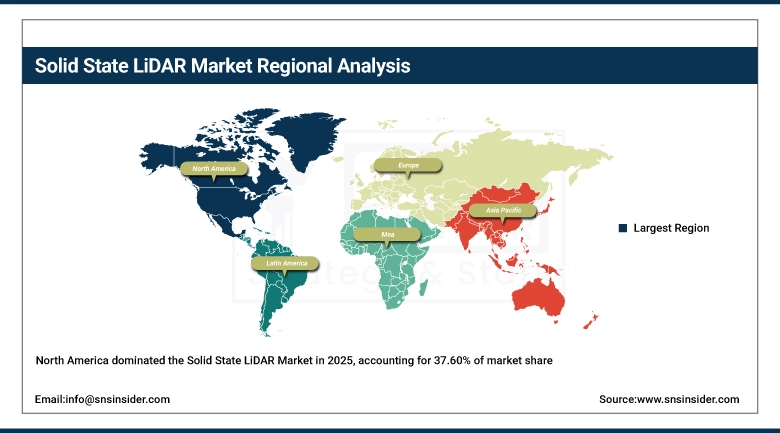
North America (Dominating – 37.60% in 2025 → 31.80% in 2035, CAGR 18.16%)
-
Asia-Pacific (Fastest Growing – 29.70% in 2025 → 38.40% in 2035, CAGR 23.26%)
-
Europe (24.90% in 2025 → 22.70% in 2035, CAGR 19.06%)
-
Latin America (4.20% in 2025 → 3.10% in 2035, CAGR 16.53%)
-
Middle East & Africa (3.60% in 2025 → 4.00% in 2035, CAGR 21.44%)
North America Solid State LiDAR Market Insights:
North America will continue to be the largest region in the Solid-State LiDAR market due to robust technological advancements, higher adoption rate of autonomous vehicles, and investments in ADAS and smart Mobility solutions. With leading companies like Luminar Technologies and Ouster Inc. based in the region, the leadership is also reinforced. Moreover, presence of supportive regulatory frameworks and deployment expansion of this technology in robotics, industrial automation, and smart infrastructure drive its growth over the forecast period.
Get Customized Report as per Your Business Requirement - Enquiry Now
U.S. Solid State LiDAR Market Insights:
The United States Solid-State LiDAR market is growing rapidly, driven by strong R&D investments, increasing autonomous vehicle testing, rising ADAS integration, and the presence of leading LiDAR innovators and technology companies.
Asia-Pacific Solid State LiDAR Market Insights:
Asia Pacific is currently the fastest growing region in the Solid-State LiDAR market as it is a rapidly growing region for automotive sector, there is rising penetration of Advanced driver-assistance systems (ADAS) technologies, coupled with strong government support for autonomous mobility. With China, Japan, and South Korea largely leading growth with large-scale manufacturing and technology. Further rise in investment towards smart cities, robotics and industrial automation, coupled with presence of key LiDAR manufacturers is further enabling regional market growth in the country.
China Solid State LiDAR Market Insights:
China is a key driver and dominant country in the Solid-State LiDAR market, fueled by strong government support, rapid autonomous vehicle adoption, expanding EV production, and significant investments in smart infrastructure and AI technologies.
North America Solid State LiDAR Market Insights:
The Solid-State LiDAR market in North America is expected to grow the most, owing to the rapid evolution of autonomous driving technologies, integration of key innovators in the network, such as Luminar Technologies, Inc., Ouster Inc. and others, and increasing investments in advanced driver assistance systems (ADAS) and robotics. Increase in the usage of LiDAR in smart infrastructure and industrial automation, along with increasing regulatory frameworks also promotes the growth of market. Furthermore, interaction between automakers, tech firms, and startups furthers innovation, establishing the area as a rapid growth center.
U.S. Solid State LiDAR Market Insights:
The United States Solid-State LiDAR market is growing rapidly, driven by strong R&D investments, increasing autonomous vehicle testing, rising ADAS integration, and the presence of leading LiDAR innovators and technology companies.
Europe Solid State LiDAR Market Insights:
The Europe Solid-State LiDAR market is witnessing stable growth, supported by strong automotive manufacturing, increasing adoption of ADAS technologies, and stringent safety regulations. Countries such as Germany, France, and United Kingdom are leading innovation, backed by collaborations between automakers and LiDAR providers. Growing investments in smart mobility, industrial automation, and infrastructure modernization further contribute to consistent market expansion across the region.
Germany Solid State LiDAR Market Insights:
Germany is one of the largest markets for Solid-State LiDAR due to strong automotive OEM presence, advanced engineering capabilities, increasing adoption of ADAS, and partnerships between major automakers and LiDAR technologies.
Latin America Solid State LiDAR Market Insights:
The Latin America Solid-State LiDAR market is showing a sluggish growth due to the increasing penetration of advanced driver-assistance systems, gradual spread of automotive manufacturing, and the rising investments in smart city projects. Top demand are leaded through countries like Brazil and Mexico, underpinned by industrial automation and infrastructure modernisation. Further, rising concern for road safety and technological advances is leading to steady determination of the market in the region.
Brazil Solid State LiDAR Market Insights:
The Brazil Solid-State LiDAR market is projected to grow at a modest annual growth rate due to increasing automotive production, increasing adoption of ADAS, modernization of infrastructure, and slow investment in smart mobility and industrial automation technologies.
Middle East & Africa Solid State LiDAR Market Insights:
The Middle East & Africa Solid-State LiDAR market is expanding owing to growing investment in smart city projects, development of infrastructure and rising adoption of advance sensing technologies. Publicly-initiated digital transformation programs are driving growth in the United Arab Emirates and Saudi Arabia. This is expected to expand the market over time as an increasing number of LiDAR applications serve regional security, transportation, and industrial automation forces.
Saudi Arabia and the United Arab Emirates (UAE) Solid State LiDAR Market Insights:
The growth of the Saudi Arabia and United Arab Emirates Solid-State LiDAR Market is at steady rate, which can be attributed to booming smart cities initiatives, infrastructure development and rising adaption of advanced sensing technologies across transportation and security segments.
Solid State LiDAR Market Competitive Landscape:
Hesai Group, established in 2014 and headquartered in Shanghai, China, is a leading developer of high-performance LiDAR solutions for automotive and robotics applications, known for its advanced R&D capabilities, scalable manufacturing, and strong global customer base.
-
In October 2025 – Hesai Group became the first LiDAR company to produce 1 million units annually, marking a major milestone in large-scale production and global adoption.
Luminar Technologies, established in 2012 and headquartered in Orlando, Florida, is a leading developer of advanced LiDAR and perception technologies for autonomous vehicles, specializing in long-range sensing solutions and partnering with major automotive OEMs to enable safer, high-performance driver assistance and self-driving systems.
-
In Dec 2025 – Luminar Technologies declared Chapter 11 bankruptcy amid patent fights and impending foreclosure of factories, while seeking to continue operating and offering up its assets for sale to ensure continued LiDAR supply throughout a working capital reorganization.
Solid State LiDAR Companies are:
-
Hesai Group
-
Luminar Technologies
-
Innoviz Technologies
-
Ouster Inc.
-
Cepton Technologies
-
Quanergy Systems
-
LeddarTech
-
SICK AG
-
Valeo
-
AEye Inc.
-
Huawei Technologies
-
Seyond
-
Neuvition Inc.
-
Scantinel Photonics
-
Opsys Technologies
-
Baraja
-
LuminWave
-
Innovusion
| Report Attributes | Details |
|---|---|
| Market Size in 2025 | USD 2.18 Billion |
| Market Size by 2035 | USD 13.69 Billion |
| CAGR | CAGR of 20.17% From 2026 to 2035 |
| Base Year | 2025 |
| Forecast Period | 2026-2035 |
| Historical Data | 2022-2024 |
| Report Scope & Coverage | Market Size, Segments Analysis, Competitive Landscape, Regional Analysis, DROC & SWOT Analysis, Forecast Outlook |
| Key Segments | • By Technology (Flash LiDAR, Phased Array LiDAR and Scanning LiDAR) • By Component (Laser Source, Receiver, Optics and Processing Unit) • By Application (Autonomous Vehicles, Mapping and Surveying, Infrastructure Monitoring, Agriculture and Robotics) • By End Use (Automotive, Aerospace, Defense, Construction and Environmental Monitoring) |
| Regional Analysis/Coverage | North America (US, Canada), Europe (Germany, UK, France, Italy, Spain, Russia, Poland, Rest of Europe), Asia Pacific (China, India, Japan, South Korea, Australia, ASEAN Countries, Rest of Asia Pacific), Middle East & Africa (UAE, Saudi Arabia, Qatar, South Africa, Rest of Middle East & Africa), Latin America (Brazil, Argentina, Mexico, Colombia, Rest of Latin America). |
| Company Profiles | Hesai Group, RoboSense, Luminar Technologies, Innoviz Technologies, Ouster Inc., Cepton Technologies, Aeva Technologies, Quanergy Systems, LeddarTech, SICK AG, Valeo, AEye Inc., Huawei Technologies, Seyond, Neuvition Inc., Scantinel Photonics, Opsys Technologies, Baraja, LuminWave, Innovusion. |

Frequently Asked Questions
North America dominated the Solid State LiDAR Market in 2025.
The “Flash LiDAR” segment dominated during the projected period.
The Solid-State LiDAR market is driven by rising demand for autonomous vehicles and ADAS, rapid advancements in silicon photonics and 4D sensing technologies, increasing need for compact and cost-efficient high-precision sensors, and growing adoption in robotics, smart mobility, and industrial automation applications.
The Market was valued at USD 2.18 Billion in 2025 and is projected to reach USD 13.69 Billion by 2035.
The Market is expected to grow at a CAGR of 20.17% during 2026–2035.
