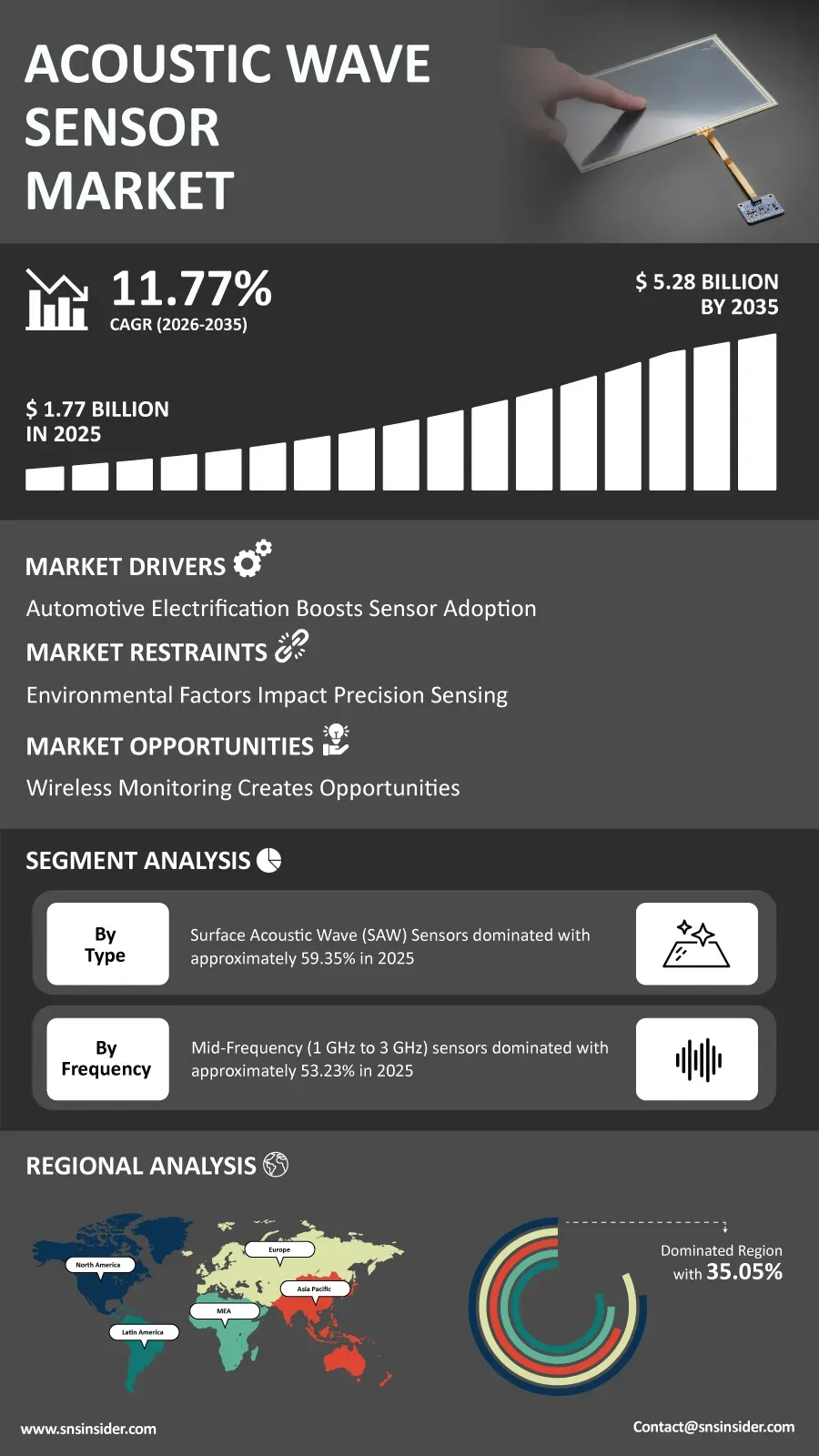
The global Acoustic Wave Sensor Market is witnessing strong momentum as demand for high-precision sensing technologies expands across telecommunications, automotive, industrial automation, and healthcare applications. According to a recent study by SNS Insider, the global Acoustic Wave Sensor Market size valued at USD 1.77 billion in 2025, is anticipated to grow to USD 5.28 billion by 2035, registering a CAGR of 11.77% over the 2026–2035 forecast period.
Increased use of next generation wireless communications systems, increased digitization in industries, and growing popularity of intelligent sensor systems are fueling market growth. The acoustic wave sensors have been receiving increased acceptance as a result of their high measurement accuracy, fast response, stability and reliability in harsh environments.
There is an increased emphasis by companies on developing smart sensor systems that ensure better performance and integration of small devices in diverse applications. There is ongoing development of piezoelectric materials and wireless sensing technology.
To Get Detailed Insights on the Acoustic Wave Sensor Market – Request a Sample Report
Expanding Smart Infrastructure Creates New Market Opportunities
Monitoring systems that have connectivity capabilities are gaining popularity among businesses to optimize efficiencies, predictive maintenance, and even real-time asset tracking. Acoustic wave sensing technology is one of the critical technologies being used by industries due to their accuracy and maintenance-free nature.
There has been massive adoption of infrastructure such as 5G, Internet of Things (IoT) in industry, autonomous vehicles, and diagnostics in medicine, which is opening up avenues for sensors manufacturing. The resilience of acoustic waves sensors in difficult environmental conditions is another key factor behind their increasing popularity.
Advancements in wireless passive sensing, MEMS integration, and biosensor development are expected to further expand the technology's commercial footprint over the coming decade.
Key Market Insights Highlight Shifting Demand Patterns
By type, Surface Acoustic Wave (SAW) sensors segment held around 59.35% of global market revenue in 2025, supported by their widespread deployment in wireless communication and radio frequency applications. Bulk Acoustic Wave (BAW) sensors are projected to record the fastest growth at a CAGR of 12.60% through 2035 as higher-frequency communication networks continue expanding globally.
On the basis of frequency, mid-frequency sensors operating between 1 GHz and 3 GHz segment held approximately 53.23% of market revenue in 2025. High-frequency sensors operating above 3 GHz are forecast to experience the strongest growth, registering a CAGR of 13.09% due to increasing deployment in advanced wireless communication systems.
On the basis of sensing parameter, temperature sensing dominated with approximately 32.80% of global revenue in 2025 owing to broad industrial and automotive applications. Humidity sensing is projected to emerge as the fastest-growing segment with a CAGR of 12.97% as environmental monitoring and smart infrastructure investments continue increasing.
In terms of end-use industry, consumer electronics are forecast to account for approximately 29.17% of market revenue in 2025, driven by large-scale production of connected electronic devices. Automotive is anticipated to be the fastest-growing end-use segment, expanding at a CAGR of 13.59% as vehicle electrification and intelligent mobility technologies gain momentum.
Wireless Sensing Technologies Continue to Transform Industrial Applications
The need for wireless devices without any batteries for monitoring applications is growing, especially those that can operate in hard-to-reach environments and do not require maintenance. Acoustic wave devices help monitor conditions in rotating machinery, industrial equipment, and infrastructure and save money on maintenance and ensure safety.
Another area of use of these acoustic wave sensors is healthcare. They have a potential use in fast diagnostics, detection of biomarkers, environmental monitoring, and food safety applications. The sensitivity and miniature size of these devices are driving their investments in the medical device industry.
Regional Markets Display Strong Growth Potential
The North American region will hold about 35.05% of the market revenues in 2025 owing to its capability of conducting extensive research, well-developed manufacturing facilities, extensive use of automation in industries, and consistent investments in defense and healthcare technology.
Asia Pacific is anticipated to dominate the market as it grows at a CAGR of 13.20% till 2035. High consumer electronics manufacturing facilities, growth in 5G infrastructure, rise in manufacturing of electric vehicles, and growth in industrial automation are creating high demand in the region.
Increasing investments in manufacturing of semiconductors and construction of intelligent industrial facilities are expected to further boost the regional market growth.
Industry Participants Accelerate Product Innovation
Competition within the Acoustic Wave Sensor Market remains dynamic as leading manufacturers focus on expanding product portfolios, improving sensing performance, and supporting next-generation wireless communication technologies. Companies continue investing in high-frequency filters, wireless passive sensors, precision resonators, and integrated sensing platforms to address evolving customer requirements across multiple industries.
Key companies operating in the global Acoustic Wave Sensor Market include Qorvo Inc., Broadcom Inc., Skyworks Solutions Inc., TDK Corporation, Murata Manufacturing Co. Ltd., EPCOS AG (TDK Group), Abracon LLC, API Technologies Corp., Vectron International, Sangshin Elecom Co. Ltd., NDK (Nihon Dempa Kogyo Co. Ltd.), Kyocera Corporation, Microsemi (Microchip Technology), Qualtre Inc., SiTime Corporation, Micro Crystal AG, Advanced Energy Industries, Sensanna Inc., G-Star Technologies, and Infineon Technologies AG.
An SNS Insider analyst Sushant Kadam commented, “Rapid advances in wireless connectivity, industrial automation, and intelligent sensing technologies are creating sustained demand for acoustic wave sensors across multiple industries. Manufacturers investing in high-frequency performance, wireless sensing capabilities, and application-specific innovation will be well positioned to capitalize on emerging opportunities throughout the forecast period.”
About the Author

Get in touch