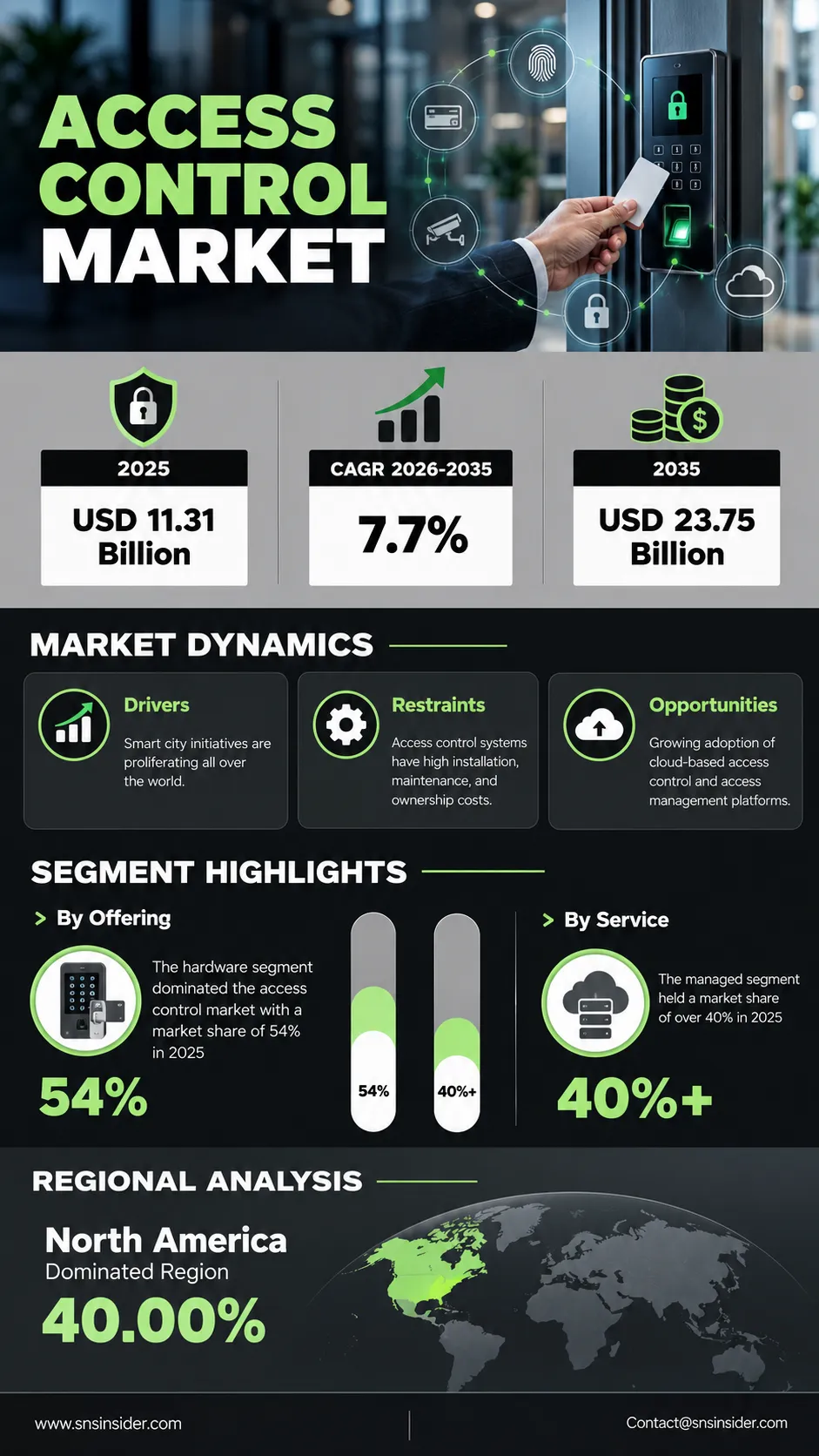
The global access control industry is gaining traction due to the growing emphasis by enterprises on the need for physical security and authentication, among others. The growing number of security threats and the digitization process are driving firms to upgrade from their traditional access management systems. “According to a recent study by SNS Insider, the global Access Control Market size was valued at USD 11.31 billion in 2025 and is anticipated to reach USD 23.75 billion by 2035, registering a CAGR of 7.7% over the 2026–2035 forecast period.”
Access control technology is now transcending the traditional approach of using keys, identification cards, and locks. With the increasing adoption of biometric verification, mobile credentialing, smart cards, and cloud-based systems, it is becoming easy for companies to streamline access control and get increased visibility on their facilities. The technology allows security professionals to track activities, keep access logs, and identify any risks associated with such activities. The adoption of connected technologies and security platforms increases the need for versatile access control systems.
To Get Detailed Insights on the Access Control Market – Request a Sample Report
Growing Security Requirements and Smart City Investments Drive Market Expansion
The growing significance of public safety, asset protection, and identity management plays an important role in the expansion of the global access control market. In order to protect information, equipment, employees, and secure locations, financial institutions, healthcare organizations, business offices, and industries should have efficient access control systems. The development of smart cities will benefit the market due to the fact that municipalities are more concerned about connected infrastructure, transportation, and safety of the city.
Moreover, the move towards hybrid workplaces and mobile services influences the decision-making process regarding purchases. Companies require efficient centralized management, remote credential management, and real-time monitoring. Mobile-based access has become very common in comparison with traditional tokens, and cloud-based systems allow security managers to control access rights to various sites without relying only on local systems.
Nevertheless, expensive installation, maintenance costs, software updates, and integration needs pose notable constraints. Such factors may hinder the implementation of access control systems in SMEs because they require modernizing the existing legacy infrastructure.
Key Market Insights Highlight Shifting Demand Patterns
Hardware held a dominating position in the access control market by holding a market share of 54% in 2025 through offering. Card readers, biometric scanners, electronic locks, and control panels still hold significance in the realm of security systems. The continuous demand for such devices signifies the necessity for verification as well as the growing installation of security systems. In addition, software is expected to exhibit greater growth during the forecast period owing to the increasing use of cloud administration.
On the basis of service, the managed segment contributed more than 40% to the market’s revenue in 2025 and is anticipated to witness a higher growth rate until 2035. The managed access control assists companies in managing the permissions, monitoring the access activities, and coordinating the security policies via centralized solutions. Also, outsourcing aspects of system management is beneficial in minimizing the burden on internal teams and for companies lacking security resources.
In terms of industry verticals, the commercial vertical was dominant in the market with more than 35% share in 2025. The offices, banks, hospitals, and other commercial buildings utilize the access control solution in protecting their employees, assets, confidential data, and restricted areas. The residential vertical is poised to grow at a higher CAGR owing to the growing use of smart locks, mobile credentials, and biometric entry.
Technology Integration Reshapes Access Control Deployment
The merger of access control technologies with the IoT (Internet of Things), cloud technology, and building management systems is providing fresh opportunities for the companies manufacturing access control equipment. Such technologies offer the possibility to monitor activities from one place, update credentials, and ensure coordination of access policies between various properties. The use of biometrics and multifactor identification is also becoming relevant where strong authentication is necessary.
Mobile credentialing is gaining popularity due to organizations' desire to replace conventional cards with something more convenient. In addition, cybersecurity, data privacy, and interoperability become significant aspects when it comes to the interconnection of physical access infrastructure. Companies which offer both good authentication and well-designed software architecture, reliable services, and integration solutions can satisfy customers' needs.
North America Leads Access Control Market with Over 40% Share as Asia Pacific Accelerates
North America was the key market segment for access control in 2025, capturing more than 40% of the overall market share. Existing commercial infrastructures, security needs, and investments in building technologies fuel the demand in the region. Banks, hospitals, government departments, and industries will continue to need systems that can provide security while making access control easier. The use of smart home technology will drive the residential demand.
The Asia Pacific region will be the most promising one with respect to CAGR between 2026 and 2035. Urbanization, infrastructure development, implementation of smart cities, and investments in commercial buildings are driving the market growth. More use of biometric authentication, RFID identification systems, and cloud-based management systems is further bolstering the demand in the region. Europe is another major market driven by security requirements, regulations, and upgrading of commercial and industrial facilities. Latin America and the Middle East and Africa will benefit from infrastructure development and commercial construction activities.
Competitive Landscape Emphasizes Cloud Platforms and Authentication Innovation
The players in the market are concentrating on such factors as integrated platforms, mobile access, biometric technology, and cloud-based management to improve their market position. The product development is becoming more focused on interoperability, remote management, and the capability of integration with other access control systems and building security/automation systems. Managed services and scalable solutions are also very relevant approaches for customer reach.
Key companies operating in the access control market include dormakaba Holding AG, Johnson Controls International plc, Honeywell International Inc., Nedap N.V., Thales Group, NEC Corporation, ASSA ABLOY AB, Allegion plc, Identiv, Inc., Suprema Inc., Bosch Security Systems, HID Global Corporation, Gallagher Group Limited, Axis Communications AB, Stanley Security Solutions, Salto Systems S.L., LenelS2, Siemens AG, Vanderbilt Industries, and Gunnebo AB.
According to SNS Insider analyst Sushant Kadam, the access control market is positioned for sustained expansion as security requirements converge with connected infrastructure and digital identity management. The analyst’s point of view emphasizes the significance of cloud-based management, mobile credentials, and strong authentication technology in dealing with customer demands. Companies that can strike a balance between security efficiency and cost-effectiveness will have more chances in business, residential, and government markets.
About the Author

Get in touch