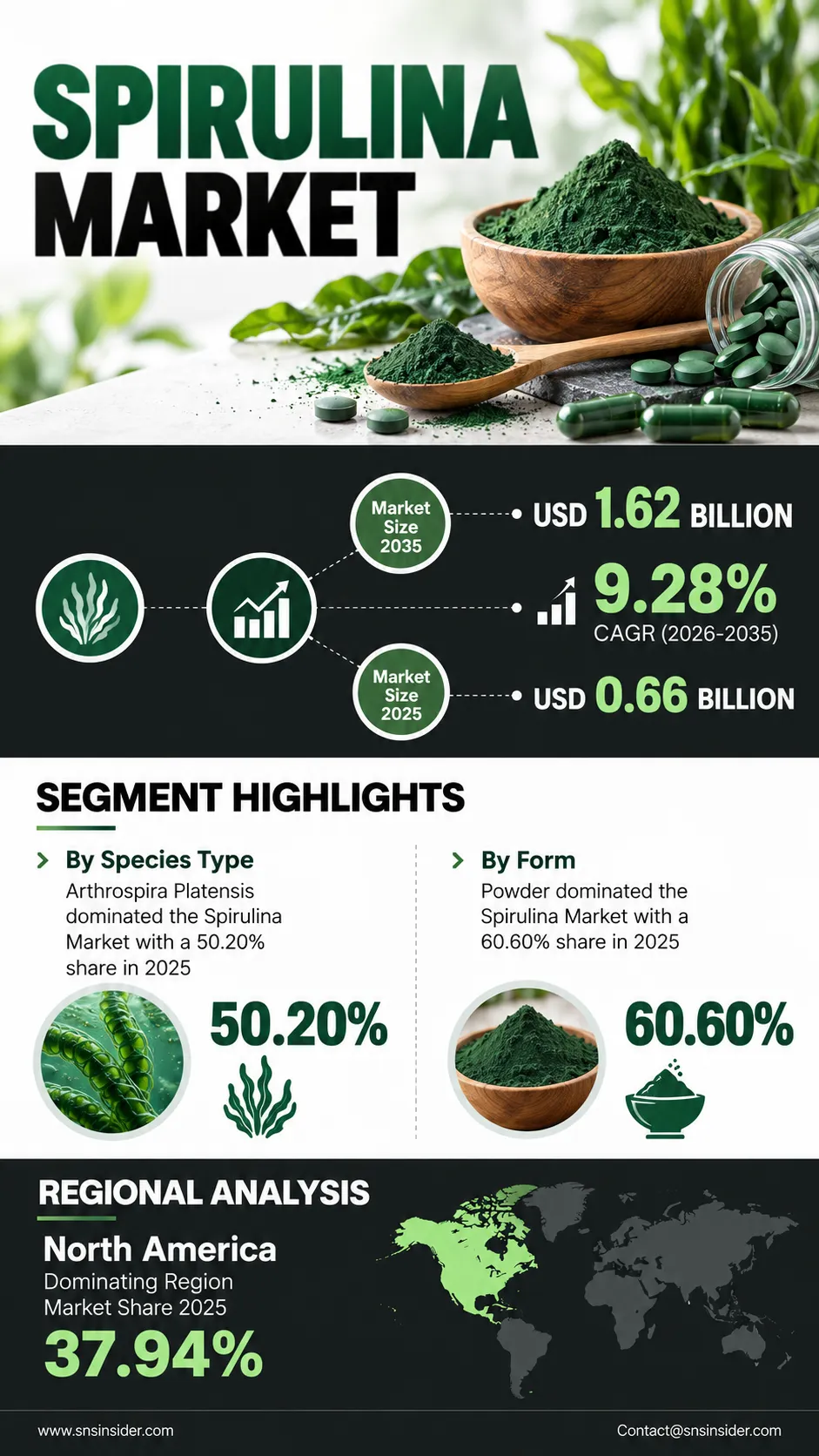
The global Spirulina Market is set for significant expansion as health awareness and plant-based protein demand continue to reshape natural superfood ingredient sourcing worldwide. “According to a recent study by SNS Insider, the global Spirulina Market size valued at USD 0.6688 billion in 2025, is anticipated to grow to USD 1.624 billion by 2035, registering a CAGR of 9.28% over the 2026–2035 forecast period.”
There have been notable changes within microalgae cultivation technology over time, due to which many producers who aim at improving yield and purity of their products can take advantage of this trend. This includes the need for more advanced cultivation and extraction techniques that will provide food, cosmetics, and nutraceutical companies with the ability to access reliable, high-quality spirulina ingredients. This applies in situations where spirulina supports dietary supplements, functional foods, cosmetics, and animal feed applications. Producers are constantly working hard to ensure that their spirulina products perform better than before in order to meet various consumer health and quality requirements.
To Get Detailed Insights on the Spirulina Market – Request a Sample Report
Phycocyanin Colorant Innovation Creates New Demand
The spirulina market has evolved from a niche superfood supplement to an increasingly mainstream, multi-application natural ingredient category. The growing investment in phycocyanin extraction technology, species diversification, and functional food innovation across producers of all sizes has required the development of more versatile and higher-value spirulina products.
The introduction of new extraction methods and cultivation methods will lead to increased availability of nutrients, improved stability of the color, and make it possible for the products to be used in more applications, from food and cosmetics to pharmaceutical products.
Spirulina cultivators, nutraceutical brands, and food and beverage manufacturers are increasingly cooperating thanks to the growing interest in developing future solutions for versatile, high-purity natural superfood ingredients.
Key Market Findings Highlight High-Growth Segments
The Arthrospira platensis segment dominated all categories in the spirulina market share with 50.20% due to its higher protein content and cost-efficient cultivation. The fastest growing category is expected to be Arthrospira maxima which will grow at a CAGR of 11.84% through 2035, owing to growing cultivator interest in species diversification.
By form, powder held the largest share of total market revenue due to its versatility across food, supplements, and cosmetics. Liquid formats will see the fastest growth in revenue generation at a CAGR of 12.51%, driven by increasing use in functional beverages and ready-to-consume nutrition formats.
Based on grade, food-grade spirulina dominated the market thanks to expanding applications in functional foods and regulatory approvals such as FDA GRAS status. On the other hand, pharma-grade spirulina will be the segment recording the fastest revenue growth at a CAGR of 9.80%, supported by growing pharmaceutical interest in bioactive compounds.
Distributive application trends are changing as well. Food and beverages accounted for the largest revenue share owing to nutritional benefits and natural coloring properties. But cosmetics and personal care will turn out to be the fastest-growing application through 2035, on the back of growing formulator interest in phycocyanin's detoxifying and skin-hydrating properties.
Nutrient Bioavailability, Color Stability, and Application Diversity Gain Importance
In this regard, manufacturers have been looking at spirulina products that would deliver more consistent nutrient bioavailability while requiring greater purity and color stability.
Innovation in phycocyanin extraction technology, species diversification, and cultivation efficiency has been making it possible for companies to come up with products that appeal to increasingly health-conscious and clean-label-focused consumers. In addition to that, increasing emphasis on innovative whole-food product development is also making it possible for manufacturers to find solutions that expand spirulina's reach beyond traditional supplement categories. Such trends are likely to become even more prominent in the future.
North America Emerges as the Largest Market with 37.94% Regional Revenue Share Amid Rising Dietary Supplement Penetration
The North America region represented the largest share of regional market revenue in 2025 at 37.94%, owing to high penetration of dietary supplements and strong clean-label awareness across the region. On the other hand, Asia Pacific leads in Spirulina Market volume and is expected to sustain rapid growth through 2035, supported by large-scale production hubs and export-oriented supply chains.
Leading Companies Drive Innovation and Competition
The environment continues to stay very dynamic since players continue innovating on phycocyanin extraction and species diversification as well as forming partnerships in order to enhance their position in the industry. Some of the major companies that operate in the global spirulina market are DIC Corporation, Cyanotech Corporation, Algatech, EID Parry, Fuqing King Dnarmsa Spirulina, NOW Health Group, Yunnan Green A Biological Project, Tianjin Norland Biotech, Far East Bio-Tec, and Earthrise Nutritionals.
An SNS Insider analyst Parry Kardani commented, "The growing consumer demand for natural, plant-based superfoods is creating sustained opportunities across dietary supplement, food, and cosmetics applications. Producers that successfully combine cultivation efficiency, phycocyanin extraction innovation, and species diversification will be best positioned to capitalize on emerging opportunities across conventional and specialty spirulina segments."
About the Author

Get in touch