
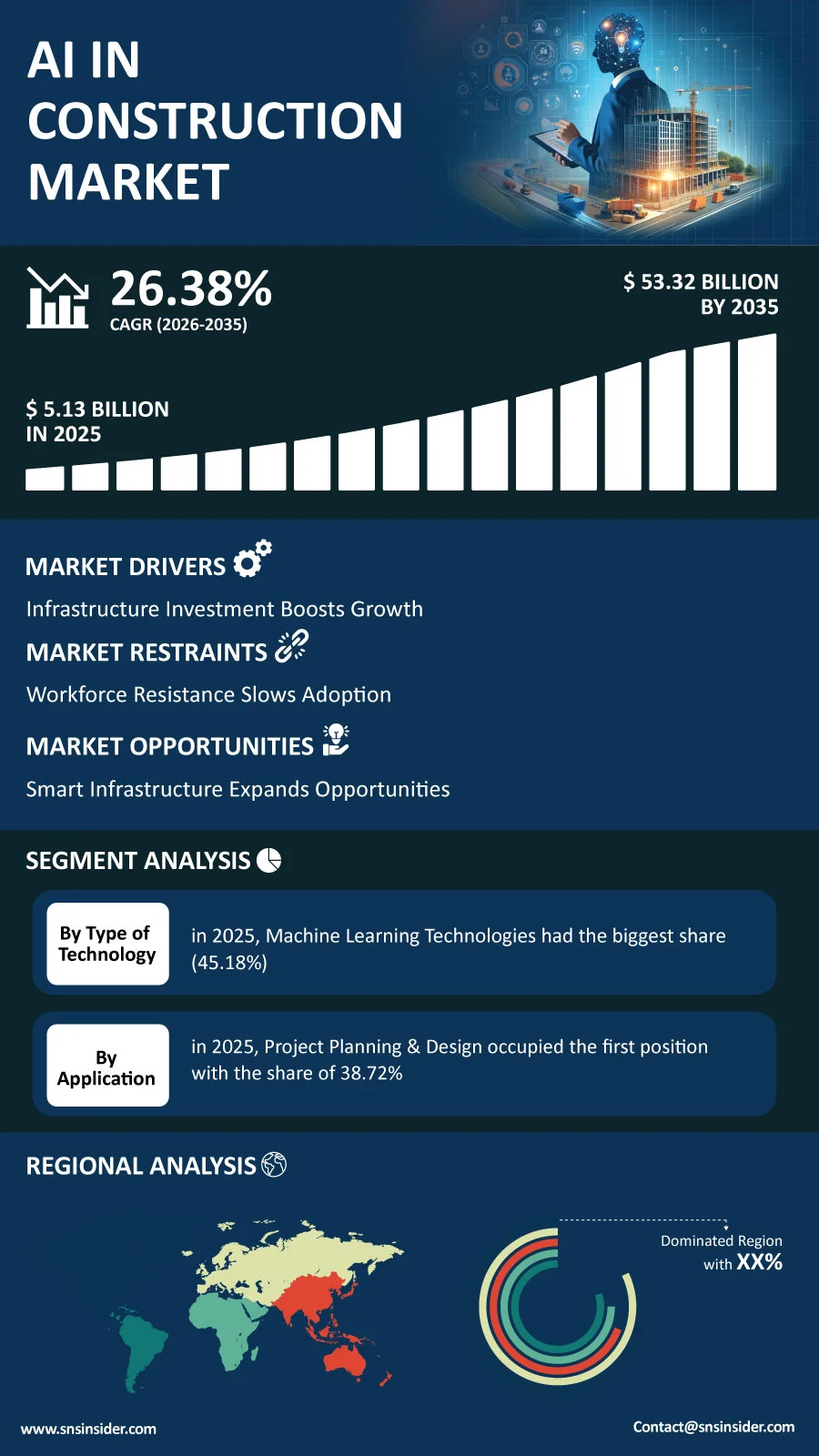
The global AI in Construction Market is expected to witness remarkable expansion as contractors, infrastructure developers, and engineering firms increasingly deploy artificial intelligence to improve project execution, enhance worker safety, and optimize resource utilization. “According to a recent study by SNS Insider, the global AI in Construction Market size valued at USD 5.13 billion in 2025, is anticipated to grow to USD 53.32 billion by 2035, registering a CAGR of 26.38% over the 2026–2035 forecast period.”
AI is becoming increasingly popular in the construction industry due to the increasing complexity of the construction process, the lack of personnel, and high operating costs. With the help of intelligent solutions, companies can ensure more precise scheduling, avoid expensive errors, track progress in real-time, and deliver projects more efficiently. Construction firms can now make decisions quickly and with minimum delays using the power of artificial intelligence.
Thanks to fast advancements in machine learning, computer vision, robotics, and predictive analytics, construction processes from planning to completion are getting transformed with the help of intelligent solutions. Increasingly often, the construction process involves the use of BIM, digital twins, autonomous construction machines, and smart monitoring systems.
To Get Detailed Insights on the AI in Construction Market – Request a Sample Report
Intelligent Construction Technologies Create Long-Term Growth Opportunities
There is massive investment in smart infrastructure projects that require advanced technology. There is a trend for developers and governments to use innovative infrastructure that involves artificial intelligence in large-scale transportation, energy, housing, and commercial development to enhance the project delivery and management of its life cycle.
Construction businesses are also making huge investments in autonomous equipment, robotic construction solutions, and drone surveys to compensate for the shortage of manpower while increasing efficiency at the same time. Using such technology allows for efficient performance of routine and dangerous jobs as well as lowering the risk and cost of operation.
In addition, new technologies related to generative AI, cloud-based project management solutions, and predictive analytics allow construction companies to anticipate risks, use materials more efficiently, and collaborate better with other parties involved in the construction process.
Key Market Insights Highlight Shifting Demand Patterns
Based on offering, software is estimated to account for 57.42% of global market revenue in 2025 due to its widespread use in project planning, cost estimation, scheduling, predictive analytics, and construction management applications. The services segment is projected to register the fastest growth through 2035 as organizations increasingly require consulting, system integration, implementation, and AI deployment expertise.
By technology, machine learning is expected to contribute 45.18% of total market revenue in 2025 owing to its ability to analyze project data, predict delays, optimize resource allocation, and improve construction planning accuracy. Robotics technologies are anticipated to witness the highest growth during the forecast period as autonomous equipment, robotic bricklaying systems, intelligent drones, and automated earthmoving machines become more widely deployed across construction sites.
In terms of application, project planning and design held approximately 38.72% market share in 2025 because AI-enabled design optimization, BIM integration, and predictive scheduling have become essential tools for complex construction projects. Safety and risk management is forecast to experience the fastest expansion through 2035 as AI-powered computer vision, wearable technologies, and intelligent monitoring systems help organizations reduce workplace incidents and improve regulatory compliance. Among end-use industries, infrastructure represented the largest market share in 2025, while commercial construction is expected to record the strongest growth over the forecast period as demand for smart buildings and digitally managed construction projects continues to increase.
Advanced Artificial Intelligence Technologies Accelerate Industry Transformation
In addition to that, artificial intelligence is radically transforming construction through the implementation of automation, intelligent decision-making processes, and constant project monitoring. With computer vision, digital twins, forecasting, autonomy, and AI-powered design software, construction is becoming more precise, as well as decreasing human intervention throughout the process of project development.
The manufacturers of construction equipment and technologies are currently working on intelligent construction systems that would be able to combine BIM, IoT, cloud collaboration, robotics, and analytics within the project management platform. These advancements assist contractors to be more productive, efficient, safe, and cost-effective throughout the construction process.
North America Held the Largest Share of the AI in Construction Market in 2025; Asia Pacific Projected to Register the Fastest CAGR Through 2035
It is forecasted that North America will account for the largest revenue share due to massive infrastructure development and the high adoption rate of construction technologies along with the availability of AI software providers in the region. The U.S. remains to be the leading force in the regional market thanks to intelligent project management tools, autonomous construction equipment, and AI safety monitoring systems.
Asia-Pacific will continue to grow at the fastest rate among all regions up to 2035 due to rapid urbanization, large-scale initiatives related to the construction of smart cities, development of transport infrastructure, and governmental spending on construction projects in China, India, Japan, and South Korea.
The European region retains the leadership in terms of digital construction solutions, environmental standards, and BIM standards adoption. In turn, the Middle East, Africa, and Latin America have been investing massively into mega-infrastructure projects, smart cities development, and advanced construction technologies.
Industry Participants Focus on Innovation and Intelligent Construction Solutions
The competitive landscape remains highly dynamic as leading software developers, construction technology providers, equipment manufacturers, and cloud platform companies continue investing in artificial intelligence, robotics, predictive analytics, autonomous machinery, and integrated digital construction ecosystems. Strategic product innovations, technology partnerships, and research investments are enabling industry participants to deliver next-generation construction solutions that improve productivity, enhance safety, and support sustainable infrastructure development.
Key companies operating in the global AI in Construction Market include Autodesk Inc., Trimble Inc., Oracle Corporation (Aconex), Procore Technologies Inc., Bentley Systems Inc., Komatsu Ltd. (SmartConstruction), Built Robotics Inc., Hilti Group, Doxel Inc., Buildots Ltd., Nemetschek Group, Hexagon AB, Topcon Corporation, Skanska AB, Turner Construction Company, IBM Corporation, Microsoft Corporation (Azure), Amazon Web Services Inc., NVIDIA Corporation, and Palantir Technologies Inc.
An SNS Insider analyst Sakshi Kale commented, “Artificial intelligence is rapidly becoming a strategic foundation for the future of construction by improving project efficiency, strengthening workplace safety, and enabling data-driven decision-making throughout the project lifecycle. Organizations investing in intelligent automation, AI-powered analytics, robotics, and connected construction platforms will be well positioned to capitalize on the industry's accelerating digital transformation over the next decade.”
About the Author

Get in touch




