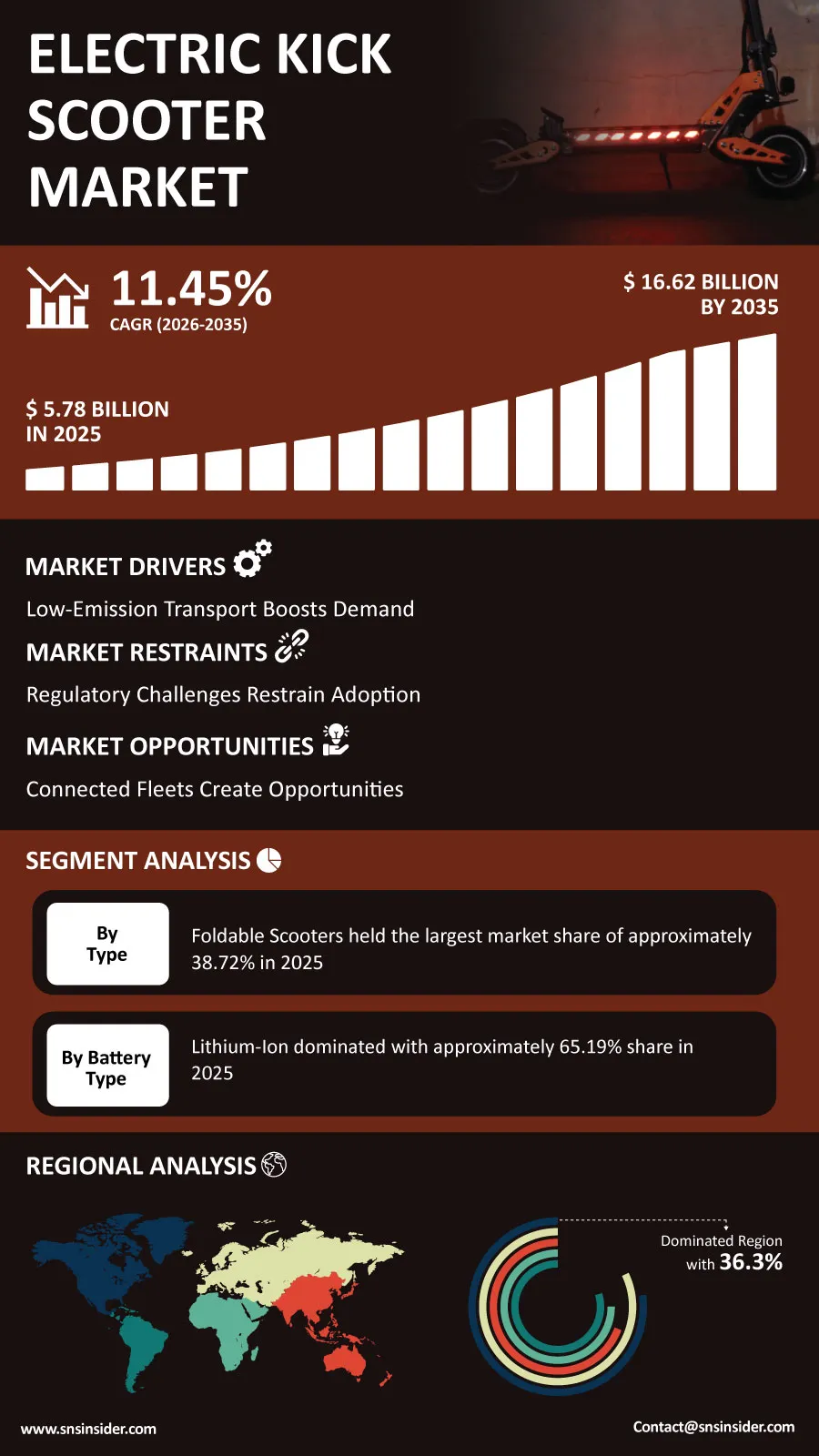
The global Electric Kick Scooter Market is entering a new era of growth as cities around the globe continue to develop sustainable mobility infrastructure and consumers become more interested in low-cost, green transportation options. “According to a recent study by SNS Insider, the global Electric Kick Scooter Market size valued at USD 5.78 billion in 2025, is anticipated to grow to USD 16.62 billion by 2035, registering a CAGR of 11.45% over the 2026–2035 forecast period.”
Rapid urbanisation, congestion of traffic and increasing environmental concerns are changing the way short-distance movement is done by developed as well as emerging economies. Electric kick scooters have come a long way from being recreational products to practical mobility solutions supporting daily commuting, last-mile connectivity, and shared transport services. Continued improvements in battery technology, lightweight materials and connected mobility features further cement consumer adoption.
Through investments in cycling lane and smart city infrastructure, and the business need to meet mandates on low-emission mobility, governments are also incentivizing cleaner transportation solutions. Such developments are creating attractive opportunities for manufacturers, fleet operators, and technology providers within the electric kick scooter ecosystem.
To Get Detailed Insights on the Electric Kick Scooter Market – Request a Sample Report
Smart Urban Mobility Initiatives Create New Market Opportunities
The global mobility landscape is being reshaped by an expansion of smart cities and digital transportation networks. Micromobility solutions are being adopted into urban transportation planning by municipal authorities to de-congest road networks, improve accessibility, and achieve reductions in carbon emissions.
Increased adoption of Electric Scooters for commuting, tourism, campus mobility and commercial operation due to rising consumer preference for flexible transportation solutions. Simultaneously fleet operators are now using all connected technologies like GPS tracking, predictive maintenance and app-based fleet management to achieve better operational efficiency and optimize the rider experience.
Manufacturers are responding by developing products that boast a longer battery life, quicker charging capabilities and better rider safety features while improving portability which makes electric kick scooters more appealing among varying user segments.
Key Market Insights Reflect Evolving Consumer Preferences
By product, in 2025 foldable electric kick scooter had the maximum market share with a contribution of 38.72% to total revenue, owing to high demand from commuters for light weight, portable transport medium and suitability for multimodal travel.
At the same time, self-balanced scooters are expected to register a highest growth through 2035 with a higher CAGR of 12.84% over the forecast period as technology makes them steadier and more accessible to first-time users.
The market is segmented based on battery technology, wherein, the lithium-ion battery dominated and captured 65.19% revenue share in 2025 as this battery technology offers high energy density, lightweight designs and long operational range. On the other hand, nickel-metal hydride batteries are projected to grow at the highest CAGR of 13.47% due to demand for cost-sensitive commercial applications.
On the basis of riding range, 20–40 kilometer scooters accounted for 41.63% market revenue in 2025 and those which can go more than 40 kilometers on a single charge are projected to show the highest growth rate as users look for greater commuting capabilities.
The offline retail remains the most common distribution channel with a market share of 52.28% in 2025, and online sales are projected to grow at the fastest CAGR of 15.03%, bolstered by direct-to-consumer strategies, increased digital marketing, and expanding e-commerce adoption.
Technology Innovation and Connected Mobility Drive Industry Transformation
Continuous innovation is still the top strategy for long-term growth in the sector. Manufacturers are integrating smart connectivity functions such as mobile device compatibility, ride data, anti-theft features and remote diagnostics for better convenience of the user and resource effectiveness of the fleet.
Advancements in batteries are extending range and decreasing charging time, which makes it possible for electric scooters to compete better with non-electric forms of daily transport in urban environments. Suspension technology, braking systems and even the shape of scooter frames also evolve to make riding more comfortable and safer.
Commercial demand is diversifying beyond passenger transportation into logistics, campus operations, hospitality, and corporate mobility programs, which opens long-term revenue generation for both manufacturers and fleet operators.
North America Accounted for 36.3% Market Share in 2025; Asia Pacific Forecast to Register the Fastest Growth Through the Forecast Period
The Electric Kick Scooter Market in North America held the largest revenue share of about 36.3%, due to significant investment on shared mobility services, pro-Green transportation policies from government & increasing affinity towards sustainable commuting options among consumers by 2025. Ongoing investment in micromobility infrastructure alongside widened retail availability is predicted to support regional leadership.
Throughout the forecast period, Asia Pacific is expected to be the fastest growing regional market. The robust manufacturing capabilities, rapid urban population growth, conducive government initiatives to boost electric mobility and increasing adoption of E-bike batteries across countries including China, India, Japan and Southeast Asia are witnessing ample of opportunities for the market expansion.
Regional demand for electric kick scooters is forecast to accelerate sharply over the next 10 years as cities move towards cleaner transport systems and modern mobility infrastructure.
Industry Participants Focus on Innovation and Market Expansion
The competition in the global Electric Kick Scooter Market massively hiked with manufacturers diversifying product portfolio, optimizing distribution network, and advancing pocket mobility. Companies are continuing to scale for personal ownership and commercial fleet segments while focusing on multiple fronts like product quality, rider safety, battery performance and digital integration.
Key companies operating in the global Electric Kick Scooter Market include Segway-Ninebot, Xiaomi Corporation, Apollo Scooters, GOTRAX, Yadea Technology Group Co. Ltd., NIU International, Bird Rides Inc., Lime (Neutron Holdings Inc.), Razor USA LLC, Inokim Inc., Dualtron (Minimotors), Kaabo Electric Scooter, Unagi Scooters, Joyor, Turboant, Spin (Ford Motor Company), Voi Technology AB, Dott, Tier Mobility SE, and Superpedestrian Inc.
An SNS Insider analyst Santosh Bhul commented, "Growing investment in sustainable urban transportation, expanding smart city initiatives, and continuous advances in battery and connected mobility technologies are reshaping the electric kick scooter industry. Companies that prioritize innovation, safety, and user experience will be well-positioned to capitalize on the accelerating global transition toward cleaner and more efficient urban mobility solutions."
About the Author

Get in touch