
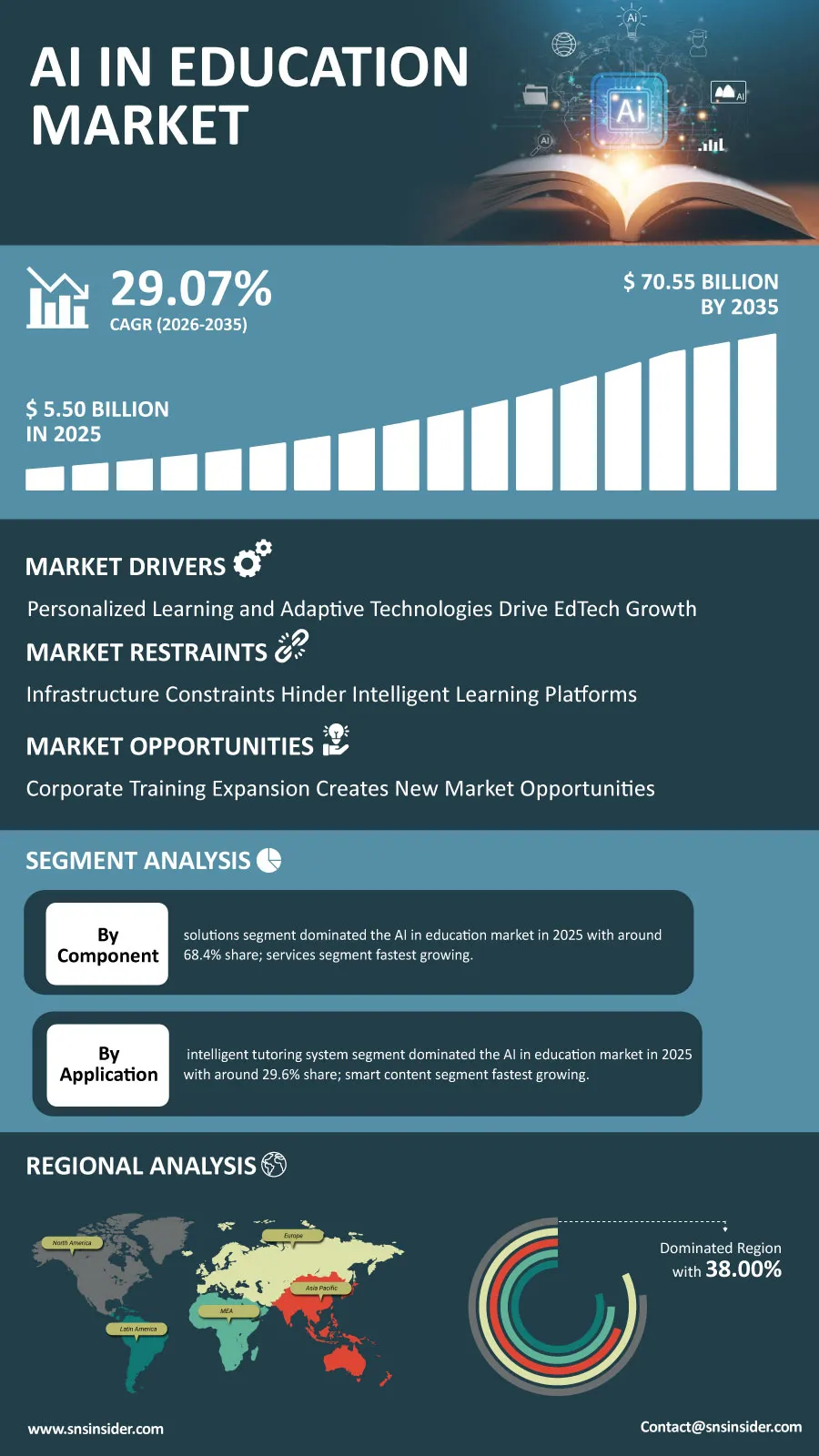
The AI in Education market is poised to enter its next phase of development through increased adoption of artificial intelligence technology in learning and administration at schools and universities, businesses, and government offices. “According to a recent study by SNS Insider, the global AI in Education Market size valued at USD 5.50 billion in 2025, is anticipated to grow to USD 70.55 billion by 2035, registering a CAGR of 29.07% over the 2026–2035 forecast period.”
With AI changing how people learn and study, there are several positive aspects of incorporating AI in education as it helps create personalized experiences, helps manage the classroom more efficiently, and assists teachers with data analytics. Digital connectivity, the use of cloud ecosystems in learning, and advances in generative AI make the growth even faster.
There are numerous examples of companies and institutions adopting AI technologies that help them to simplify course development and perform routine tasks and personalize education experiences.
To Get Detailed Insights on the AI in Education Market – Request a Sample Report
Digital Learning Transformation Creates Significant Growth Opportunities
Learning providers from around the globe are increasing their investments in intelligent learning infrastructure because digital learning is now seen as a strategic priority for the future. Intelligent technologies allow them to create interesting, personalized, and accessible learning experiences that can efficiently cater to large numbers of students.
Organizations are also making use of intelligent technologies to increase workforce competencies via AI-enabled training programs. They are using intelligent learning systems to offer personalized training to their employees, assess skills automatically, and track progress using predictive analytics.
Fast advancements in machine learning, natural language processing, and generative AI are allowing new possibilities for interactive learning content, learning in multiple languages, virtual assistants, and instant academic assistance. All of these advancements are likely to lead to widespread adoption of AI in academic and corporate learning spaces over the next decade.
Key Market Insights Highlight Evolving Adoption Trends
Based on component, the solutions segment accounted for approximately 68.4% of market revenue in 2025, indicating the increasing use of artificial intelligence learning platforms, intelligent tutoring systems, and automated education software. The services segment is expected to grow at the highest rate up to 2035 since organizations will have increasing requirements for implementation services, consulting services, integration services, and others.
Based on applications, the intelligent tutoring systems segment captured almost 29.6% of the market revenue in 2025 due to increasing demand for adaptive and personalized learning. The smart content segment is expected to have the highest growth because organizations will invest more in artificial intelligence-based learning materials and digital learning contents.
Based on technology, the machine learning segment accounted for around 64.7% of market revenue in 2025 because of the wide usage of machine learning in predictive analytics, adaptive education, and assessment of student performances. The natural language processing (NLP) segment is expected to have the highest growth rate because of conversational AI and multilingual education solutions.
Artificial Intelligence Innovation Continues to Modernize Education
AI features that enable better teaching efficiency and enhance learning experience are continually being introduced by technology providers. The use of generative AI, intelligent analytics, and automation enables teachers to create customized lesson plans, track learners' academic performance, and lessen their administrative workload.
In addition to this, there is a concerted effort on the part of educational technology firms in deploying AI ethically through robust data privacy, transparency, and ethical governance of AI.
North America Held 38% of the AI in Education Market Share in 2025; Asia Pacific Projected to Register the Fastest CAGR Through 2035
North America represented around 38% of market revenue in 2025 owing to heavy investments in educational technology, digital infrastructure development, and adoption of AI-driven learning platforms. All universities, schools, and companies in the region are increasingly deploying intelligent education systems to enhance their operational efficiency and effectiveness.
Asia Pacific is likely to show the most rapid growth in the market until 2035 with governments ramping up their digital education initiatives and investments in smart learning environments. High internet penetration rates, growing online education trends, and AI uptake in schools and universities will drive the market growth over the long term.
Europe shows steady market growth owing to supportive digital education initiatives and rising adoption of AI-based classroom technologies. At the same time, Latin America and Middle East & Africa regions are gradually improving their education technology ecosystems through investments in learning platforms and technologies.
Industry Participants Focus on Intelligent Learning Platforms and AI Innovation
The dynamics of competition in the market for AI in Education is high because the technology firms and educational solutions providers are still making investments in intelligent software, generative AI, and learning analytics. The key focus areas for the organizations include strategic alliances, platform innovations, and responsible AI development.
Key companies operating in the global AI in Education Market include Google, Microsoft, Duolingo, BYJU'S, Pearson, Khan Academy, Coursera, Squirrel AI, Carnegie Learning, Cognii, Nuance Communications, Blippar, Century Tech, Querium, HowNow, KidSense, Practically, Docebo, MagicSchool AI, and IONI.
An SNS Insider analyst Sakshi Kale commented, "Artificial intelligence is becoming an integral part of modern education by enabling personalized learning, intelligent automation, and data-driven decision-making. Organizations that continue investing in scalable AI technologies, responsible innovation, and digital learning ecosystems are expected to strengthen their competitive position as global education increasingly embraces intelligent transformation."
About the Author

Get in touch




