
Artificial Intelligence in Mental Health Market is making tremendous progress, considering that healthcare organizations, businesses, insurance firms, and tech companies are investing heavily in digital care platforms based on artificial intelligence that are geared towards enhancing the availability of mental health services. The use of artificial intelligence in mental healthcare is becoming instrumental in providing early interventions and personalized therapy suggestions among others.
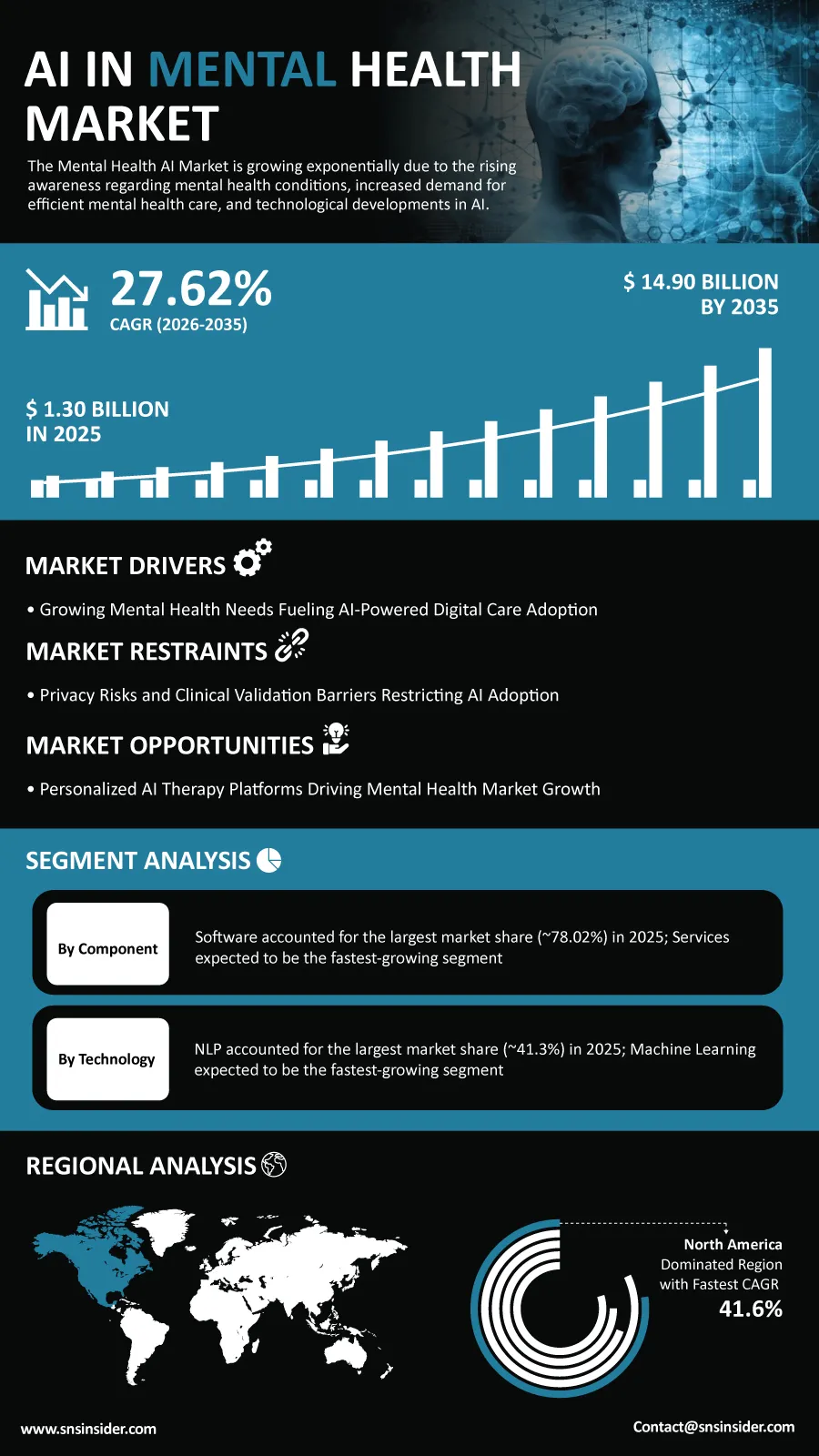
According to a recent study by SNS Insider, the global Artificial Intelligence in Mental Health Market size valued at USD 1.30 billion in 2025, is anticipated to grow to USD 14.90 billion by 2035, registering a CAGR of 27.62% over the 2026–2035 forecast period. Rapid advances in generative AI, predictive analytics, and digital therapeutics are enabling more responsive mental healthcare solutions, while expanding telehealth adoption and growing awareness of emotional wellbeing continue to strengthen long-term market prospects.
The use of artificial intelligence in healthcare organizations is on the rise as they incorporate the use of AI in the processes of patient evaluation, behavioral studies, therapy development, and monitoring. In parallel, companies and universities have begun utilizing AI-enabled wellness platforms to enhance mental well-being among employees and students respectively.
To Get Detailed Insights on the Artificial Intelligence in Mental Health Market – Request a Sample Report
Artificial Intelligence Reshapes the Delivery of Mental Healthcare
AI companies have started moving away from conventional uses of chatbots by developing advanced technologies that can analyze behavioral traits, detect the presence of mental illnesses at an early stage, and assist medical professionals in making evidence-based decisions. Continuous developments in the areas of natural language processing, machine learning, wearables, and digital therapeutic devices are enabling the use of AI in the domains of prevention, diagnosis, treatment, and management.
Rising adoption of telehealth services has also led to increased adoption of AI-based mental health applications that not only facilitate accessibility but also overcome barriers to professional help.
Market Segments Highlight Strong Innovation Opportunities
By component, software remained the dominant category, accounting for approximately 78.02% of market revenue in 2025, supported by widespread adoption of AI-powered mental wellness applications, virtual therapy platforms, and digital self-assessment tools. Services are expected to record the fastest growth during the forecast period as healthcare providers increasingly seek implementation support, AI-enabled telehealth services, and managed digital care solutions.
Based on technology, Natural Language Processing (NLP) represented approximately 41.3% of global revenue in 2025 due to its critical role in conversational AI, emotion recognition, and intelligent virtual assistants. Machine Learning is projected to deliver the highest growth as predictive models become more effective in identifying patient risks, personalising treatment pathways, and improving clinical decision support.
Among disorders, anxiety accounted for approximately 32.8% of market revenue during 2025, reflecting growing demand for accessible digital interventions and AI-assisted cognitive behavioural therapy. Schizophrenia is anticipated to emerge as the fastest-growing application area as advanced monitoring technologies improve early detection and long-term patient management.
Digital Care Models Strengthen Industry Growth
Collaborations between healthcare professionals, technological organizations, insurance companies, and businesses are driving fast adoption of AI-enabled mental health solutions. Many organizations have increased their spending on intelligent triage solutions, virtual behavioral coaching services, personalized therapy suggestions, and other similar tools for continuous engagement to optimize clinical results and reduce expenses associated with healthcare.
There have been some business developments that prove the commercial potential of Artificial Intelligence in Mental Health as well. In 2026, Wysa scaled its AI-driven mental health solution after receiving FDA Breakthrough Device designation for conversational therapies to treat anxiety and depression in patients suffering from chronic pain. The AI companion product of Headspace Health named Ebb was introduced to help patients find coaches, therapists, psychiatrists, and self-care programs, while Spring Health announced that it planned to purchase Alma.
Regional Markets Continue to Expand
The North America region accounted for the majority of the global Artificial Intelligence in Mental Health Market in 2025, holding a share of around 41.6%. This can be attributed to the presence of developed digital health systems, high health tech investment, and adoption of AI behavioral health solutions. The U.S. held about 42% share in regional revenue. The U.S. Artificial Intelligence in Mental Health Market held a value of USD 0.49 billion in 2025 and is estimated to grow up to USD 5.36 billion till 2035 with a CAGR of 27.02%.
In terms of regional growth, the Asia Pacific region holds the highest CAGR during the forecast period till 2035, accounting for 28.77%. This is due to an increase in awareness regarding mental health and digitization of the healthcare industry in major economies. China holds a revenue share of approximately 38% in the region owing to the fast growth of startups providing AI-based healthcare solutions and rising smartphone penetration.
Elsewhere, Germany represented approximately 27% of European regional revenue, reflecting continued investment in digital health innovation. Brazil accounted for approximately 40% of Latin American revenue, while the United Arab Emirates contributed approximately 28% of Middle East & Africa revenue as healthcare digitalization gains momentum.
Industry Leaders Accelerate AI Innovation
Competition within the Artificial Intelligence in Mental Health Market continues to intensify as companies enhance platform capabilities, expand strategic partnerships, and develop clinically validated digital care solutions. Leading participants include Wysa, Woebot Health, Headspace Health, Talkspace, BetterHelp, Calm, Sword Health, Spring Health, Lyra Health, Ginger, Quartet Health, Brightside Health, ieso Digital Health, SilverCloud Health, Limbic, Mindstrong Health, Koa Health, Innerworld, Cerebral, and Alto Neuroscience.
An SNS Insider analyst Parry Kardani commented, "Artificial intelligence is rapidly transforming mental healthcare from episodic treatment into continuous, personalised support. Organisations that successfully combine advanced AI technologies with clinical expertise, regulatory compliance, and patient trust will be well positioned to lead the next phase of digital behavioural healthcare worldwide."
About the Author

Get in touch




