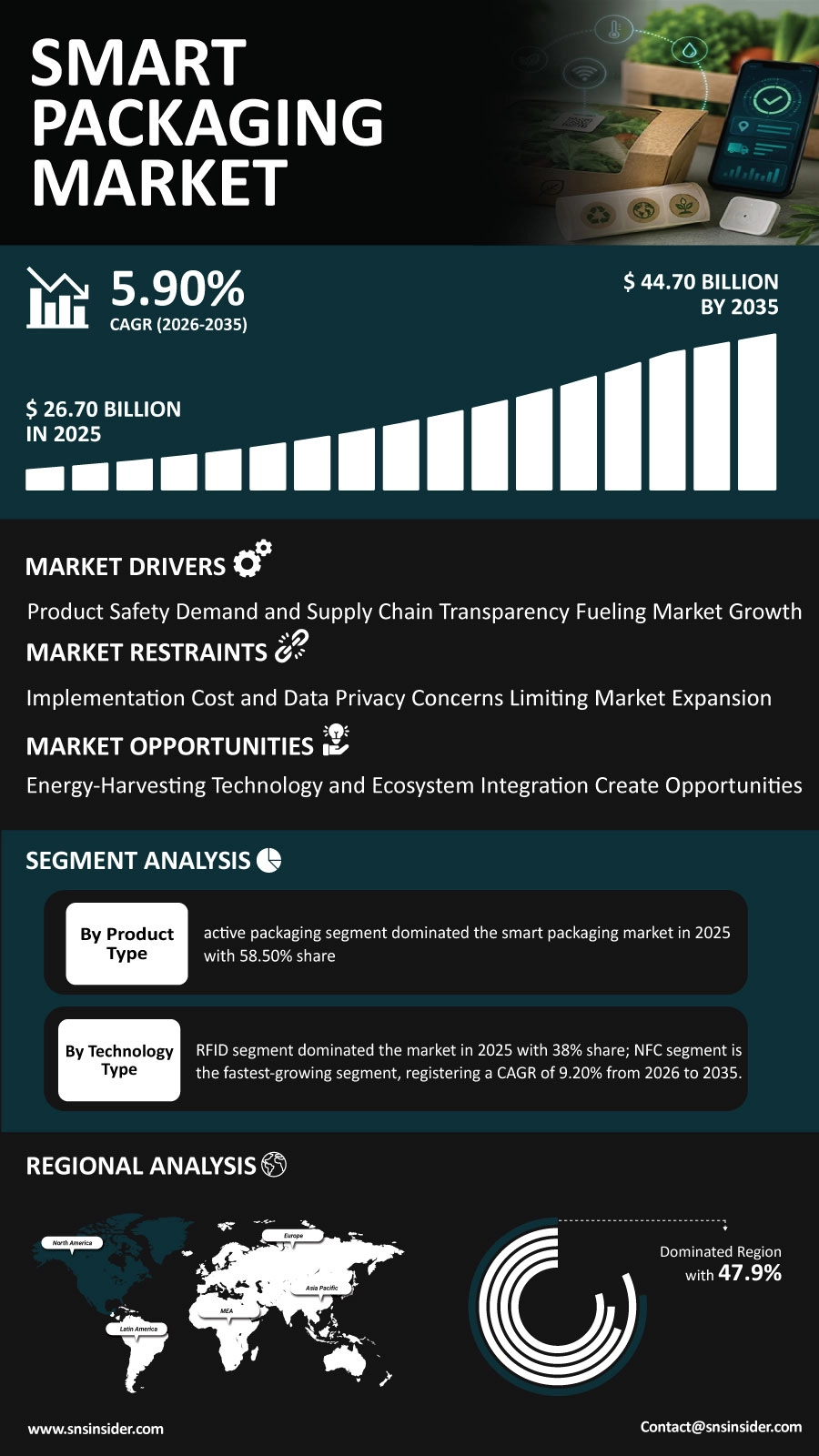
The global Smart Packaging Market is on a steady growth path through 2035, as product safety demand and supply chain transparency requirements continue reshaping how brands design and deploy packaging worldwide. “According to a recent study by SNS Insider, the global Smart Packaging Market size valued at USD 26.70 billion in 2025, is anticipated to grow to USD 44.70 billion by 2035, registering a CAGR of 5.90% over the 2026-2035 forecast period.”
Packaging has quietly taken on a second job over the past decade, no longer just protecting a product but actively communicating about it, when it was made, whether it is still fresh, whether it has been tampered with along the way. That shift from passive protection to active communication is what defines this category.
Sustainability pressure is reshaping smart packaging investment in a genuinely interesting way, pushing manufacturers toward solutions that improve traceability and material efficiency at the same time rather than treating them as separate design goals.
To Get Detailed Insights on the Smart Packaging Market – Request a Sample Report
Active Communication Becomes a Packaging Standard
Where packaging once succeeded simply by staying intact through distribution, brands increasingly expect it to actively signal freshness, authenticity, and handling history to both retailers and end consumers. This shift is changing how packaging suppliers compete, since software and data platform capability is becoming as important a differentiator as physical material innovation used to be on its own.
Suppliers investing in both active packaging chemistry and intelligent data capture are positioning themselves to capture demand across the full spectrum of smart packaging applications rather than a single niche.
Key Market Findings Highlight High-Growth Segments
Active packaging held the largest share of the Smart Packaging Market in 2025, at 58.50%, reflecting its proven, measurable value in extending shelf life across food and pharmaceutical applications. Intelligent packaging is the fastest-growing product type, expanding at an 8.60% CAGR, pulled forward by brands adopting data-capturing packaging for traceability and engagement.
By technology, RFID led with 38% share in 2025, while NFC is growing fastest, at a 9.20% CAGR, as smartphone-based scanning lowers the barrier to consumer engagement features. Food & beverage remained the largest end-use industry at 44% share, but e-commerce & logistics is climbing fastest, at a 9.60% CAGR, driven by rising direct-to-consumer shipping volumes.
Traceability Depth and Data Platform Capability Anchor Competitive Positioning
Brands are increasingly evaluating smart packaging suppliers on traceability depth and data platform capability nearly as much as on physical material cost. Investment in energy-harvesting technology and software ecosystem integration is becoming a genuine competitive differentiator among larger manufacturers, while smaller suppliers without that investment increasingly compete only in basic, single-feature segments.
This divide is expected to sharpen further as more brands treat packaging as a data channel rather than purely physical protection.
North America Leads as Asia Pacific Grows Fastest
North America holds the largest share of global market revenue, anchored by a strong domestic focus on innovation and well-established pharmaceutical cold-chain monitoring infrastructure. Asia Pacific, meanwhile, is growing fastest, propelled by China's position as a prominent smart packaging manufacturing hub and rapidly expanding e-commerce and pharmaceutical sectors.
Europe holds a meaningful, mature share as well, shaped by packaging waste regulation and strong consumer sustainability expectations.
Leading Companies Drive Innovation and Competition
Competition in this market centers on traceability technology, active packaging chemistry, and software ecosystem capability nearly as much as on price, with major players investing heavily in RFID and sensor manufacturing capacity.
Some of the major companies that operate in the global smart packaging market are Amcor plc, Sealed Air Corporation, Avery Dennison Corporation, 3M Company, Ball Corporation, Crown Holdings, Inc., BASF SE, Multisorb Technologies.
An SNS Insider Analyst Himanshu Sharma commented, “Smart packaging has moved well past being a novelty feature, brands now need genuine traceability and data capability alongside basic product protection, and the companies capturing the fastest-growing parts of this market are the ones bundling active packaging chemistry with intelligent data platforms rather than treating them as separate product lines. As e-commerce and regulatory requirements keep tightening globally, integrated smart packaging capability is becoming a genuine competitive advantage.”
About the Author

Get in touch