
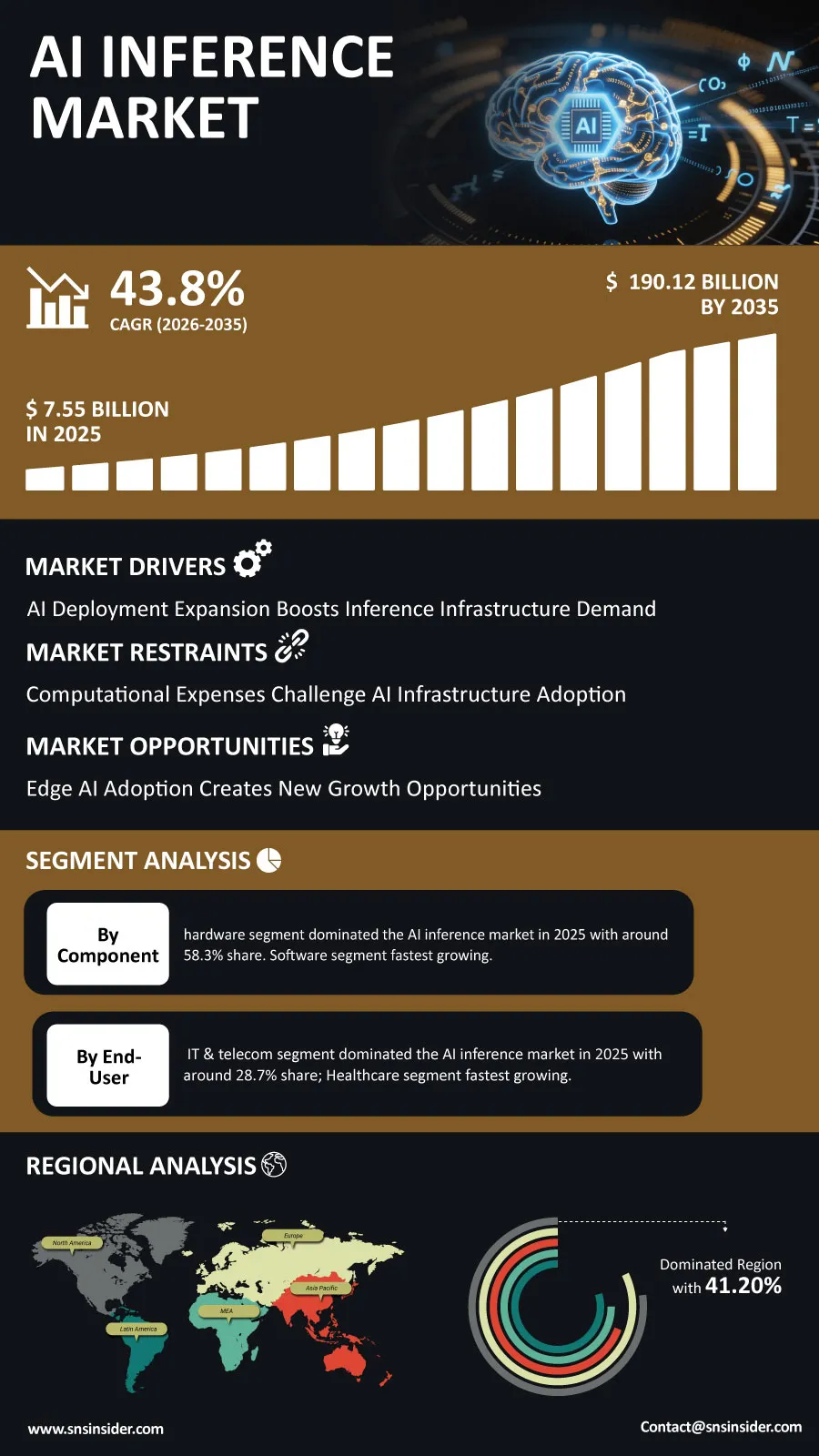
The worldwide market for AI Inference is witnessing an era of unprecedented growth because companies have started using artificial intelligence in their day-to-day commercial activity, customer interaction, and industrial automation. “According to a recent study by SNS Insider, the global AI Inference Market size valued at USD 7.55 billion in 2025, is anticipated to grow to USD 190.12 billion by 2035, registering a CAGR of 43.8% over the 2026–2035 forecast period.”
The rise in enterprise use of generative AI, intelligent assistants, predictive analytics, and autonomous decision-making applications is driving up the need for high-performance inference engines. Companies are increasingly focused on adopting tools that can perform the execution of the AI models in a faster manner without incurring any delay and operational inefficiencies.
Moreover, businesses are increasingly upgrading their digital architecture in order to accommodate real-time AI workloads. The constant developments in processors and software optimization techniques are helping businesses increase the performance of AI inference operations while simplifying the process at the same time.
To Get Detailed Insights on the AI Inference Market – Request a Sample Report
Edge Computing and Enterprise AI Investments Unlock New Growth Opportunities
The growth in AI use moving away from experiments and towards production scale is increasing the need for more efficient inference. Enterprises have been allocating vast amounts of investments into their AI infrastructure to provide better inference efficiency and intelligent automation.
Further development in edge computing is opening new avenues for AI inference providers. Performing inference on-site leads to faster reaction times, enhanced privacy of processed data, and lesser reliance on cloud-based infrastructure, making edge inference increasingly important for manufacturing, logistics, retail, healthcare, and smart cities.
Moreover, the advancement in semiconductor engineering and development of more efficient AI hardware along with AI software optimization platforms makes it possible for enterprises to perform more complex inference tasks with increasing performance per watt ratio and lower operational costs.
Key Market Insights Highlight Changing Enterprise Priorities
Based on components, the hardware segment held about 58.3% market share of revenues in 2025 driven by increasing demand for AI accelerators and inference processors in enterprise and hyperscale computing. Software is expected to have the highest growth rate through 2035 driven by increasing use of model optimization software, inference orchestration software, and AI deployment software.
On the basis of applications, natural language processing captured almost 35.2% market share of revenues in 2025 driven by extensive use of conversational AI, intelligent assistants, and enterprise language models. Computer vision is expected to have the highest growth throughout the forecast period due to increasing application of visual analytics using AI.
According to deployment types, the cloud inference generated around 62.1% market share of revenues in 2025 due to scalability and accessibility. Edge deployment is expected to grow at a high rate since there would be increased need for real-time AI capability near connected devices.
Based on end-users, the IT & Telecom industry captured approximately 28.7% market share in 2025, while healthcare is expected to grow at the fastest rate as AI would have increasing implementation in diagnostics, clinical decision support, and patient monitoring.
Advanced AI Infrastructure Continues Transforming Enterprise Computing
The rapid advancements being made in AI computing are redefining the way in which companies adopt machine learning models into production environment. Companies have started developing more efficient inference chips, advanced software platforms, and deployment solutions that help them in scaling large foundation models with better efficiency.
Increasing use of multimodal AI applications, intelligent automation systems, and hybrid cloud and edge-based architecture are driving enterprises towards modernizing their AI infrastructure. Such advancements are helping businesses enhance customer experience, automate business processes, enhance cybersecurity solutions, and drive digital transformation initiatives.
North America Held 41.20% of the AI Inference Market Share in 2025; Asia Pacific Projected to Register the Fastest CAGR Through 2035
North America has a market revenue share of 41.20% in 2025 due to its presence of top AI companies, semiconductor manufacturers, cloud services, and technology enterprises. The region will see continuous investments in AI R&D, computing capacity, and commercial AI usage, further enhancing its leadership status.
Asia Pacific will register the highest growth in the period up to 2035 with continued developments in government and enterprise AI developments in manufacturing, financial services, health care, and digital infrastructure. Cloud usage, semiconductor advances, and enterprise investments in AI will provide tremendous opportunities for growth in the region.
Europe will enhance its leadership role through the implementation of responsible AI projects, digitalization of industry, and adoption of enterprise AI, whereas Latin America and Middle East & Africa will develop the implementation of AI in government services, telecommunications, financial institutions, and smart infrastructure projects.
Industry Participants Accelerate Innovation Across AI Inference Platforms
The competitive spirit persists in the AI Inference environment with the continued investment in technologies like specialized AI processors, optimized inference engines, and cloud-native computing environments by the technology companies, who are making strategic investments in research and development for the changing requirements in various industries.
Key companies operating in the global AI Inference Market include NVIDIA, Intel, AMD, Qualcomm, Amazon Web Services, Google Cloud, Microsoft Azure, IBM, Groq, Cerebras Systems, SambaNova Systems, Graphcore, Hugging Face, OctoAI, Anyscale, Together AI, Fireworks AI, Replicate, Mistral AI, and Anthropic.
An SNS Insider analyst Sakshi Kale commented, "Organizations are rapidly transitioning from experimental AI initiatives toward enterprise-scale deployment, making efficient inference infrastructure a strategic priority. Companies investing in optimized AI hardware, intelligent software platforms, and scalable deployment ecosystems are expected to capture substantial long-term opportunities as real-time AI adoption accelerates across industries."
About the Author

Get in touch




