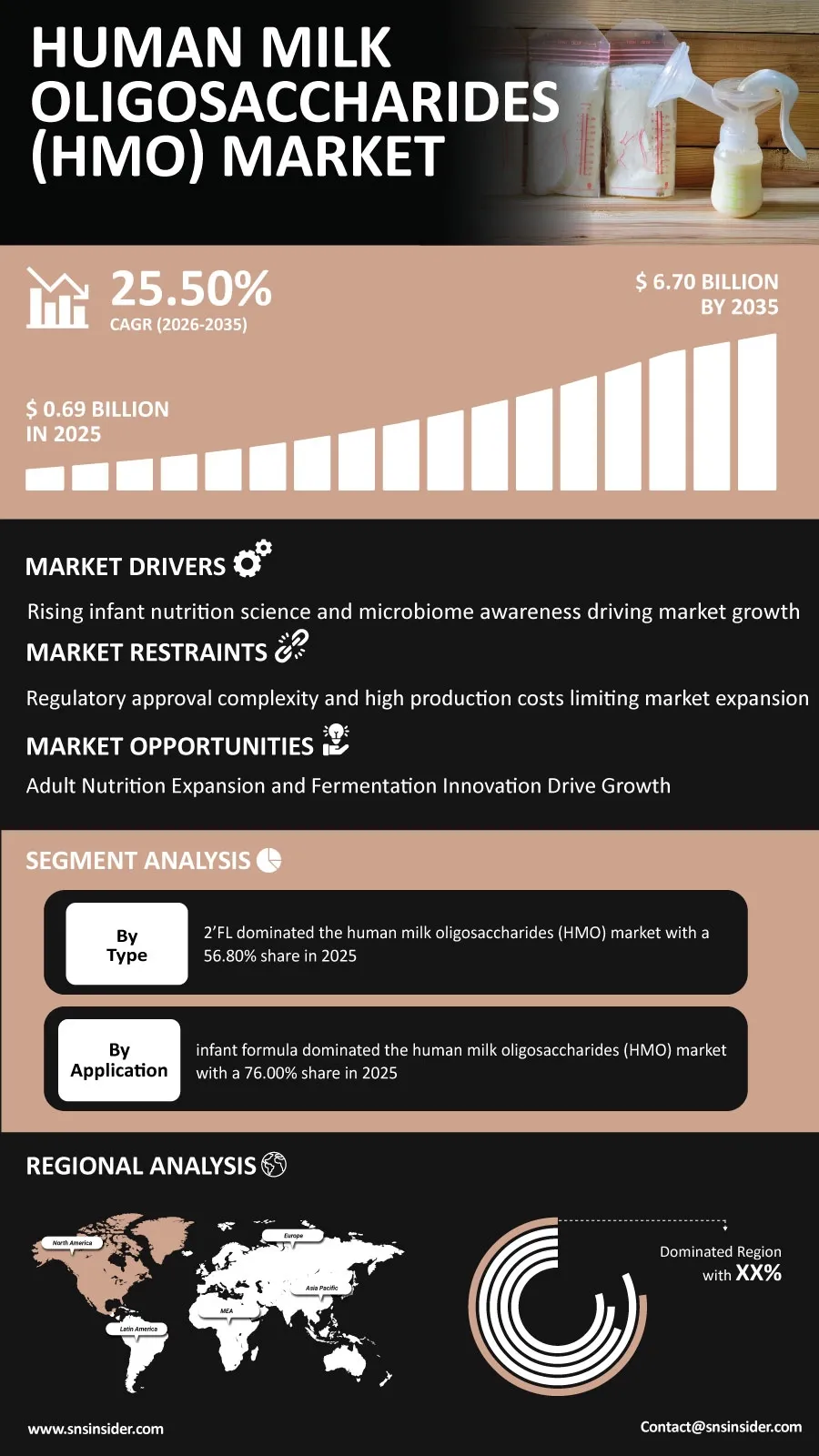
The global Human Milk Oligosaccharides (HMO) Market is set for significant expansion as microbiome-based nutrition science and premium infant formula demand continue to reshape functional ingredient sourcing worldwide. “According to a recent study by SNS Insider, the global Human Milk Oligosaccharides (HMO) Market size valued at USD 0.692 billion in 2025, is anticipated to grow to USD 6.70 billion by 2035, registering a CAGR of 25.50% over the 2026–2035 forecast period.”
There have been notable changes within HMO production technology over time, due to which many manufacturers who aim at improving structural diversity and scalability of their products can take advantage of this trend. This includes the need for more advanced fermentation and synthesis techniques that will provide infant formula and functional food companies with the ability to access diverse, high-purity HMO ingredients. This applies in situations where HMOs support infant formula, functional foods, and adult nutrition applications. Manufacturers are constantly working hard to ensure that their HMO products perform better than before in order to meet various consumer health and regulatory requirements.
To Get Detailed Insights on the Human Milk Oligosaccharides (HMO) Market – Request a Sample Report
Adult Nutrition Expansion Creates New Demand
The human milk oligosaccharides market has evolved from a narrow infant formula ingredient category to an increasingly diversified functional ingredient spanning adult nutrition and wellness applications. The growing investment in fermentation technology, structural diversification, and clinical validation across producers of all sizes has required the development of more scalable and diverse HMO products.
Innovative technologies related to production and formulation can enhance the structural variety, make the production process more scalable, and create opportunities for entering new areas such as infant formula, functional food, and adult wellness products. Thus, there is a potential for creating products that have consistent quality and gut and immune benefits.
HMO producers, infant formula manufacturers, and functional beverage brands are increasingly cooperating thanks to the growing interest in developing future solutions for diverse, clinically validated microbiome-supporting ingredients.
Key Market Findings Highlight High-Growth Segments
The 2'-FL, dominated all categories in the HMO market share with 42% of revenue in 2025 due to continued research validation strengthening its position as a leading HMO type. The fastest growing category is expected to be 3’-FL which will grow at a CAGR of 22.00% through 2035, owing to growing scientific validation of additional HMO structures.
By application, infant formula held 76% of market revenue in 2025 due to HMOs' fundamental role replicating breast milk's prebiotic benefits. The functional foods and adult nutrition, will see the fastest growth in revenue generation at a CAGR of 29.60%, driven by HMO-infused functional drinks gaining ground in adult wellness markets.
Based on distribution channel, drug stores and pharmacies generated the largest share of market revenue thanks to infant formula's established professional retail distribution. On the other hand, hypermarkets and supermarkets will be the segment recording the fastest revenue growth at a 22.90% CAGR, supported by growing consumer preference for convenient in-store shopping.
Distributive production technology trends are changing as well. Biotechnology-driven fermentation accounted for 71% of total HMO output owing to superior scalability and cost-effectiveness. But chemical synthesis will turn out to be the fastest-growing production technology through 2035, on the back of growing demand for structurally precise specialty HMO compounds.
Structural Diversity, Scalability, and Clinical Validation Gain Importance
In this regard, infant formula and functional food manufacturers have been looking at HMO products that would deliver more structural diversity while requiring greater production scalability and clinical validation.
Innovation in precision fermentation technology, structural diversification, and clinical research investment has been making it possible for companies to come up with products that appeal to increasingly evidence-driven infant nutrition and functional food manufacturers. In addition to that, increasing emphasis on adult nutrition application development is also making it possible for producers to find solutions that expand HMOs' reach beyond traditional infant formula categories. Such trends are likely to become even more prominent in the future.
Europe Emerges as the Largest Market with 38% Regional Revenue Share Amid Strong Infant Formula Manufacturing
The Europe region represented the largest share of regional market revenue in 2025 at 38%, owing to the region's strong infant formula manufacturing base and stringent regulatory frameworks supporting HMO ingredient safety validation. On the other hand, Asia Pacific is expected to register the fastest regional CAGR during the forecast period through 2035, driven by the region's growing population and increasing birth rates, particularly in China and India.
Leading Companies Drive Innovation and Competition
The environment continues to stay very dynamic since players continue innovating on fermentation technology and structural diversification as well as forming partnerships in order to enhance their position in the industry. Some of the major companies that operate in the global human milk oligosaccharides market are Abbott Laboratories, Inbiose, Glycom, Chr. Hansen, Elicityl, ZuChem, Biosynth Carbosynth, Dextra Laboratories, IFF, and Glycosyn.
An SNS Insider analyst Santosh Bhul commented, "The growing scientific validation of HMOs' gut health and immune benefits is creating unprecedented demand for diverse, high-purity oligosaccharide ingredients across infant and adult nutrition applications. Producers that successfully combine fermentation technology innovation, structural diversification, and clinical research investment will be best positioned to capitalize on emerging opportunities across infant formula and functional food segments."
About the Author

Get in touch