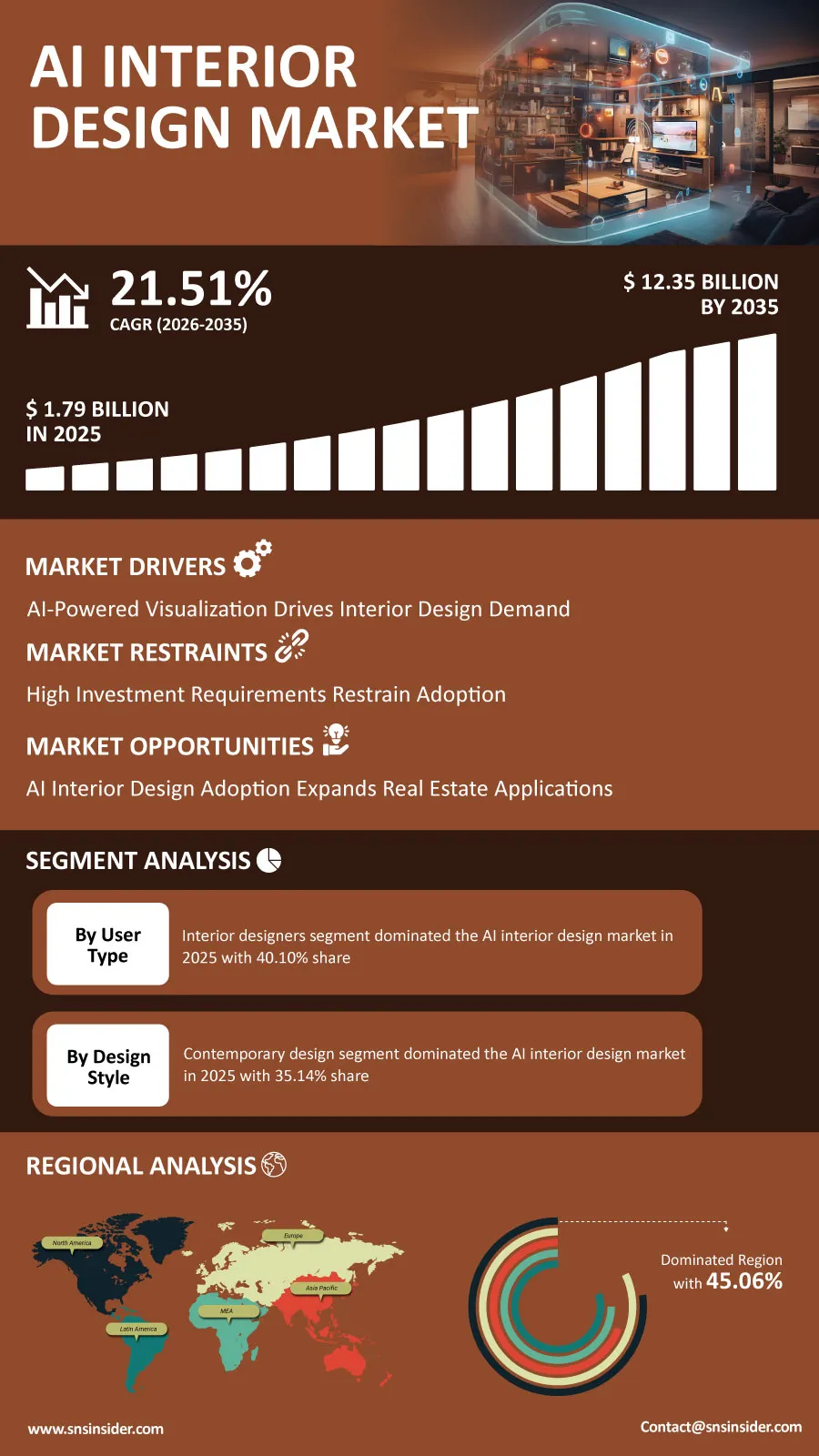
The global AI Interior Design Market is entering a new phase of growth as artificial intelligence transforms the way residential and commercial spaces are planned, visualized, and customized. “According to a recent study by SNS Insider, the global AI Interior Design Market size valued at USD 1.79 billion in 2025, is anticipated to grow to USD 12.35 billion by 2035, registering a CAGR of 21.51% over the 2026–2035 forecast period.”
The usage of artificial intelligence is becoming an inevitable part of the design process, allowing for rapid ideation, smart suggestions on layout, and ultra-realistic visualizations. Designers, architects, and property owners alike are starting to embrace AI-driven design services as a way to cut time spent on a project and ensure its precision and consumer engagement.
Increased funding in digital construction technology, cloud-based collaboration and immersive visualizations will drive further growth of the market. With rising demands for customized spaces and effective use of square footage, AI-driven interior design is gaining momentum.
To Get Detailed Insights on the AI Interior Design Market– Request a Sample Report
Digital Design Innovation Creates New Business Opportunities
The swift emergence of generative AI technologies, advanced rendering software, and cloud collaboration systems is opening up new possibilities within the entire interior design industry. Companies have started developing intelligent tools that will be able to create a number of design ideas, layout rooms, and suggest suitable furniture, materials, and color schemes.
Moreover, the increasing use of smart home technology and digitally enabled buildings is driving the adoption of AI-powered planning tools. The use of augmented reality and virtual reality technologies will enable customers to visualize designs in advance and make their purchases more confident, cutting down the expenses on redesigning.
The constant advances in computer vision, machine learning, and automation will facilitate further adoption of such technologies in residential projects, hospitality industry, retail stores, and commercial office buildings.
Key Market Insights Highlight Evolving Customer Preferences
Based on user type, interior designers accounted for 40.10% of global market revenue in 2025 due to increasing reliance on AI-powered visualization and workflow automation. Real estate developers are projected to register the fastest growth through 2035 as digital property marketing and virtual project visualization become increasingly important.
By design style, the contemporary design segment represented 35.14% of market revenue in 2025, supported by strong consumer demand for modern and adaptable interiors. Minimalist design is anticipated to witness the fastest expansion over the forecast period as efficient space planning gains importance.
In terms of technology integration, 3D visualization tools captured 35.04% of market revenue in 2025, while augmented reality applications are expected to achieve the highest growth owing to increasing adoption of immersive customer experiences. Within applications, residential interior design held 40.12% market share in 2025, whereas commercial interior design is forecast to expand at the fastest pace.
AI and Immersive Technologies Transform Interior Planning
Design solutions with greater intelligence continue being developed by technology companies in terms of automation and better visualization. The use of AI combined with real-time rendering and spatial computing provides designers with opportunities to assess different designs rapidly and offer highly customized recommendations.
Additionally, AI software is increasingly becoming integrated into digital construction solutions which improves productivity throughout the design process for architects, interior designers, and other development specialists involved in project planning, renovation, and execution.
North America Held 45.06% of the AI Interior Design Market Share in 2025; Asia Pacific Projected to Register the Fastest 23.23% CAGR Through 2035
North America held a share of 45.06% of the market revenue globally in 2025 due to the presence of wide acceptance of digital design solutions, sophisticated software capabilities, and heavy investments in smart homes as well as innovation in the real estate industry. The region is currently benefitting from the early use of artificial intelligence solutions in architecture, construction, and real estate industry.
The Asia Pacific region is projected to witness the fastest growth at a CAGR of 23.23% during 2026-2035. This is attributed to fast-paced urbanization, rising disposable income levels, growth in residential construction, and increasing acceptance of artificial intelligence digital solutions.
The European region too is witnessing steady demand with the initiatives for sustainability, renovations, and digital transformation leading to AI-based solutions in the design platforms. The emerging markets in Latin America and the Middle East & Africa are gradually moving towards intelligent visualizations technology.
Industry Participants Strengthen AI Design Capabilities
Competition remains active as software developers focus on expanding AI functionality, immersive visualization, cloud collaboration, and workflow automation. Companies are investing in intelligent design assistants, photorealistic rendering technologies, and customer-centric digital experiences that improve project efficiency while supporting highly customized interior planning.
Key companies operating in the global AI Interior Design Market include RoomGPT, InteriorAI, Coohom, Spacejoy, Morpholio, Planner 5D, RoomSketcher, Foyr, ZMO.AI, Spayci, Superside, Spacely AI, Box Clever Interiors, REImagine Home, Autodesk, IBM Corporation, Microsoft, IKEA, Houzz Inc., and Cylindo.
An SNS Insider analyst Sakshi Kale commented, "Artificial intelligence is fundamentally changing how interior environments are imagined, designed, and delivered. Organizations investing in intelligent visualization, automation, and immersive digital experiences are expected to unlock significant competitive advantages as demand for personalized and efficient design solutions continues to accelerate worldwide."
About the Author

Get in touch