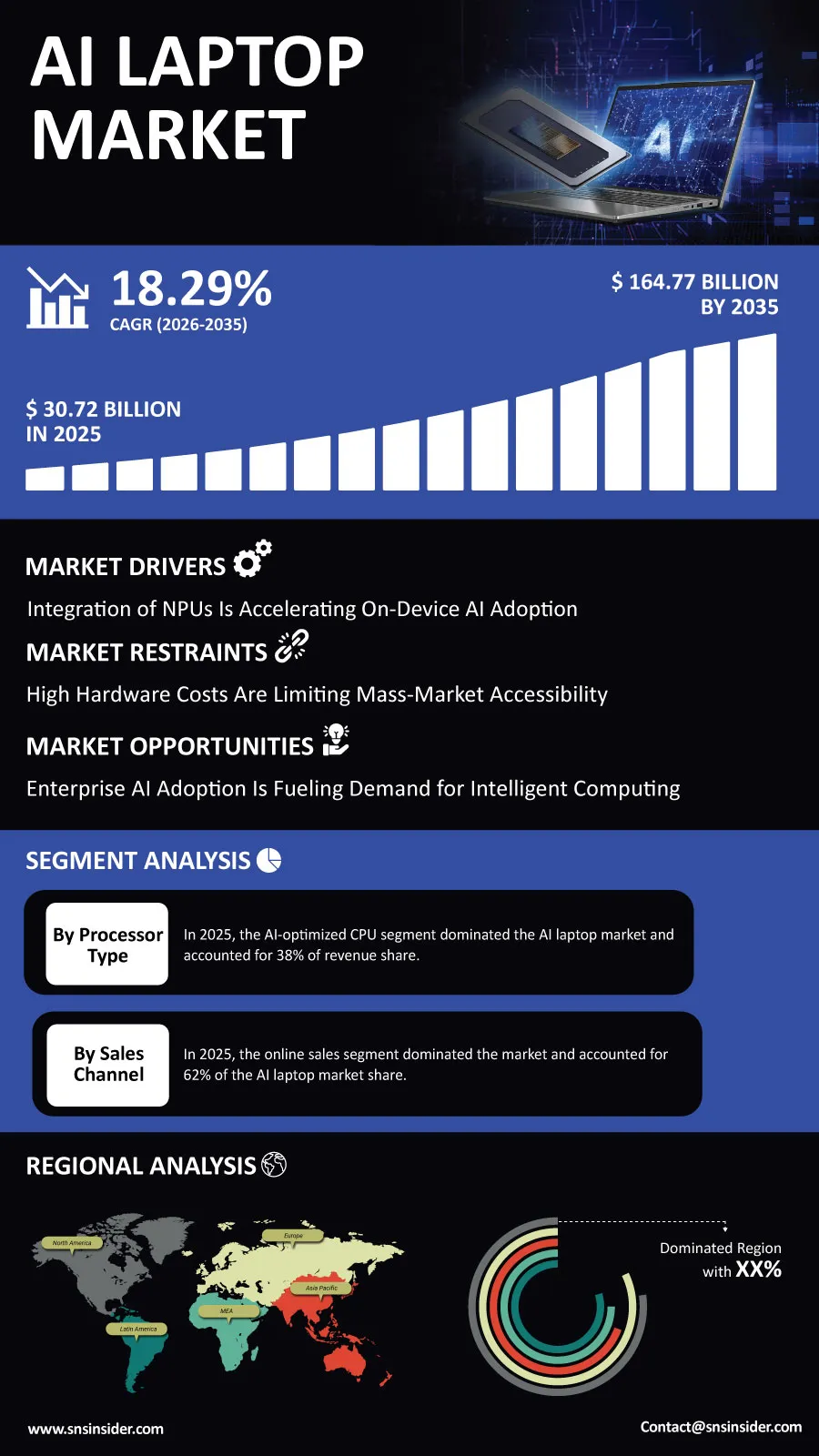
The Global AI Laptop market is poised to enter a new growth stage as artificial intelligence transforms from an advanced function into a core function of personal computers. “According to a recent study by SNS Insider, the global AI Laptop Market size valued at USD 30.72 billion in 2025, is anticipated to grow to USD 164.77 billion by 2035, registering a CAGR of 18.29% over the 2026–2035 forecast period.”
The development of AI-native computing experience has led to increased expectations from both consumer and business laptop markets. People are expecting computers which can support complex processing tasks at local level and provide them with quick response, privacy, and better productivity without having to rely completely on cloud technology. Such changes have led to manufacturers designing hardware that supports AI-based tasks.
The growing use of intelligent software in work environments, schools, entertainment, and services has increased the need even further. Companies are upgrading their employees' computers to help in automating work processes, while users are using AI-based computer features to make their daily computing easy and personalized.
To Get Detailed Insights on the AI Laptop Market – Request a Sample Report
Enterprise Adoption and Intelligent Computing Unlock Long-Term Market Opportunities
Organizations across the globe are implementing a wide range of digital transformation programs that necessitate devices that support the growing complexity of artificial intelligence applications. Advanced intelligent assistants, automated creation, superior collaboration technologies, and predictive analytics systems have become integral parts of the workspace, leading to an increasing need for laptops with AI accelerators.
Moreover, the growing trend of the creator economy is providing many growth opportunities to laptop manufacturers. Filmmakers, software developers, engineers, and digital marketers are increasingly relying on AI-powered systems that provide benefits such as faster local computations, low latency, and system responsiveness.
In addition to this, developments in the fields of semiconductor engineering and power management are allowing manufacturers to produce thin, lightweight, and efficient AI laptops without reducing their computing capabilities.
Key Market Insights Highlight Shifting Demand Patterns
AI-enabled CPUs were estimated to represent about 38% of revenue of the global market share in 2025 as a result of high popularity of these processors among the majority of laptops and balanced efficiency. At the same time, NPU sector is forecasted to register the highest CAGR through 2035 due to increasing need for AI processing for intelligent workloads on the device.
Regarding distribution channels, online sector was estimated to account for almost 62% of market revenue in 2025 because of growing number of purchases of AI-enabled processors via digital platforms due to comparison and customization opportunities and more affordable pricing. Offline sector is forecasted to have the largest CAGR during the forecast period due to importance of demonstrations and consultations.
As for the end user segments, consumer sector occupied the leading market position in 2025 because of increasing demand for the productivity, entertainment and computing experience with the help of AI technology. At the same time, content creators sector is forecasted to have the highest CAGR through 2035 due to increased number of AI-enabled processes in work of designers.
AI Hardware Innovation Continues to Transform Personal Computing
New generations of AI-enabled processing chips continue being developed by tech firms that provide increased computing efficiency and lower energy consumption. With the help of dedicated AI engines, advanced graphics technologies, and intelligent resource management, laptops can successfully run sophisticated tasks at ever-higher speeds and efficiencies.
Another trend in development is an enhanced software ecosystem to leverage hardware capabilities via efficient AI software applications. As more local AI experiences emerge in application development, new generations of laptops will show marked advances in productivity, collaboration, security, and personalization of user experiences.
North America Held the Largest AI Laptop Market Share in 2025; Asia Pacific Projected to Register the Fastest CAGR Through 2035
The North American region captured the highest share of the global AI Laptop Market in 2025 owing to strong infrastructure, early adoption of AI-based computing technology, and sustained investments in AI computing technology from top semiconductor and software players.
In addition, increasing demands from corporations, educational institutions, and professionals will continue to aid regional market growth.
Meanwhile, Asia Pacific is expected to witness the fastest CAGR in the AI laptop market during the forecast period owing to increased investments in artificial intelligence, semiconductors, and digitization by governments, manufacturers, and technology suppliers in the region. The rapid growth of gaming community, creator economy, and technology usage in China, India, Japan, and South Korea is expected to drive market growth over the forecast period.
Finally, the European region continues to display strong momentum owing to modernization of digital workplace and deployment of AI in industrial, educational, and professional application.
Industry Participants Focus on AI Hardware and Software Integration
Competition in the international AI Laptop Market is becoming fiercer due to the development of sophisticated processor technology, AI software optimization techniques, efficient computer systems architecture, and intelligent computing systems. Collaboration between hardware makers, OS providers, and AI software providers is driving innovation and increased commercialization.
Key companies operating in the global AI Laptop Market include Apple, Dell, HP, Lenovo, ASUS, Acer, Microsoft, Samsung, MSI, Razer, Huawei, LG, Gigabyte, Intel, AMD, NVIDIA, Qualcomm, MediaTek, Google, and Framework.
An SNS Insider analyst Sakshi Kale commented, "The rapid evolution of AI-enabled personal computing is transforming laptops into intelligent productivity platforms capable of delivering faster, more secure, and highly personalized experiences. Organizations investing in AI-optimized hardware, advanced semiconductor technologies, and integrated software ecosystems are expected to capture significant long-term growth opportunities as intelligent computing becomes mainstream."
About the Author

Get in touch