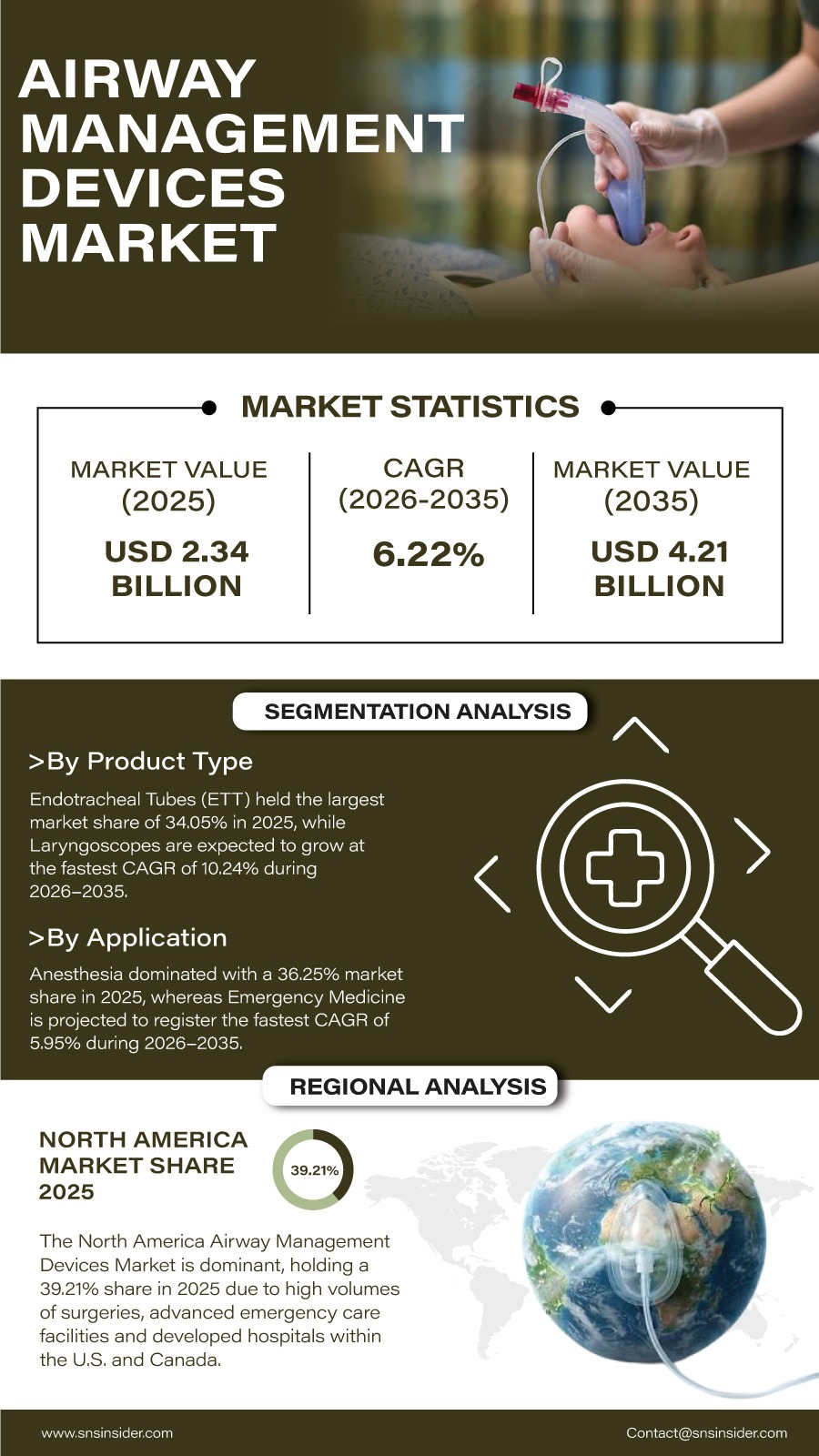
The global Airway Management Devices Market is predicted to undergo considerable growth during the next ten years due to the increasing investments by healthcare providers in innovations aimed at ensuring safety and efficiency of procedures. “According to a recent study by SNS Insider, the global Airway Management Devices Market size valued at USD 2.34 billion in 2025, is anticipated to grow to USD 4.21 billion by 2035, registering a CAGR of 6.22% over the 2026–2035 forecast period.”
The rising demand for effective airway management systems in operating rooms, emergency rooms, ICU, and ambulatory care facilities is changing the face of medicine around the globe. With the increasing number of hospitals providing critical care and surgery, the demand for airway management systems will also remain high.
Technology advancements have increasingly been concentrating on innovations which make airway access easier and facilitate visualization as well as reduce complications and infections associated with the procedure. Such advancements in technology have enabled practitioners to carry out airway procedures with more ease and better results.
To Get Detailed Insights on the Airway Management Devices Market – Request a Free Sample Report
Innovation Continues to Shape the Future of Airway Management
Fast-paced technological advances in the area of airway visualization devices, improved ergonomics of devices used for this purpose and compact portable medical equipment are leading to a transformation in the management of patients with difficult airways by medical practitioners.
The trend towards infection control has also led to increased use of single-use airway devices in hospitals and surgical centers, which helps healthcare practitioners to implement patient safety strategies without compromising patient health.
It is anticipated that developments in the field of digital imaging, improved visualization technology and ergonomic design of devices will help the market grow into the areas of emergency medicine, anesthesia and intensive care.
Key Market Findings Highlight Growth Opportunities
Among product categories, endotracheal tubes accounted for 34.05% of global market revenue in 2025, maintaining their position as the leading airway management solution due to widespread clinical use across surgical and critical care procedures.
Meanwhile, laryngoscopes are projected to register the fastest growth through 2035, expanding at a CAGR of 10.24%, reflecting increasing demand for improved airway visualization and higher procedural success rates.
By application, anesthesia represented 36.25% of market revenue in 2025, supported by consistent utilization of airway devices during elective and emergency surgical procedures. At the same time, emergency medicine is expected to witness the fastest growth at a CAGR of 5.95%, driven by rising trauma cases and growing emphasis on rapid airway intervention.
Hospitals remained the largest end-user segment, accounting for 62.25% of total market revenue in 2025, while home care settings are anticipated to record the fastest growth, expanding at a CAGR of 7.50% during the forecast period, reflecting increasing adoption of respiratory support technologies beyond traditional hospital environments.
Technology preferences are also evolving. Conventional airway devices accounted for 48.23% of market revenue in 2025, whereas video-assisted and advanced airway devices are projected to grow at the fastest CAGR of 7.80% through 2035, supported by increasing demand for enhanced visualization and greater procedural accuracy.
An Infographic Representation of the Global Airway Management Devices Market
Healthcare Investments Continue to Support Market Expansion
Healthcare organizations around the world have been working to enhance their preparation for emergencies, increase their surgery capabilities, and upgrade their critical care facilities. This will create a favorable environment for the incorporation of technologically advanced airway management devices.
The rising emphasis on safety, standardization, and efficiency in procedures has led healthcare organizations to upgrade their traditionally used equipment with technologically advanced airway devices that can support complicated procedures.
Regional Markets Present Strong Growth Potential
The North American region contributed 39.21% to the overall market share in 2025, owing to their well-established healthcare infrastructure, extensive use of cutting-edge technology in the medical sector, and high demands in the realm of surgery and emergency treatments.
Meanwhile, Asia Pacific is projected to emerge as the fastest-growing regional market, registering a CAGR of 8.44% through 2035. Expanding healthcare infrastructure, rising surgical volumes, improving emergency care capabilities, and increasing healthcare expenditure are creating significant opportunities for manufacturers across the region.
Leading Companies Continue to Expand Innovation Efforts
The competition in the market for airway management devices is still very high because of the continuing investments in innovations and research by these companies. They have been developing sophisticated technologies that will enhance the efficiency of the procedures and ensure safety of the procedure.
Key companies operating in the global airway management devices market include Medtronic, Teleflex Incorporated, Ambu A/S, Smiths Medical, ICU Medical, GE HealthCare, Koninklijke Philips, Dräger, Olympus Corporation, and KARL STORZ.
An SNS Insider analyst Parry Kardani commented, "The airway management devices market is evolving rapidly as healthcare providers prioritize technologies that improve clinical efficiency, patient safety, and procedural accuracy. Continued innovation in visualization systems, disposable devices, and minimally invasive airway solutions is expected to create substantial opportunities for manufacturers throughout the forecast period."
About the Author

Get in touch