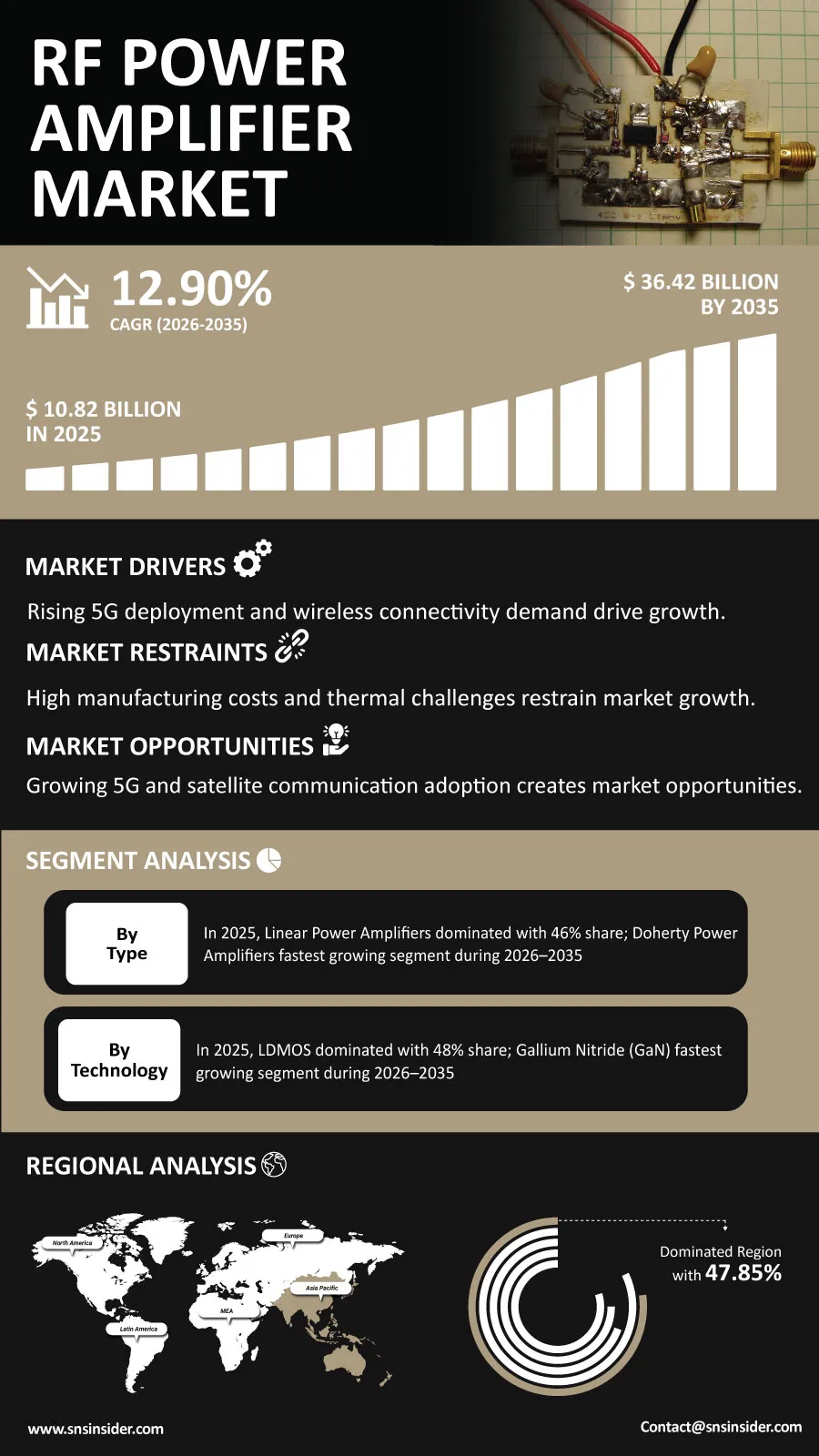
The global RF Power Amplifier Market is witnessing substantial growth as telecommunications providers, semiconductor manufacturers, and technology companies invest in advanced wireless communication infrastructure and high-performance radio frequency technologies. “According to a recent study by SNS Insider, the global RF Power Amplifier Market size, valued at USD 10.82 billion in 2025, is anticipated to reach USD 36.42 billion by 2035, registering a CAGR of 12.90% over the forecast period 2026–2035.”
Deployment of 5G networks, high-speed wireless network demands, and use of connected devices are contributing to an increased need for efficient RF signal amplification. RF power amplifiers are used to boost radio frequency signals for effective transmission through wireless communication networks, providing connectivity in cellular networks, smartphones, satellite communications, and various industrial applications. Advances in the GaN technology and the LDMOS technology are contributing to more efficient amplification, higher power densities, and enhanced amplifier performance.
With the increasing use of wireless networks and the rising complexity of communication needs, the relevance of RF Power Amplifiers is rising not only within traditional telecommunications. Increased spending on aerospace and defense equipment, automotive radar systems, satellite systems, and the Internet of Things technologies presents possibilities for advanced RF components development. Miniaturization and energy efficiency are among the other focuses of interest for manufacturers.
To Get Detailed Insights on the RF Power Amplifier Market – Request a Sample Report
5G Infrastructure Expansion and Advanced Semiconductor Technologies Create New Growth Opportunities
The fast growth of the number of facilities for 5G makes telecommunication companies and equipment suppliers consider investing in high-performance RF amplifiers that can provide high network capacity and reliable signal transmission. Currently, there is a need to have effective amplification in many frequency ranges, especially with the implementation of massive MIMO antennas and the extension of networks in dense populations. RF amplifiers are necessary for providing good quality signals in modern wireless communication applications.
Moreover, the increasing popularity of GaN power semiconductors creates more prospects for RF components manufacturers. The GaN amplifier is characterized by its high-power density, good high-frequency properties, and high efficiency in the appropriate applications. It is useful for telecommunications networks, aerospace applications, radars, and defense systems. In addition, there is an expanding network of satellite communications and demand for advanced automotive radars, which stimulates the creation of new amplification technologies.
However, high manufacturing costs, thermal management considerations, and reliance on semiconductor sourcing remain problematic. Designing amplifiers that can operate at high frequencies necessitates special materials, advanced manufacturing techniques, and control of signal distortion and thermal management issues. This can lead to increased manufacturing costs, especially in cases where power density is high and size is reduced. Semiconductor component manufacturers are adapting by improving semiconductor packaging, thermal considerations, manufacturing processes, and amplifier design.
Key Market Insights Highlight Shifting Demand Patterns
By type, Linear Power Amplifiers constituted around 46% of the total revenue of the RF Power Amplifier Market in 2025 owing to their capability to amplify radio frequency signals without causing any distortion or sacrificing on signal integrity. This feature is critical in telecommunication, broadcasting, and RF testing operations. Doherty Power Amplifiers are expected to witness the highest growth until 2035 owing to the rising emphasis of network providers on the need for efficiency in cellular base stations. Their ability to improve efficiency under backed-off operating conditions makes them particularly valuable for modern wireless signals with high peak-to-average power ratios.
Based on technology, LDMOS captured the maximum market share of about 48% in terms of revenue in 2025, as a result of its presence in telecommunications equipment and the availability of manufacturing expertise, reliability, and cost-effectiveness. LDMOS technology still serves the purpose of extensive use in cell phone towers and other high power RF devices. The highest growth is forecasted for the GaN technology during the forecast period as a result of increasing demand for increased power density and frequency capabilities.
By application, Telecommunication segment accounted for around 51% of market revenues in 2025 owing to the extensive use of radio frequency power amplifiers in cellular networks, base stations, and wireless transmitters. The fastest growth rate is likely to be seen in the automotive segment due to the adoption of advanced driver assistance systems, radar, and connected car applications. Among the end-users, telecom infrastructure held the largest share of about 49% in 2025, whereas consumer electronics was the fastest-growing segment, benefiting from increased usage of smartphones and wireless wearables.
Satellite Communications and Automotive Radar Strengthen Demand for Advanced RF Technologies
As the need for reliable wireless communication increases in important applications, manufacturers are developing RF amplifiers that can perform efficiently at higher frequencies and more stringent conditions. High-quality amplifiers are needed for satellite communications in order to ensure efficient communication between ground stations and satellites. Also, military radar and electronics applications need dedicated RF amplifiers that have the ability to provide high output power and stable performance. Higher levels of investment in communication satellites, military equipment and advanced wireless infrastructure are contributing to growing demand for RF components.
There are other applications such as automotive electronics and consumer devices that are presenting new challenges for RF amplifiers. Automotive electronics applications use high frequency semiconductor technologies in radar systems for object detection, distance measurement and assisted driving capabilities. Meanwhile, manufacturers of smartphones and wearables are developing RF amplifiers that are smaller in size and do not consume too much power from batteries of devices.
Asia Pacific Leads RF Power Amplifier Market with 47.85% Share and Registers Fastest Growth at 13.8% CAGR
The Asia Pacific region continues to dominate the global RF Power Amplifier Market, holding about 47.85% of total revenue in 2025. Factors that drive the leadership of the Asia Pacific region include availability of well-established semiconductors industry, rapid growth of telecom network infrastructure, and rising demand for mobile phones and other electronic devices. Some of the major countries include China, Japan, South Korea, and India, backed up by the growing deployment of 5G networks, existing electronics industry, and adoption of wireless communication technology. Moreover, it is expected to be the fastest-growing region, at a CAGR of 13.8% between 2026 and 2035, as regional manufacturers increase production of high-performance RF components and telecommunications operators continue expanding wireless infrastructure.
The North American region continues to be significant due to investments in 5G communication networks, aerospace and defense technology, and semiconductor research. North America is contributing to the growth of the RF power amplifier market, with the RF Power Amplifier Market in the United States estimated to be around USD 3.96 billion in 2025, which is expected to rise up to USD 14.85 billion by 2035. Growth in the usage of GaN technology, increased investment in defense electronics, and increasing demand for satellite communication are some of the factors driving demand from within the country. Other regions, such as Europe are contributing to the RF Power Amplifier Market through developments in automotive radar, industrial communication, and defense electronics.
Industry Participants Focus on GaN Innovation and Energy-Efficient RF Solutions
Competition in the RF Power Amplifier Market is increasingly centered on power efficiency, operating frequency, thermal performance, and semiconductor integration. Leading manufacturers are developing advanced GaN and LDMOS devices to address growing demand across telecommunications infrastructure, radar systems, satellite communications, and consumer electronics. Companies are also investing in compact packaging, optimized amplifier designs, and integrated RF front-end solutions to improve performance while reducing equipment complexity and energy consumption.
In March 2025, Qualcomm introduced its X85 5G Modem-RF platform, reinforcing its focus on advanced wireless connectivity and integrated radio frequency technologies for next-generation mobile devices. In June 2025, Qorvo introduced compact RF components designed for 5G massive MIMO and fixed wireless access applications, emphasizing improved thermal performance and reduced radio equipment footprint. During the same month, MACOM announced new GaN-on-silicon-carbide RF power amplifiers for advanced radar applications, including high-power S-band devices capable of delivering up to 800 watts. These developments demonstrate the industry's increasing emphasis on efficiency, miniaturization, and specialized RF performance across communication and defense systems.
Key companies operating in the global RF Power Amplifier Market and related RF semiconductor ecosystem include Qualcomm Incorporated, Toshiba Corporation, Infineon Technologies AG, Broadcom Inc., Mitsubishi Electric Corporation, Skyworks Solutions Inc., Murata Manufacturing Co., Ltd., Analog Devices Inc., NXP Semiconductors N.V., ETL Systems Ltd., OPHIR RF, CML Microsystems Plc, Qorvo Inc., MACOM Technology Solutions Holdings Inc., STMicroelectronics N.V., Texas Instruments Incorporated, Wolfspeed Inc., Nokia Corporation, and Rohde & Schwarz GmbH & Co. KG.
An SNS Insider analyst, Sushant Kadam, commented, “The rapid expansion of 5G infrastructure, increasing demand for high-speed wireless connectivity, and growing adoption of advanced semiconductor technologies are creating significant opportunities across the global RF power amplifier market. As telecommunications operators and technology manufacturers prioritize energy efficiency, reliable signal transmission, and higher-frequency performance, companies that deliver advanced GaN solutions, compact RF architectures, and cost-effective amplification technologies will be well positioned to benefit from continued investment in next-generation wireless communication, automotive electronics, and defense systems.”
About the Author

Get in touch