
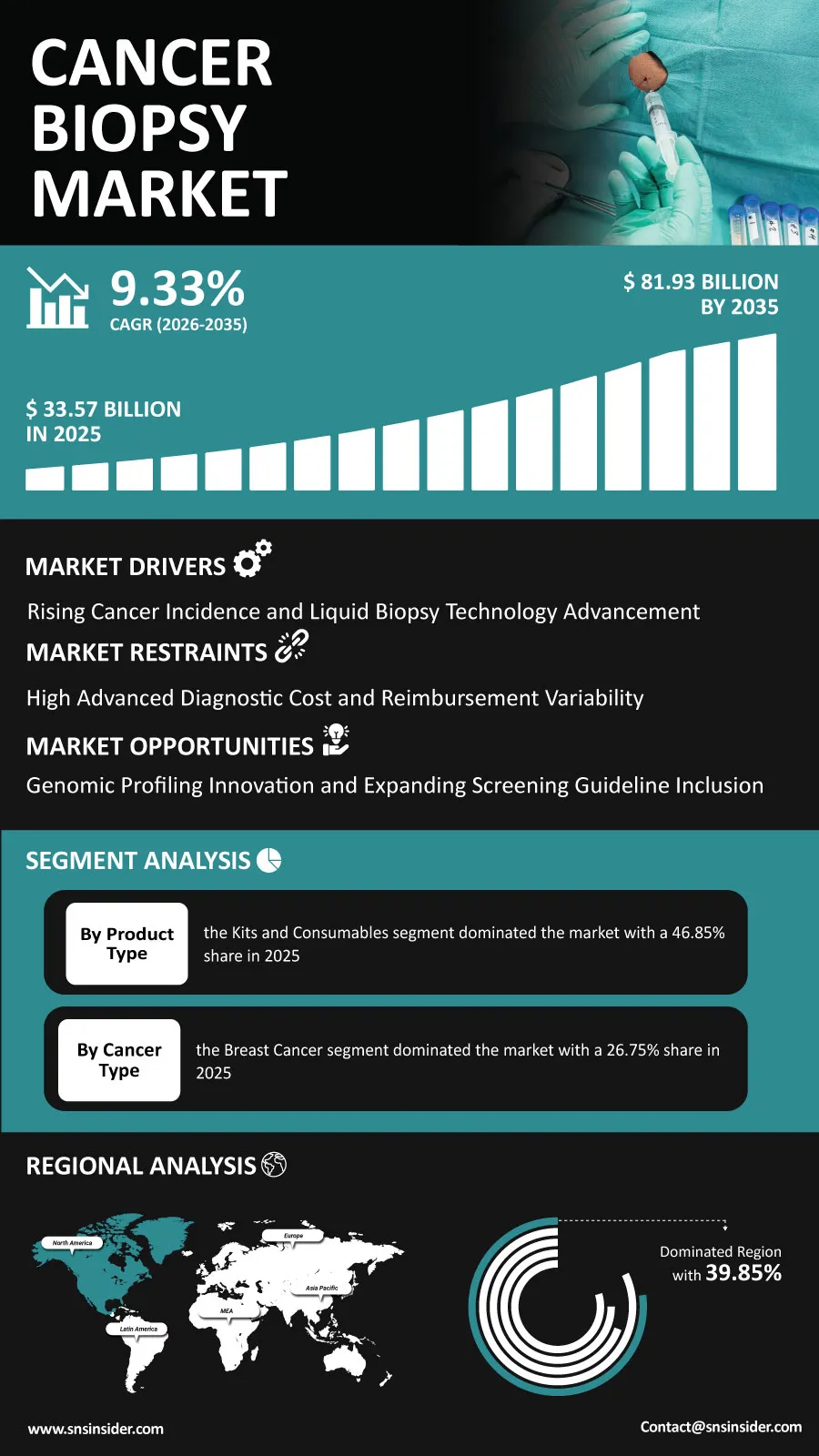
A single blood draw that can now reveal not just whether a patient has cancer but exactly which treatment is most likely to work represents one of the more consequential shifts in modern oncology. According to a recent study by SNS Insider, the global Cancer Biopsy Market, valued at USD 33.57 billion in 2025, is projected to reach USD 81.93 billion by 2035, registering a CAGR of 9.33% across the 2026-2035 forecast period.
Cancer biopsy encompasses the full range of procedures, instruments, and laboratory technologies used to sample and analyse suspicious tissue or tumour DNA circulating in a patient's bloodstream, to confirm a cancer diagnosis, determine its molecular characteristics, and guide treatment selection. The category has evolved from a purely diagnostic confirmation step into an ongoing tool for monitoring how a patient's cancer responds to treatment and evolves over time, and demand for it continues to track closely with both rising global cancer incidence and the field's rapid technological advancement.
To Get Detailed Insights on the Cancer Biopsy Market – Request a Sample Report
Rising Cancer Incidence and Liquid Biopsy Advancement Fuel Growth
Rising global cancer incidence continues to widen demand, as growing diagnosis volumes worldwide directly expand the population requiring biopsy confirmation, molecular characterisation, and ongoing treatment monitoring. Growing demand for early diagnosis reinforces this trend, as well-established evidence linking earlier detection to improved outcomes continues to drive expanding screening adoption.
Companies are responding with continued liquid biopsy technology advancement, combining genomic and epigenomic profiling within a single blood draw, and with continued expansion of companion diagnostic indications that increasingly guide targeted therapy selection for an expanding range of cancer types and treatments.
Segment Findings Point to a Market in Transition
Kits and consumables led the market in 2025 with a 46.85% share, reflecting the recurring nature of biopsy procedure volume, while instruments are recording the fastest growth at a 10.75% CAGR as precision image-guided sampling technology advances. Tissue biopsies account for 61.40% of procedure-type demand given their established diagnostic gold-standard role, though liquid biopsy is expanding fastest at 14.85% as blood-based testing gains regulatory approval and clinical adoption.
Breast cancer holds the largest cancer-type share at 26.75%, while pancreatic cancer is growing fastest at 11.65% as liquid biopsy finally offers practical surveillance for this historically hard-to-screen cancer type. Hospitals account for the largest end-user share, and ambulatory surgical centers are growing fastest at 12.85% as lower-complexity procedures shift to outpatient settings. Cancer diagnosis and staging leads by application, though treatment monitoring is growing fastest at 13.15% as longitudinal liquid biopsy monitoring gains traction.
North America Leads, Asia Pacific Set to Grow Fastest
North America constituted the highest revenue percentage in the world in 2025, accounting for 39.85% of total revenue due to increasing demand for personalized medicine and increased knowledge of cancer in physicians and patients. The United States was the largest market in the region.
Asia Pacific is projected to expand at the fastest rate of any region through 2035, at a CAGR of approximately 12.45%, as China, Japan, and India continue expanding hospital infrastructure and national cancer screening programs. Europe remains a significant contributor, anchored by Germany's substantial healthcare infrastructure, while Latin America and the Middle East and Africa continue building adoption at a more gradual pace.
Genomic Profiling Innovation and Regulatory Milestones Reshape Competitive Dynamics
Competition within this market increasingly centres on which companies can pair reliable core diagnostic technology with genuinely differentiated genomic and epigenomic profiling breadth, as leading companies continue racing to expand companion diagnostic indications and secure formal screening guideline inclusion that meaningfully broadens their addressable patient population.
Some of the major companies operating in the global cancer biopsy market include Becton, Dickinson and Company, Hologic, Inc., Danaher Corporation, Thermo Fisher Scientific Inc., Roche Holding AG, Guardant Health, Inc., Exact Sciences Corporation, Illumina, Inc., Merit Medical Systems, Inc., and Argon Medical Devices, Inc.
Looking ahead, the pace of genomic profiling innovation, continued screening guideline inclusion, and sustained rising cancer incidence are likely to determine which companies gain the most share over the coming decade. Companies that combine proven diagnostic reliability with genuine molecular profiling breadth are expected to be best placed to benefit from the market's sustained, precision-oncology-driven growth throughout the forecast period.
Real-world evidence generation from large patient testing populations continues to strengthen the competitive moat of the largest liquid biopsy providers in a way that is difficult for smaller entrants to replicate quickly. Companies that have already tested more than a million patients accumulate a genuinely valuable dataset that informs algorithm refinement, supports additional regulatory submissions, and builds the kind of longitudinal clinical evidence base that increasingly influences both physician confidence and payer coverage decisions, a data advantage that continues to compound over time in ways that favour established, high-volume testing providers over newer market entrants.
The transition from laboratory-developed tests toward formally FDA-approved diagnostic platforms is emerging as a genuinely important competitive dynamic across the industry. As companies increasingly convert tests that once operated under laboratory-developed test regulatory pathways into fully FDA-approved assays, they gain meaningfully broader prescribing latitude and stronger reimbursement positioning than the LDT pathway alone typically provides, and this regulatory maturation continues to reward companies with the clinical evidence depth and regulatory expertise to navigate formal approval successfully.
An SNS Insider Analyst, Parry Kardani commented, "This market continues to benefit from a genuine convergence of rising global cancer incidence and rapidly maturing liquid biopsy and genomic profiling technology. Companies that pair proven diagnostic reliability with genuine molecular profiling innovation are best positioned to capture the next phase of demand, particularly across Asia Pacific's fast-growing healthcare infrastructure and national cancer screening program investment."
About the Author

Get in touch




