
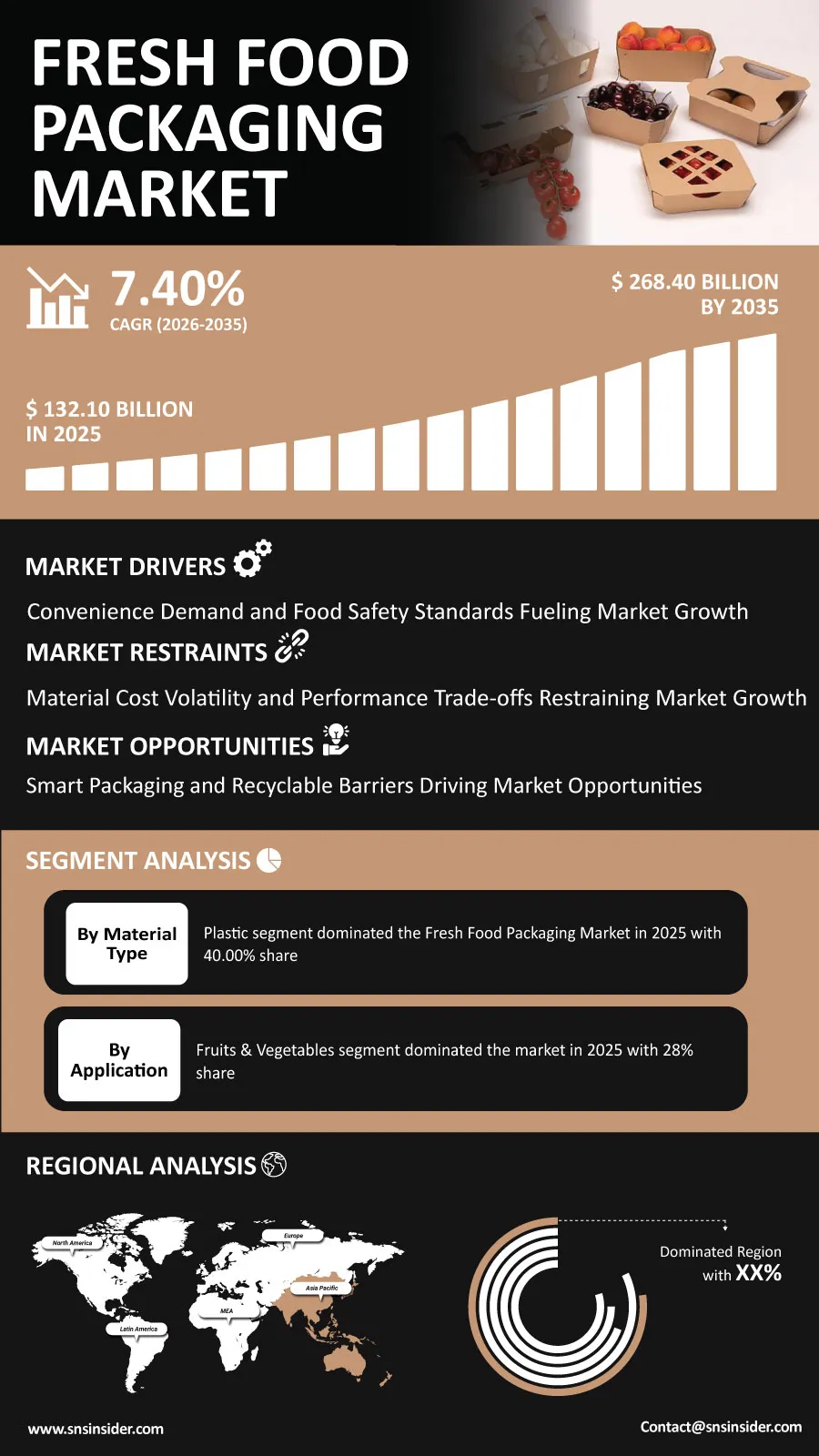
The global Fresh Food Packaging Market is on a steady growth path through 2035, as food safety demand and e-commerce grocery delivery continue reshaping how perishable products get packaged worldwide. “According to a recent study by SNS Insider, the global Fresh Food Packaging Market size valued at USD 132.10 billion in 2025, is anticipated to grow to USD 268.40 billion by 2035, registering a CAGR of 7.40% over the 2026-2035 forecast period.”
Fresh food packaging faces a genuinely harder technical challenge than most other packaging categories, keeping a perishable product safe and appealing for days or weeks without the shelf-stable chemistry that canned or frozen goods can lean on. Vacuum skin and modified atmosphere packaging have become the industry's two primary answers to that challenge, tightly managing the environment around the product rather than simply containing it.
E-commerce grocery delivery is adding a genuinely new complication to this challenge, as fresh products increasingly need to survive multi-hour, less-controlled shipping journeys that traditional retail-to-home trips never required.
To Get Detailed Insights on the Fresh Food Packaging Market – Request a Sample Report
Barrier Technology Adapts to E-Commerce Delivery Demands
Where fresh food packaging was historically engineered around retail shelf life and short in-store handling, brands are increasingly designing formats specifically for the extended, less predictable conditions of home delivery.
This shift is changing how packaging suppliers approach product development, since insulation, tamper-evidence, and barrier performance now all have to be engineered together rather than treated as separate design considerations.
Suppliers who can demonstrate reliable performance across both retail and e-commerce delivery conditions are increasingly winning contracts with brands expanding into direct-to-consumer fresh food distribution.
Key Market Findings Highlight High-Growth Segments
Plastic held the largest share of the Fresh Food Packaging Market in 2025, at 40.00%, reflecting its unmatched barrier performance and compatibility with vacuum skin and modified atmosphere packaging systems.
Paper & paperboard is the fastest-growing material, expanding at a 9.20% CAGR, pulled forward by plastic-reduction regulation and consumer demand for curbside-recyclable packaging.
By format, rigid packaging led with 46.00% share in 2025, while flexible packaging is growing fastest, at an 8.60% CAGR, as brands prioritize lighter, more material-efficient formats.
Fruits & vegetables remained the largest application at 28% share, but ready-to-eat foods is climbing fastest, at a 9.80% CAGR, driven by rising convenience food consumption.
Barrier Performance and Cold-Chain Reliability Anchor Competitive Positioning
Brands are increasingly evaluating fresh food packaging suppliers on barrier performance and cold-chain reliability nearly as much as on cost, particularly for premium and e-commerce-focused product lines.
Investment in vacuum skin and modified atmosphere packaging technology is becoming a genuine competitive differentiator among larger suppliers, while smaller regional players without that investment increasingly compete only in commodity, price-sensitive segments.
This divide is expected to sharpen further as e-commerce grocery delivery and sustainability regulation both continue reshaping packaging specifications.
Asia Pacific Leads as North America Grows Fastest
Asia Pacific holds the largest share of global market revenue, anchored by expanding organized retail infrastructure and rapid urbanization across China and India. North America, meanwhile, is growing fastest, propelled by rising demand for convenience, eco-friendly packaging adoption, and healthy eating habits.
Europe holds a meaningful, mature share as well, shaped heavily by strong sustainability mandates and widespread packaged produce usage across the region.
Leading Companies Drive Innovation and Competition
Competition in this market centers on barrier technology, material sustainability, and cold-chain packaging capability nearly as much as on price, with major players investing in recyclable formats to differentiate from smaller regional competitors.
Some of the major companies that operate in the global fresh food packaging market are Amcor plc, Graphic Packaging International, LLC, Sealed Air Corporation, Smurfit Westrock plc, Anchor Packaging LLC, Ball Corporation, Pactiv Evergreen Inc., Sonoco Products Company.
An SNS Insider Analyst Santosh Bhul commented, “Fresh food packaging has moved well past simple containment, brands now need barrier performance, cold-chain reliability, and genuine recyclability all in the same package, and the suppliers capturing the fastest-growing parts of this market are the ones delivering all three at once. As e-commerce grocery delivery keeps expanding into new markets, the packaging performance bar is only going to keep rising.”
About the Author

Get in touch




