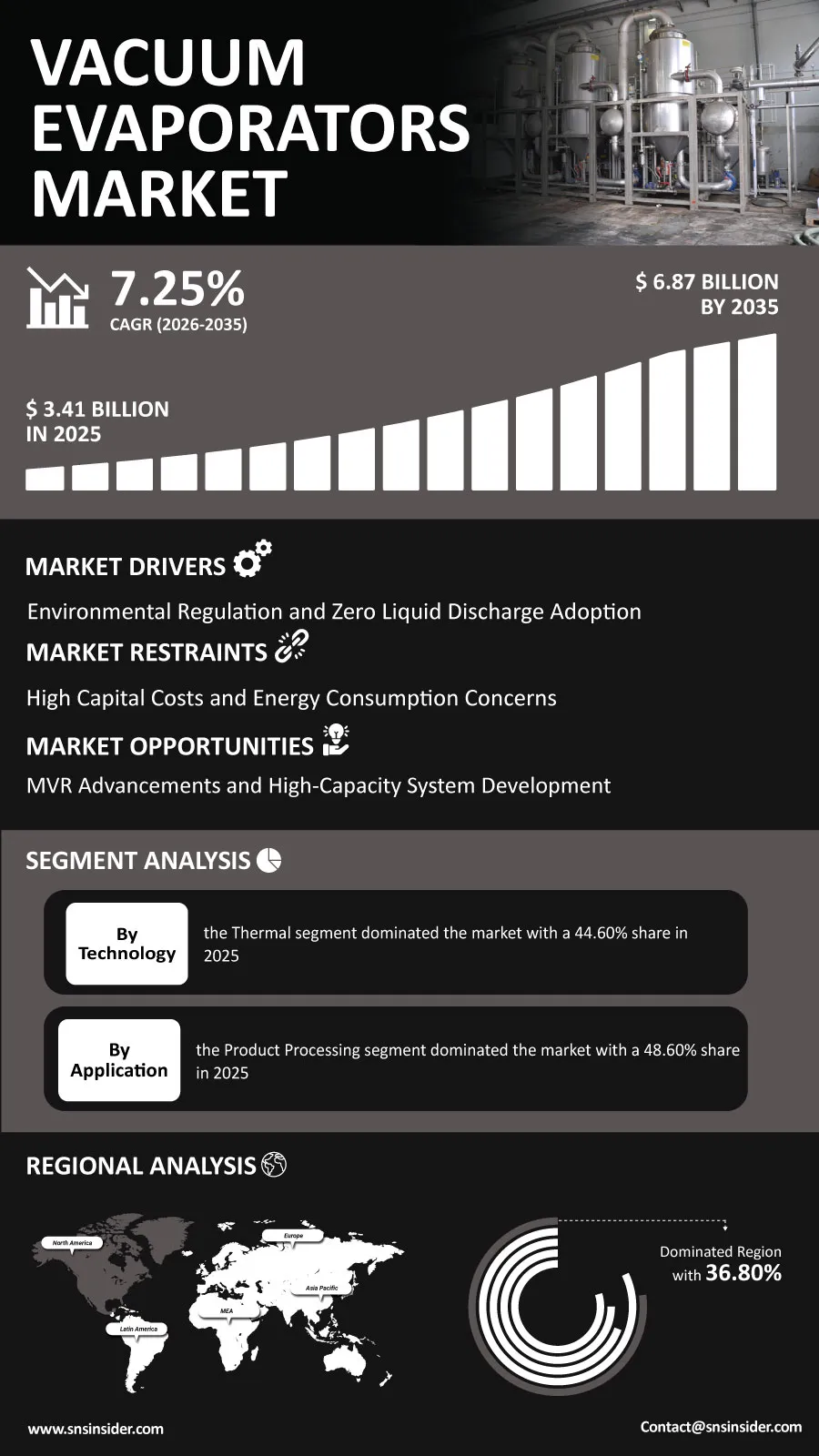
Pharmaceutical manufacturers and chemical processors around the world continue to invest in increasingly sophisticated evaporation technology as environmental regulations tighten and water scarcity intensifies. "According to a recent study by SNS Insider, the global Vacuum Evaporators Market valued at USD 3.41 billion in 2025, is projected to reach USD 6.87 billion by 2035, registering a CAGR of 7.25% across the 2026-2035 forecast period."
This consistent growth is due to the combination of two separate factors: rising global demand for the treatment and recycling of industrial wastewater and an energy-efficiency revolution that goes beyond thermal evaporation. The processors not only want concentration systems but also systems of vapor recompression and zero liquid discharge that meet increasing environmental regulations. This is being addressed by manufacturers with developments in energy-efficient systems that support the thermal systems that have dominated this market in the past.
To Get Detailed Insights on the Vacuum Evaporators Market – Request a Sample Report
Environmental Regulation Fuels Sustained Demand
The ongoing implementation of stringent environmental standards ensures that the demand for vacuum evaporators remains high not only in wastewater treatment but also in product processing applications. Growing deployment of zero liquid discharge systems adds another dimension to this, with a range of industries such as chemicals, pharmaceuticals, food and beverages, and mining coming under greater pressure to manage their wastewater treatment and reuse.
It is in this environment that manufacturers are increasingly placing emphasis on investing in mechanical vapor recompression and heat pump technologies rather than older thermal technologies.
Segment Findings Point to a Market in Transition
The thermal technology has been the largest in terms of revenue because of its reliable and cost-efficient operations in numerous applications in processing. Mechanical Vapor Recompression technology, on the other hand, will be the most rapidly growing due to efforts towards significantly lower energy consumption.
Product Processing applications have dominated the market in terms of the highest market share owing to the need for concentration of products in the pharmaceutical, food, and chemical industries, whereas Wastewater Treatment application will grow the most rapidly due to increased regulation. The pharmaceutical industry will still dominate in terms of end-use, but the chemical industry will catch up fast.
North America Leads, Asia Pacific Set to Grow Fastest
North America represented the highest regional share of the global market, amounting to 36.80% of revenue in 2025, due to the presence of a well-established pharmaceutical and chemical manufacturing industry in North America, along with an environment-friendly regulation system in the region. The U.S., with its key players in pharmaceuticals, food and beverages, and chemical processes, impacts regional demand.
Asia Pacific will grow at the fastest pace among all regions till 2035, growing at a CAGR of 8.20%, as China, South Korea, and Japan invest in their capabilities in the manufacture of pharmaceuticals and chemicals, which require advanced evaporation technology. Europe is one of the major contributors to the global market due to the presence of an established chemical and pharmaceutical manufacturing industry in Germany.
Energy Efficiency Innovation Reshapes Competitive Dynamics
Competition within this market increasingly centers on which manufacturers can pair reliable concentration performance with genuinely differentiated energy-efficiency credentials, and on the degree to which companies can demonstrate validated zero liquid discharge and mechanical vapor recompression technology. Companies pursuing deeper investment in high-capacity system development and sustainability-focused innovation continue to position themselves favourably for the next phase of industry growth.
Some of the major companies operating in the global vacuum evaporators market include Alfa Laval AB, GEA Group AG, SPX FLOW, Inc., Sulzer Ltd., Veolia Water Technologies, Condorchem Envitech, HRS Heat Exchangers Ltd., Saltworks Technologies Inc., Encon Evaporators, and Aqua-Chem, Inc.
An SNS Insider Analyst Himanshu Sharma commented, “This market continues to benefit from a genuine convergence of environmental regulation and maturing energy-efficient evaporation technology. Manufacturers that can pair proven concentration performance with genuinely differentiated mechanical vapor recompression capability are best positioned to capture the next phase of demand, particularly across Asia Pacific's fast-growing pharmaceutical and chemical manufacturing investment.”
About the Author

Get in touch