
Allergy Immunotherapy Market is entering a new phase of growth as more and more health care providers have shifted their focus toward disease management rather than temporary management of symptoms. Drug manufacturers have started making more investments in cutting-edge immunotherapy technologies, whereas doctors tend to prescribe drugs that help to alter the immune system response rather than provide only temporary relief from seasonal allergies.
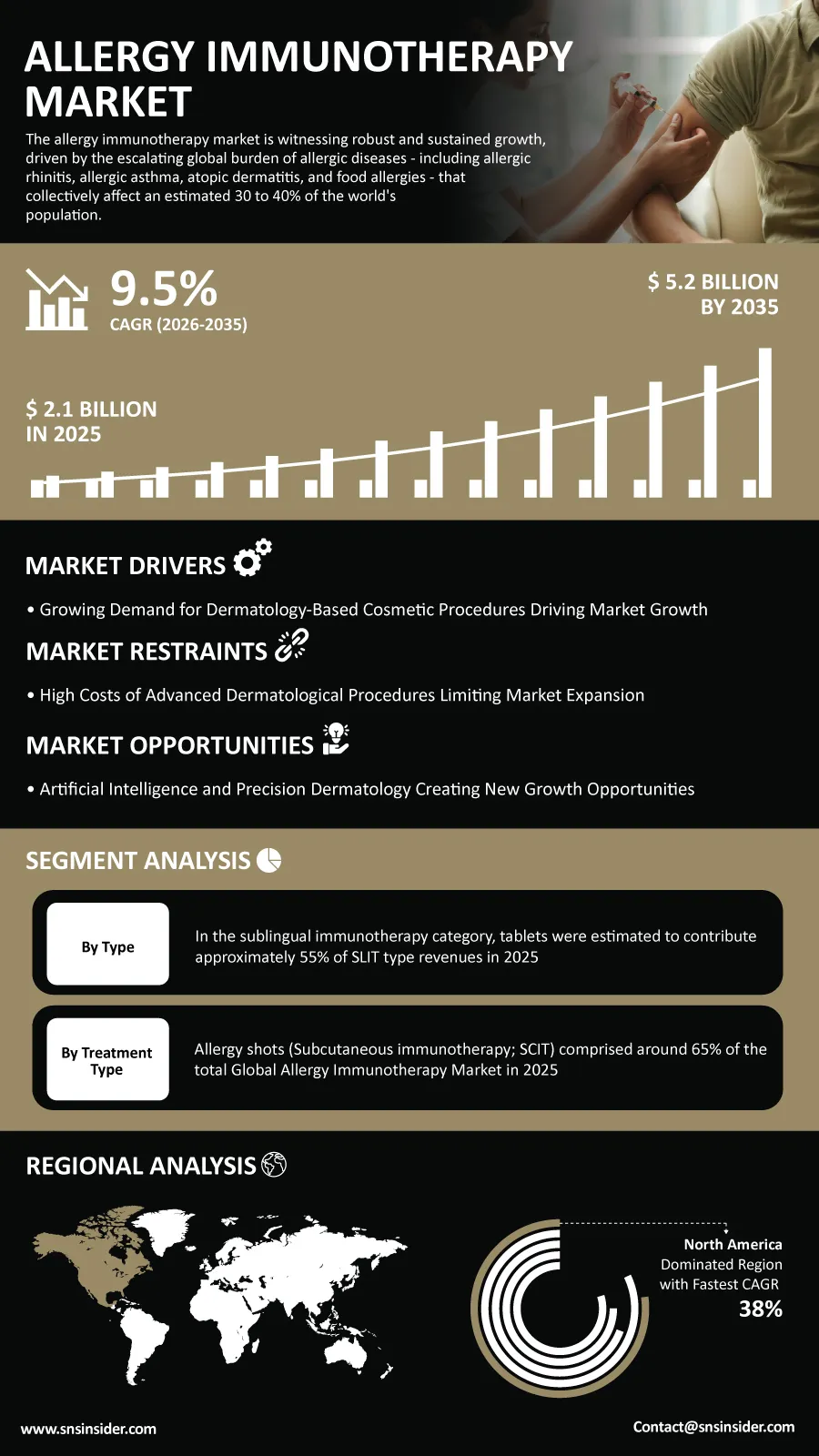
According to a recent study by SNS Insider, the global Allergy Immunotherapy Market size valued at USD 2.1 billion in 2025, is anticipated to grow to USD 5.2 billion by 2035, registering a CAGR of 9.5% over the 2026–2035 forecast period. Increasing cases of respiratory allergies, food allergies, and allergic asthma, together with expanding regulatory approvals and improved patient access to modern therapies, continue to support market expansion across developed and emerging healthcare markets.
Healthcare providers have also observed that patients have become more accepting of therapies that provide clinical benefits in the long run by regulating their immune systems. With improvements in healthcare services provided digitally, manufacturers have been offering formulations that make the process of administering therapy easier for patients.
To Get Detailed Insights on the Allergy Immunotherapy Market – Request a Sample Report
Home-Based Therapies and Precision Medicine Transform Patient Care
Allergy immunotherapy is increasingly moving away from conventional treatments provided within the clinical settings. An increasing supply of SLIT tablets and liquid preparations has made it possible for patients to carry out the treatment at their homes through proper guidance from a physician.
At the same time, the use of molecular allergy diagnosis and precision medicine has made it possible to diagnose individual allergies accurately. This has supported personalized treatment methods, which has also encouraged pharmaceutical companies to come up with treatments that are directed specifically towards particular patient groups. Telemedicine and adherence applications are also contributing towards the effective treatment management process.
Market Segments Highlight Strong Commercial Opportunities
Within the product landscape, SLIT tablets were responsible for about 55% of sublingual immunotherapy sales in 2025, owing to standardized dosing, regulatory approval, and increasing physician confidence in SLIT tablets. SLIT drops will see a notable increase in their adoption with increased accessibility in developing healthcare markets.
Based on treatment type, Subcutaneous Immunotherapy (SCIT) constituted around 65% of the global market share in 2025 because of its established usage in treating several types of allergies. On the other hand, Sublingual Immunotherapy (SLIT) is likely to grow at the fastest pace, reaching around 9.6% CAGR over the forecast period as demand rises for convenient, non-invasive treatment options.
Among allergy indications, allergic rhinitis held around 72% of global market share in 2025, owing to high prevalence and clinical acceptance of immunotherapy for treating the condition. Food allergy immunotherapy would emerge as the fastest growing segment with regulatory developments and clinical trials being carried out.
Hospital pharmacies emerged as the most important distribution channel during 2025 because of administration of SCIT under physician supervision. Online pharmacies would register the fastest growth in the future owing to digitization of prescriptions and at-home treatments.
Regulatory Progress Creates New Growth Opportunities
Commercial prospects within the industry of allergy immunotherapy have been enhanced through recent approvals and increased research activities in the field. Companies are exploring advanced biologics, combination approaches, and new immunotherapy platforms to deliver effective therapy that can address more patients.
Increasing focus on managing allergies in children is also fueling the development of more early-intervention approaches to help reduce the progression of the disease. Further research into food allergy treatments as well as biological immunotherapy will provide further opportunities in the industry.
Regional Markets Continue Expanding
North America remained the market leader throughout 2025 with its share being approximately 38% of the market. The value of the US Allergy Immunotherapy Market in 2025 stood at USD 0.65 billion, which is expected to increase to USD 1.55 billion by 2035, growing at a CAGR of 9.1%.
The most promising region in terms of growth will be Asia Pacific with its projected 9.96% CAGR for 2035. Urbanization, changes in the environment, increasing health care facilities, and rising awareness about treatment options for allergies are driving the quick adoption rate in this region. China held a revenue share of approximately 44% in the Asia Pacific region.
Across other major regions, Germany contributed around 30% of European revenue, Brazil represented approximately 47% of Latin America, while the United Arab Emirates accounted for nearly 29% of Middle East & Africa revenue, reflecting continued investment in allergy care and specialty healthcare services.
Industry Leaders Strengthen Innovation Pipelines
Competition continues to intensify as leading biotechnology and pharmaceutical companies expand clinical development programs, strengthen digital health capabilities, and introduce advanced immunotherapy products. During 2026, ALK-Abelló expanded its Allergy+ strategy by introducing new-generation SLIT tablets alongside a digital adherence platform for patients receiving home-based therapy. Earlier milestones included the FDA approval of Xolair (omalizumab) in February 2024 for IgE-mediated food allergy management and continued investment in innovative allergy vaccines and biologic therapies.
Major companies operating in the global Allergy Immunotherapy Market include ALK-Abelló A/S, Stallergenes Greer plc, Allergy Therapeutics plc, HAL Allergy B.V., Merck KGaA, DBV Technologies, Aimmune Therapeutics (Nestlé Health Science), Regeneron Pharmaceuticals, Inc., Sanofi S.A., Novartis AG/Genentech (Roche), Biomay AG, Torii Pharmaceutical Co., Ltd., Zydus Lifesciences Ltd., Cipla Ltd., LETI Pharma, Bencard Allergie GmbH, Alk-Scherax Arzneimittel GmbH, Circassia Group plc, Mylan N.V. (Viatris), and Adamis Pharmaceuticals Corporation.
An SNS Insider analyst Parry Kardani commented, "The allergy immunotherapy market is transitioning toward more personalized, patient-friendly treatment models supported by scientific innovation, digital healthcare integration, and expanding regulatory approvals. Companies that successfully combine clinical evidence with accessible treatment solutions will be well positioned to capitalize on sustained global demand over the coming decade.
About the Author

Get in touch




