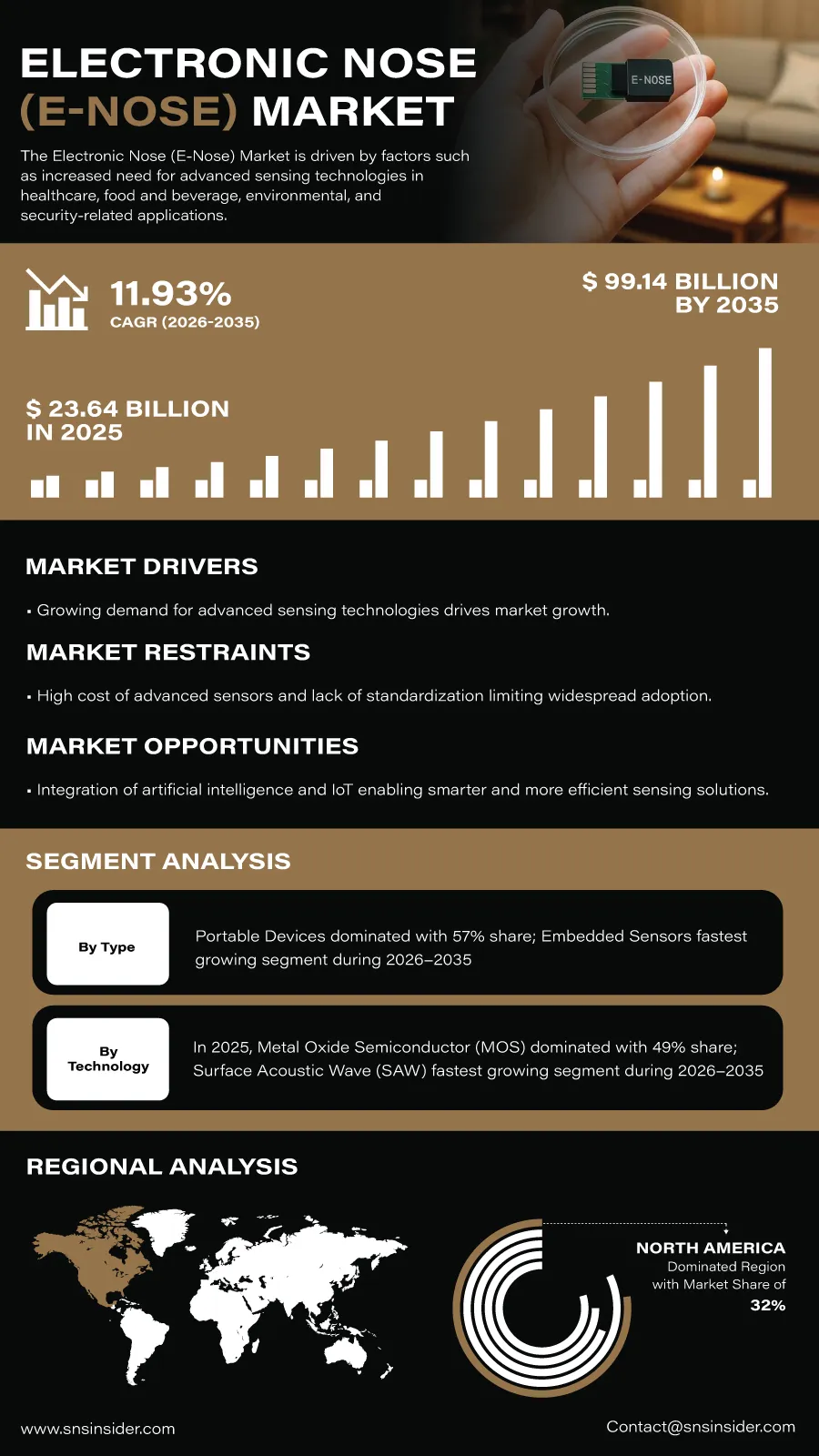
The global Electronic Nose (E-Nose) Market is gaining momentum as industries increasingly adopt intelligent sensing systems for quality assessment, safety monitoring, and rapid chemical detection. “According to a recent study by SNS Insider, the global Electronic Nose (E-Nose) Market size valued at USD 23.64 billion in 2025, is anticipated to grow to USD 99.14 billion by 2035, registering a CAGR of 11.93% over the 2026–2035 forecast period.”
Growth in the demand for non-invasive diagnostic tools, strict standards concerning food quality, and increasing safety requirements regarding the environment are presenting opportunities for the development of electronic noses. This technology makes use of sensor arrays and other analytical methods to assess complicated smells and is applicable for such tasks as food quality testing and hazardous material detection.
Artificial intelligence, machine learning, and the application of monitoring systems connected via the Internet have made electronic noses even more versatile. Companies developing these gadgets are making efforts to increase their sensitivity and portability.
To Get Detailed Insights on the Electronic Nose (E-Nose) Market – Request a Sample Report
Intelligent Sensing Technologies Create New Growth Opportunities
There is increased interest in e-nose technology as there is a need for better ways of detecting chemicals quickly and consistently. The health sector is exploring the idea of breath analysis in detecting chemicals associated with certain diseases while the food industry uses e-nose technology to evaluate product quality and contamination.
Monitoring the environment is yet another important area where e-nose technology can be applied especially with the increasing effort by industries and environmental agencies to detect harmful gases and monitor air quality. Unfortunately, high costs of equipment, the need for calibration, and inconsistent testing procedures pose some challenges to adoption by small firms.
Advances in sensor design and pattern recognition using artificial intelligence are likely to improve performance and help develop application-specific equipment.
Key Market Insights Highlight Shifting Demand Patterns
By type, portable devices held around 57% of global market revenue in 2025, supported by their suitability for on-site testing, field inspections, and rapid sample analysis. Embedded sensors are projected to be the fastest-growing segment through 2035 as connected equipment and smart industrial systems increasingly incorporate continuous odor-monitoring capabilities.
Based on technology, Metal Oxide Semiconductor (MOS) sensors dominated with a 49% market share in 2025 owing to their established commercial use, sensitivity, and cost advantages. Surface Acoustic Wave (SAW) technology is expected to record the fastest growth during the forecast period as demand increases for responsive sensing solutions in specialized applications.
By end user, food and beverage applications contributed around 34% of market revenue in 2025. The sector's emphasis on freshness assessment, contamination identification, and consistent product quality supports demand. Healthcare is expected to grow fastest as research into breath-based diagnostics and non-invasive screening expands.
In terms of application, quality control and safety was forecasted to hold around 38% of market revenue in 2025. Disease diagnosis is projected to be the fastest-growing application, driven by research into volatile biomarkers and the development of analytical systems that may complement conventional diagnostic methods.
AI Integration Expands Electronic Nose Applications
The integration of electronic noses with the use of AI and IoT technologies is changing the direction of technological development within the industry. Machine learning can help identify more complicated smells, while IoT allows for constant monitoring and analysis of the information from a distance.
Portable systems have expanded the capabilities of this technology beyond lab environments into industrial control, environmental evaluation, and even security checks. This creates possibilities for developing various systems adjusted to different operating conditions.
North America Captures 32% of Electronic Nose Market Revenue as Asia Pacific Expands Smart Manufacturing
North America is expected to continue holding on to its leadership position, taking up about 32% of E-Nose Market’s total revenue by 2025. Research funding, existing sensing technology providers, advancements in healthcare sector, and need for food and environment monitoring solutions are some of the key drivers behind this trend.
Asia-Pacific is forecasted to be the fastest growing regional market, witnessing a CAGR of around 13.52% during 2016-2035 period. Growth in the region is attributed to industrial growth, food processing activities, environment monitoring projects, and smart manufacturing in China, Japan, and India.
The European region is another significant regional market, backed by environmental regulations and quality assurance needs in food processing as well as industrial processes. Meanwhile, Latin America and the Middle East and Africa offer emerging opportunities as investment in environmental protection, industrial safety, and monitoring infrastructure increases.
Industry Participants Focus on Sensor Innovation
The competition revolves around bettering the efficiency of the sensors, precision of analysis, portability, and utility of the products. There are ongoing efforts to develop odor detection systems for various uses, including health care research, quality control in industries, monitoring, and security purposes.
Key companies operating in the global Electronic Nose (E-Nose) Market include AIRSENSE Analytics, The eNose Company, Alpha MOS, Odotech, Sensigent, eNose Technology, SCIOsense, Cambridge Sensotec, G.A.S. Sensing, ScentDetect, Sensing Solutions, Tellspec, Sensory Analytics, eNose Lab, Airsense, Cortexica, Platometrics, Molecular Vision, Fruity Fresh, and Vairus.
An SNS Insider analyst Sushant Kadam commented, “Advances in intelligent sensing, combined with rising demand for rapid quality assessment and non-invasive analytical technologies, are expanding the commercial potential of electronic nose systems. Companies that improve sensor reliability, simplify deployment, and develop application-specific solutions will be positioned to benefit from growing demand across healthcare, food safety, and environmental monitoring.”
About the Author

Get in touch