
Clinical Trials Market Report Scope & Overview:
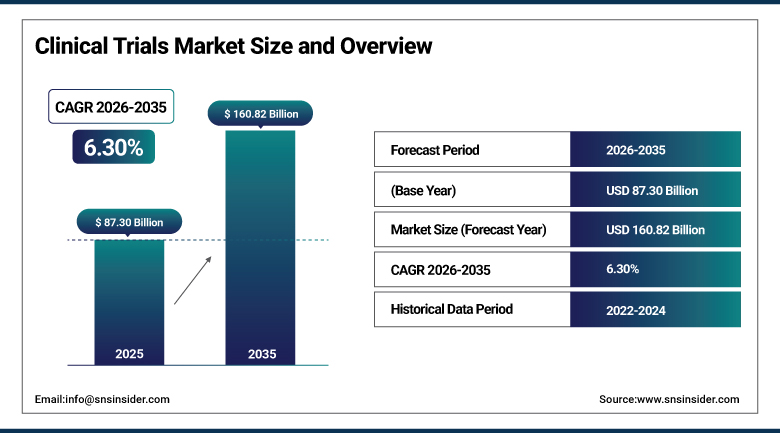
The Clinical Trials Market was valued at USD 87.30 billion in 2025 and is expected to reach USD 160.82 billion by 2035, growing at a CAGR of 6.30% from 2026–2035.
Clinical trials constitute the essential human research methodology through which new pharmaceutical compounds, biological therapies, medical devices, diagnostics, surgical procedures, behavioral interventions, and preventive strategies are evaluated for their safety, efficacy, dosing requirements, side effect profiles, and comparative effectiveness relative to existing standard-of-care treatments before regulatory agencies will consider granting marketing approval. The market encompasses the global ecosystem of services, technologies, and operational infrastructure through which over 450,000 registered clinical studies across 220 countries are designed, initiated, executed, monitored, and brought to regulatory submission including contract research organization services providing sponsor outsourcing of trial operations, site management organizations coordinating investigator site networks, clinical data management and biostatistics services transforming trial data into regulatory submission packages, patient recruitment and retention services addressing the most common cause of trial timeline delay, regulatory affairs consulting guiding sponsors through the complex multi-jurisdictional approval processes that global development programmes require, and the digital technologies including electronic data capture, electronic clinical outcome assessment, remote patient monitoring, and AI-powered trial analytics that are modernizing clinical trial conduct.
The FDA's acceptance of real-world evidence in support of regulatory submissions, the EMA's adaptive pathways programme for breakthrough therapies, and PMDA's simultaneous development programme for global applications are creating regulatory innovation pathways that accelerate the clinical development timelines of the most promising therapeutic candidates, potentially reducing the average duration and cost of pivotal clinical programmes in ways that would expand the economic accessibility of clinical development for smaller biotechnology companies.
To Get more information Clinical Trials Market - Request Free Sample Report
Clinical Trials Market Trends
-
Rapid expansion of decentralized and hybrid clinical trial models that combine remote patient monitoring, home nurse visits, local laboratory collection, telemedicine investigator consultations, and direct-to-patient drug supply shipment to reduce trial participant burden and expand geographic enrollment reach beyond the major academic medical Centre catchment areas that have historically dominated patient recruitment.
-
Accelerating AI integration across clinical trial design and operations, including machine learning-powered patient eligibility screening from electronic health records that dramatically reduces recruitment timelines, AI-assisted site selection identifying locations with optimal patient populations and operational performance track records, and natural language processing extraction of adverse event and efficacy signals from unstructured clinical notes.
-
Growing adoption of adaptive trial designs that allow pre-specified modifications to trial parameters including sample size, arm allocation ratios, dose levels, and patient population definitions based on interim analysis of accumulating data, enabling sponsors to discontinue futile programmes earlier and accelerate successful ones through seamless Phase II/III designs that compress development timelines.
-
Increasing sponsor investment in patient diversity and inclusion initiatives following FDA and EMA guidance requiring enrollment strategies that reflect the demographic diversity of the patient populations who will ultimately use approved therapies, including dedicated recruitment programmes targeting underrepresented racial, ethnic, and age groups whose historical underrepresentation in clinical trials compromises the generalizability of safety and efficacy data.
-
Expanding digital biomarker and wearable device integration in clinical trial protocols, where FDA-authorized digital health technologies including continuous glucose monitors, smartwatch-based cardiac rhythm monitoring, accelerometry-based physical function assessment, and smartphone-based cognitive testing provide more frequent, more objective, and less patient-burdensome endpoint measurements than traditional periodic clinic visit-based assessments.
U.S. Clinical Trials Market Outlook
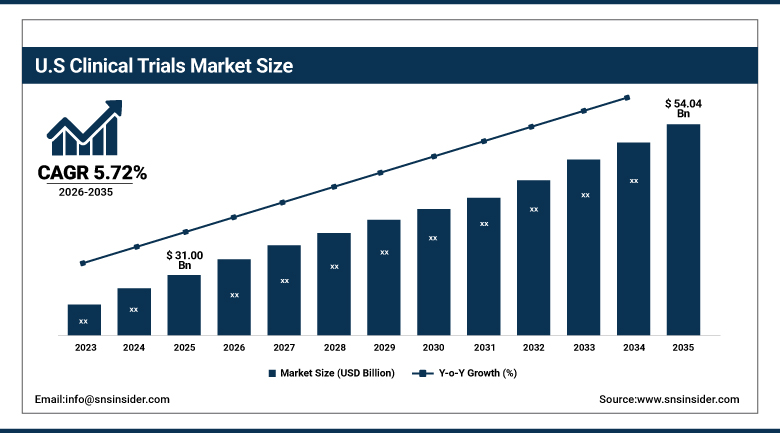
The U.S. Clinical Trials Market was valued at approximately USD 31.00 billion in 2025 and is expected to reach approximately USD 54.04 billion by 2035, growing at a CAGR of 5.72%.
The United States commands the world's largest clinical trials market through the combination of pharmaceutical and biotechnology company R&D spending that consistently exceeds USD 100 billion annually from U.S.-headquartered companies alone, the NIH's USD 45 billion annual research budget that funds a substantial academic clinical research enterprise, the most extensive investigative site network with thousands of hospitals, academic medical centers, and community physician practices participating in commercial and academic clinical research, and the FDA's regulatory science leadership whose guidance documents and pathway programmes shape global clinical development standards that U.S.-based development operations are positioned to implement most directly.
The 21st Century Cures Act's provisions for real-world evidence use in drug approvals, patient-focused drug development guidance, and the FDA's Oncology Centre of Excellence's Project Optimus initiative reforming dose optimization in cancer drug development are collectively creating a regulatory environment where clinical development programmes can be designed more efficiently, approved more rapidly for breakthrough therapies, and conducted with greater patient centricity than was possible under the regulatory frameworks that preceded these initiatives.
Clinical Trials Market Segment Analysis
-
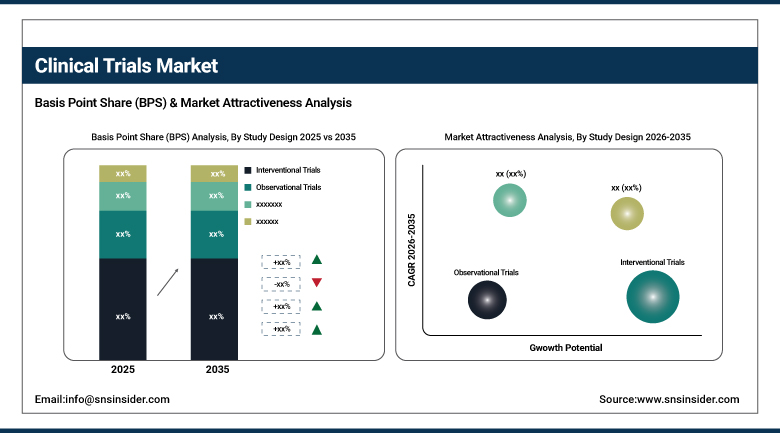
By Study Design, Interventional Trials dominated with approximately 71.29% of revenues in 2025; Observational Trials are the fastest-growing study design at a CAGR of 9.38%.
-
By Phase, Phase III held the largest proportion at approximately 53.47% in 2025; Phase II is the fastest-growing phase at a CAGR of 10.12%.
-
By Sponsor, Pharmaceutical and Biopharmaceutical Companies dominate, sponsoring over 65% of global clinical trials in 2025; CROs are the fastest-growing sponsor category through expanding outsourcing relationships with pharma companies that are progressively transferring functional responsibility for entire trial portfolios to preferred CRO partners.
-
By Service, Site Management Services dominated through supervision and compliance monitoring of over 40,000 active trial sites globally requiring consistent performance oversight; Data Management is the fastest-growing service driven by over 10,000 active trials using advanced electronic data capture and real-time analytics platforms generating exponentially growing data volumes.
-
By Therapeutic Area, Oncology dominated with over 35% of ongoing trials in 2025 as the largest and most pipeline-intensive therapeutic area driven by rising cancer incidence, breakthrough therapy designation incentives, and the convergence of immunotherapy, targeted therapy, and cell therapy innovation creating unprecedented clinical development activity across cancer indications.
By Study Design, interventional trials dominate, observational is expected to grow fastest
Interventional trials retained the dominant study design position with approximately 71.29% of the clinical trials market in 2025, as the clinical trial as an experimental intervention remains the gold standard regulatory evidence requirement for drug and device marketing approval in virtually all major regulatory jurisdictions, and the commercial imperative to bring novel therapies to market through approved regulatory pathways ensures that controlled interventional trials will remain the primary driver of pharmaceutical and biotechnology clinical development investment regardless of the growing availability of real-world evidence and observational study methodologies that supplement but cannot replace controlled trial evidence for primary efficacy demonstrations.
Observational trials are the fastest-growing study design at a CAGR of 9.38% through 2035, reflecting the growing recognition by regulators, payers, and the scientific community that controlled interventional trial populations are often insufficiently representative of the real-world patient populations who will receive approved therapies, creating demand for post-approval real-world evidence studies that characterised treatment patterns, long-term safety outcomes, comparative effectiveness versus emerging competitors, and therapeutic benefit in patient subgroups excluded from pivotal trial eligibility criteria.
By Phase, phase iii dominates, phase ii is expected to grow fastest
Phase III retained the dominant phase position with approximately 53.47% of clinical trials market revenues in 2025, as the pivotal trial phase where large-scale confirmatory evidence of therapeutic efficacy and comprehensive characterization of safety profiles must be developed to meet regulatory submission requirements naturally concentrates the highest trial expenditure through its requirements for the largest patient enrollment, longest study duration, most geographically diverse site networks, and most rigorous data monitoring and safety surveillance systems of any trial phase.
Phase II is the fastest-growing phase at a CAGR of 10.12% through 2035, as the widespread adoption of adaptive seamless Phase II/III designs that combine proof-of-concept and confirmatory development within a single protocol is attracting increasing sponsor investment into Phase II because these designs enable pivotal evidence generation to begin earlier in the development programme, compressing total development timelines by 12 to 24 months for programmes where Phase II biomarker data supports an adaptive transition to Phase III enrollment. Biomarker-driven precision medicine development approaches are also expanding Phase II investment as the identification of specific patient subpopulations defined by molecular biomarkers requires dedicated proof-of-concept studies in enriched populations before Phase III program initiation.
Regional Analysis
|
Region |
Major Country |
Share within Region, 2025 (%) |
|---|---|---|
|
North America |
United States |
86.3% |
|
Europe |
United Kingdom |
23.4% |
|
Asia Pacific |
China |
38.7% |
|
Middle East & Africa |
Israel |
24.6% |
|
Latin America |
Brazil |
44.3% |
North America Clinical Trials Market Insights
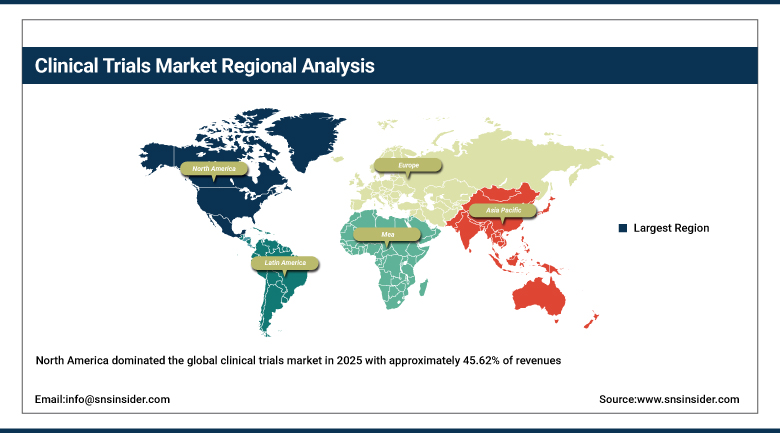
North America dominated the global clinical trials market in 2025 with approximately 45.62% of revenues, with the United States accounting for approximately 86.3% of North American revenues as the world's largest single clinical trials market by both trial volume and development expenditure. The region's dominance reflects its extraordinary concentration of pharmaceutical and biotechnology R&D investment, the world's most extensive investigative site network spanning academic medical centers, community hospitals, and specialty physician practices across thousands of trial-active sites, the FDA's regulatory science leadership that positions U.S. operations at the Centre of global development strategy, and the NIH-funded academic research enterprise that generates substantial non-commercial clinical trials activity complementing the commercially sponsored programme.
Get Customized Report as per Your Business Requirement - Enquiry Now
Europe Clinical Trials Market Insights
Europe is a major and scientifically sophisticated clinical trials market characterised by the EMA's centralized marketing authorization procedure that provides simultaneous regulatory access across 27 EU member states plus EEA countries through a single trial programme, a well-developed investigative site network in the United Kingdom, Germany, France, Spain, the Netherlands, and Eastern European countries including Poland, Czech Republic, and Romania whose lower operational costs relative to Western Europe are attracting growing shares of Phase II and Phase III trial enrollment. The United Kingdom accounts for approximately 23.4% of European clinical trial revenues, leveraging its world-class academic medical centers including the network of NIHR Clinical Research Facilities, its efficient clinical trial regulatory and ethics approval processes through the MHRA and HRA joint review service, and its comprehensive NHS electronic health record infrastructure that supports efficient patient identification and recruitment for disease-specific trial programs.
Asia Pacific Clinical Trials Market Insights
Asia Pacific is the fastest-growing clinical trials regional market with a CAGR of 7.26%, driven by the progressive shift of pharmaceutical company clinical development activity toward Asian patient populations to access the large, treatment-naive patient pools available in China, India, South Korea, Japan, and ASEAN countries, the competitive cost advantage of Asian clinical research with trial operating costs 30 to 50% below equivalent U.S. or European operations in comparable quality sites, government-backed R&D incentives accelerating trial approval timelines, and the maturing investigative site quality across the region that has progressed from supplementary to primary data contributor status in global pivotal trials. China accounts for approximately 38.7% of Asia Pacific clinical trial revenues through the extraordinary expansion of domestic pharmaceutical and biotechnology R&D investment, the NMPA's streamlined Investigational New Drug and marketing approval review timelines that now approach the speed of FDA review for priority designations, and the regulatory requirement for local bridging studies for many therapeutic categories that sustains a substantial China-specific clinical development activity base.
MEA & Latin America Clinical Trials Market Insights
The Middle East and Africa and Latin America represent growing clinical trials markets where pharmaceutical company interest in expanding geographic diversity of pivotal trial enrollment, cost competitive site operations, and access to patient populations with specific disease characteristics relevant to global drug development programmes are driving investment in clinical research infrastructure. Israel leads MEA clinical trial revenues at approximately 24.6% of regional revenues through its world-class academic medical research institutions, sophisticated medical ethics and regulatory infrastructure, and the extraordinary concentration of health data and biobanks that make Israel one of the most scientifically productive clinical research environments globally relative to its population size.
Market Dynamics
Growth Drivers: Unprecedented biopharmaceutical pipeline density across oncology, rare diseases, and immunology combined with decentralized trial model adoption expanding patient accessibility and digital technology integration improving operational efficiency
The primary structural growth drivers for the clinical trials market are the extraordinary and sustained investment in biopharmaceutical R&D that has produced an unprecedented global pipeline of over 6,500 compounds in clinical development, representing a historical peak in the density of therapeutic candidates requiring clinical evaluation resources that collectively generate sustained demand for every category of clinical trial service from site management and patient recruitment through data management and regulatory affairs. The oncology pipeline alone contains over 2,300 compounds in clinical evaluation across every cancer type, with immunotherapy, targeted therapy, antibody-drug conjugate, and cell and gene therapy modalities each generating substantial clinical development service demand from the specialist site networks, biomarker laboratory services, and complex data management capabilities that these novel modalities require. The decentralized trial model's demonstrated success in improving patient recruitment rates, reducing dropout through reduced visit burden, and expanding geographic enrollment reach is creating clinical development competitive advantage for sponsors who can execute hybrid and virtual trial designs effectively.
Restraints: Patient recruitment difficulty representing the single most common cause of trial delay and cost overrun, high operational costs limiting trial accessibility for academic and small biotechnology sponsors, and increasing protocol complexity extending study conduct timelines beyond projected duration
A significant restraint on the clinical trials market is the persistent patient recruitment challenge that represents the most commonly cited cause of clinical trial timeline delay and cost escalation, where approximately 85% of clinical trials fail to meet their original recruitment timelines and over 30% require protocol-mandated enrollment extensions that add months to trial duration and tens of millions of dollars to budget overruns in large Phase III programmes. The increasing specificity of patient eligibility criteria as precision medicine development approaches target molecularly defined patient subpopulations creates compounding recruitment challenges, as each additional eligibility biomarker reduces the eligible patient fraction while simultaneously requiring specialized screening infrastructure that many sites lack and must develop at sponsor cost during trial initiation.
Opportunities: AI-powered patient recruitment and site selection dramatically reducing enrollment timelines, decentralized trial model expansion enabling rural and underrepresented population participation, and real-world evidence integration creating new study design and regulatory submission opportunities
AI-powered clinical trial recruitment platforms that systematically analyses electronic health records across hospital networks and insurance claims databases to identify eligible patients for open trials, automatically notify their treating physicians of relevant study opportunities, and provide patient-facing educational materials and direct-to-participant recruitment outreach through digital channels represent the most operationally impactful innovation opportunity in the clinical trial market, as companies including Medidata, Veeva, Elligo Health Research, and Antidote have demonstrated that AI-enhanced recruitment can reduce average time to first patient enrolled by 40 to 60% in programmes where electronic health record integration is feasible. The decentralized trial model's expansion into patient populations in rural and geographically remote communities who have historically been excluded from clinical research participation by the impracticality of frequent major academic Centre visits is creating access to patient populations whose disease management patterns, genetic backgrounds, and treatment histories may provide scientifically valuable diversity that improves the representativeness of clinical evidence generated from more geographically concentrated conventional trial designs.
Recent Developments:
-
September 2025: IQVIA launched its AI-enabled Clinical Trial Financial Suite across more than 200 geographies to streamline budgeting, payment processing, and financial reconciliation across complex multi-country clinical trial programmes, addressing one of the most operationally burdensome aspects of global trial management that has historically been a significant source of site payment delays affecting investigator site relationships.
-
February 2025: Labcorp expanded its Global Trial Connect platform with enhanced capabilities for improving study delivery coordination between biopharmaceutical sponsors and investigative sites, incorporating new site performance analytics, automated milestone tracking, and direct communication tools designed to reduce administrative burden for participating investigators.
-
2025: Medpace Holdings reported sustained growth in its full-service CRO operations across oncology and rare disease therapeutic areas, expanding its integrated clinical pharmacology laboratory and medical writing capabilities to support the complete clinical development programme outsourcing relationships that mid-sized biotechnology companies increasingly prefer over functional service model arrangements with multiple specialist vendors.
Clinical Trials Market Key Players are:
-
ICON plc
-
Labcorp Drug Development
-
IQVIA Holdings Inc.
-
Syneos Health
-
Medpace Holdings Inc.
-
PPD (Thermo Fisher Scientific)
-
Charles River Laboratories International Inc.
-
Covance Inc.
-
Parexel International Corporation
-
PRA Health Sciences (ICON)
-
Novatek International
-
Worldwide Clinical Trials
-
Pharmaceutical Product Development (PPD)
-
Theorem Clinical Trials
-
Clinipace Worldwide
-
Premier Research Group
-
CMIC Holdings Co. Ltd.
-
Fortrea Holdings Inc.
-
Translational Drug Development
-
Rho Inc.
Clinical Trials Market Report Scope
| Report Attributes | Details |
|---|---|
| Market Size in 2025 | USD 87.30 Billion |
| Market Size by 2035 | USD 160.82 Billion |
| CAGR | CAGR of 6.30% From 2026 to 2035 |
| Base Year | 2025 |
| Forecast Period | 2026-2035 |
| Historical Data | 2022-2024 |
| Report Scope & Coverage | Market Size, Segments Analysis, Competitive Landscape, Regional Analysis, DROC & SWOT Analysis, Forecast Outlook |
| Key Segments | • By Study Design (Interventional Trials, Observational Trials, Expanded Access Trials) • By Phase (Phase I, Phase II, Phase III, Phase IV) • By Therapeutic Area (Oncology, Cardiovascular, Neurology, Infectious Diseases, Rare Diseases, Others) • By Sponsor (Pharmaceutical & Biopharmaceutical Companies, Contract Research Organizations, Academic & Research Institutions, Government) • By Service (Site Management, Data Management, Regulatory Affairs, Patient Recruitment, Others) |
| Regional Analysis/Coverage | North America (US, Canada), Europe (Germany, UK, France, Italy, Spain, Russia, Poland, Rest of Europe), Asia Pacific (China, India, Japan, South Korea, Australia, ASEAN Countries, Rest of Asia Pacific), Middle East & Africa (UAE, Saudi Arabia, Qatar, South Africa, Rest of Middle East & Africa), Latin America (Brazil, Argentina, Mexico, Colombia, Rest of Latin America). |
| Company Profiles | ICON plc, Labcorp Drug Development, IQVIA Holdings Inc., Syneos Health, Medpace Holdings Inc., PPD (Thermo Fisher Scientific), Charles River Laboratories International Inc., Covance Inc., Parexel International Corporation, PRA Health Sciences (ICON), Novatek International, Worldwide Clinical Trials, Pharmaceutical Product Development (PPD), Theorem Clinical Trials, Clinipace Worldwide, Premier Research Group, CMIC Holdings Co. Ltd., Fortrea Holdings Inc., Translational Drug Development, and Rho Inc. |
Frequently Asked Questions
North America dominated with approximately 45.62% of revenues in 2025.
Interventional Trials dominated with approximately 71.29% of revenues in 2025.
Unprecedented biopharmaceutical pipeline density across oncology, rare disease, and immunology combined with decentralized trial model adoption expanding patient accessibility and AI integration dramatically improving operational efficiency across all phases of clinical development.
The Clinical Trials Market was valued at USD 87.30 billion in 2025.
The Clinical Trials Market is expected to grow at a CAGR of 6.30% from 2026 to 2035.
