
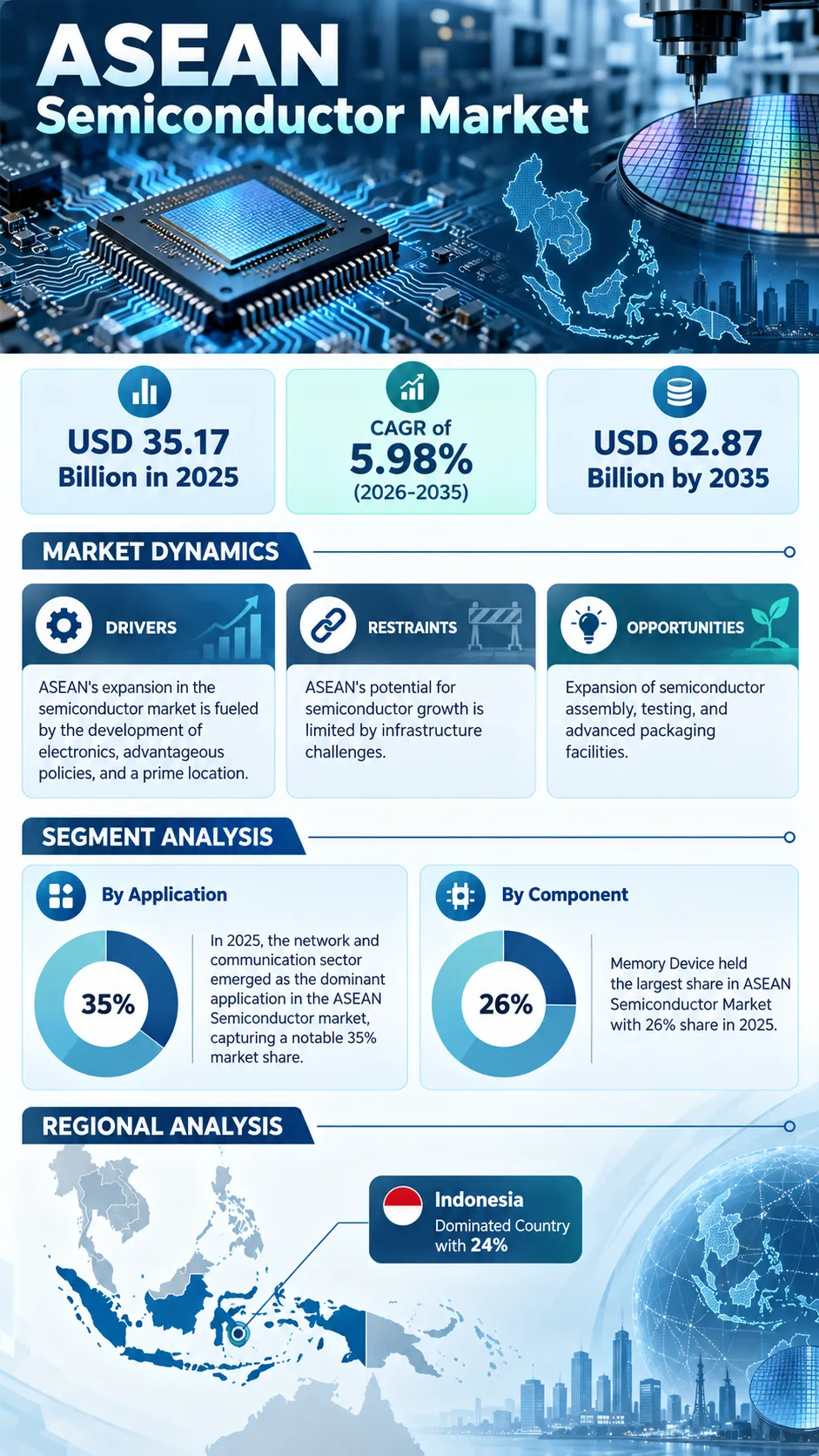
The global ASEAN Semiconductor market is expected to experience continuous growth due to Southeast Asia emerging as a dominant region in terms of manufacturing, semiconductors, and testing. “According to a recent study by SNS Insider, the global ASEAN Semiconductor Market size valued at USD 35.17 billion in 2025, is anticipated to grow to USD 62.87 billion by 2035, registering a CAGR of 5.98% over the 2026–2035 forecast period.”
The growing consumption of electronics products and their increasing digitization together with the rising need for computing and communication technologies is making investments in semiconductors a popular trend in the region. The governments have also been developing certain policies to attract foreign investors, develop local expertise, and increase involvement in the value chains of semiconductors.
The geographic position of the region between the Asian manufacturing giants is adding to its attractiveness as well. More and more companies are viewing the ASEAN countries as complementary production locations.
To Get Detailed Insights on the ASEAN Semiconductor Market – Request a Sample Report
Supply Chain Diversification Creates New Growth Opportunities
The semiconductor sector within ASEAN countries continues to benefit from the increase in the push for the distribution of production and backend activities into multiple locations. Singapore and Malaysia continue to be centers for semiconductor production, packing, equipment, and research, while Vietnam, Thailand, Philippines, and Indonesia continue to increase their presence in electronics manufacture and semiconductor-related operations.
Foreign investments have become a second growth catalyst for this sector. The governments have been encouraging the establishment of industrial parks, training initiatives, digital infrastructure, and technological cooperation in order to create the right conditions for future growth of semiconductors. The growth in electronics and batteries within Indonesia has opened new areas as well.
However, reliable electricity, transportation capacity, logistics efficiency, and skilled labor availability remain important priorities for countries seeking to attract more sophisticated semiconductor operations.
Key Market Insights Highlight Shifting Demand Patterns
By application, Network and Communication Sector will hold the maximum revenue share in the ASEAN Semiconductor Market, estimated to account for 35%. Growing adoption of mobile phones, network equipment, computers, and communication devices is driving the demand for sophisticated semiconductors. The data processing market is witnessing a rise due to the growing need for computing and storage infrastructure.
Based on component, Memory solutions are projected to contribute 26% of market revenue by 2025. The requirement for DRAM and NAND technologies is growing in areas like data centers, consumer electronics, and automotive technology. Artificial intelligence and cloud computing applications will drive up the demand for performance memory technologies, and memory will be required for the functioning of ADAS and infotainment features in vehicles.
Electronics Manufacturing and Digital Infrastructure Strengthen Regional Demand
With an increase in electronics manufacturing activities, the customers of semiconductor manufacturers are increasing in ASEAN. Increasing investments in data centers, telecommunications infrastructure, automated manufacturing plants, electric vehicles, and consumer electronics are increasing the demand for semiconductor products across a variety of applications.
This region will also continue down the path towards greater integration of its semiconductor design, fabrication, testing, and packaging abilities. The development of its human capital through government-university-industry collaborations will become even more significant in developing the skilled engineers that are necessary in advanced semiconductor operations.
Regional Markets Demonstrate Uneven but Strong Growth Potential
Indonesia is projected to keep its place as the leading country in the ASEAN Semiconductor Market and earn around 24% share of the total revenues of the region in 2025. This growth is driven by its industrial capacity, technological investment, geography, and backing by the government for development of semiconductors.
Vietnam is forecasted to have the fastest growing economy until 2035 because of fast growing manufacturing of electronics and foreign direct investment. The emergence of Vietnam as a major exporter of electronics is making multinational companies set up their manufacturing and technology businesses there.
Malaysia and Singapore remain key sources of semiconductor infrastructure, especially in advanced manufacturing, testing, packaging, equipment, and research. On the other hand, the Philippines and Thailand have benefited from investments made for supply chain diversification initiatives.
Industry Participants Focus on Technology and Manufacturing Excellence
Competitive rivalry in the semiconductor industry of ASEAN is very high due to the expansion of manufacturing, research, and regional supply chains undertaken by global technology corporations. Players in the industry are focused on new and innovative technologies of semiconductors, energy efficiency, automation in the manufacturing process, packaging capabilities, and sustainable manufacturing processes.
Top companies operating in the ASEAN Semiconductor Market include Intel Corporation, Qualcomm, Samsung Electronics, SK hynix, Taiwan Semiconductor Manufacturing Company, Texas Instruments, Toshiba Corporation, ROHM Semiconductor, Renesas Electronics Corporation, Micron Technology, NVIDIA Corporation, NXP Semiconductors N.V., Advanced Micro Devices (AMD), Broadcom Inc., STMicroelectronics, Infineon Technologies, MediaTek Inc., Analog Devices, Inc., Marvell Technology, and GlobalFoundries.
An SNS Insider analyst Santosh Bhul commented, “ASEAN is becoming increasingly important to the global semiconductor supply chain as manufacturers pursue geographic diversification, stronger production resilience, and access to expanding electronics markets. Continued investment in infrastructure, advanced manufacturing capabilities, and skilled semiconductor talent will be critical for the region to move further up the technology value chain.”
About the Author

Get in touch




