
Semiconductor Design Market Report Scope and Overview:
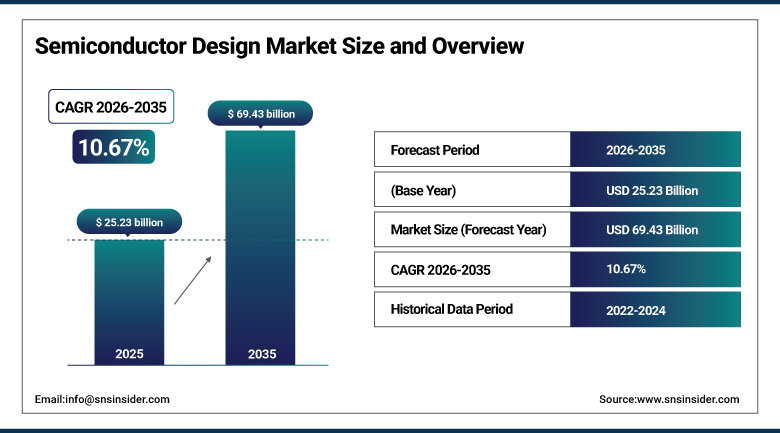
The Semiconductor Design Market size was valued at USD 25.23 Billion in 2025 and is projected to reach USD 69.43 Billion by 2035, registering a CAGR of 10.67% from 2026 to 2035.
The Semiconductor Design Market is powering the global electronics ecosystem by providing the intellectual property, engineering expertise, and electronic design automation tools required to architect logic, memory, and analog integrated circuits for every major computing and connectivity application. The market is characterized by rising demand for AI accelerator and high-performance computing chip design, growing adoption of generative AI-assisted electronic design automation tools, increased design activity around 5G and automotive electronics, and expanding investment in domestic chip design capability across multiple governments. Significant growth is being witnessed in data center processors, communication infrastructure, and automotive semiconductor design, considering that fabless companies and integrated device manufacturers are investing heavily in increasingly complex, AI-optimized chip architectures.
NVIDIA unveiled its Blackwell Ultra GPU architecture throughout 2025, engineered to deliver expanded AI training and inference performance for hyperscale data center customers deploying next-generation large language models.
To Get more information Semiconductor Design Market - Request Free Sample Report
Semiconductor Design Market Trends
-
Growing adoption of generative AI-assisted electronic design automation tools continues accelerating chip design cycles for complex SoC projects.
-
Rising demand for AI accelerator and high-performance computing chip design continues driving sustained engineering investment across leading fabless companies.
-
Increasing government investment in domestic chip design capability continues reshaping the geography of semiconductor design talent and intellectual property.
-
Expanding adoption of chiplet-based, heterogeneous system architectures continues complementing traditional monolithic semiconductor design methodologies.
-
Growing automotive demand for advanced driver assistance and centralized compute chipsets continues broadening semiconductor design activity beyond mobile and computing.
U.S. Semiconductor Design Market Size Outlook
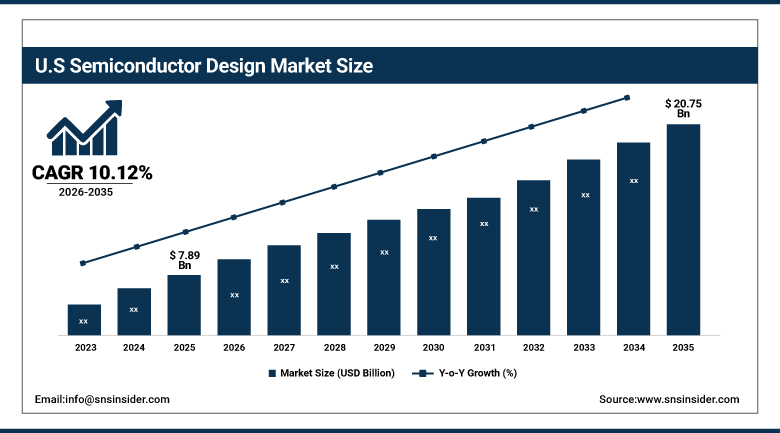
The U.S. Semiconductor Design Market was valued at approximately USD 7.89 Billion in 2025 and is projected to reach approximately USD 20.75 Billion by 2035, registering a CAGR of approximately 10.12% from 2026 to 2035.
The United States demand continued to be shaped by a deep concentration of leading fabless semiconductor companies, sustained hyperscaler investment in AI accelerator development, and strong federal support for domestic chip design and manufacturing capability under the CHIPS and Science Act. Rising deployment of generative AI-assisted design tools by domestic engineering teams continued reinforcing the country's position as both the largest and most innovation-driven semiconductor design market tracked in this report. Growing adoption across data center processors, automotive electronics, and defense computing applications added further layers of sustained domestic demand well beyond the technology's original personal computing use case.
Qualcomm introduced its Snapdragon 8 Elite Gen 5 mobile platform throughout 2025, designed to bring on-device generative AI processing to flagship smartphones with improved power efficiency for U.S. and global customers.
Semiconductor Design Market Segment Analysis
-
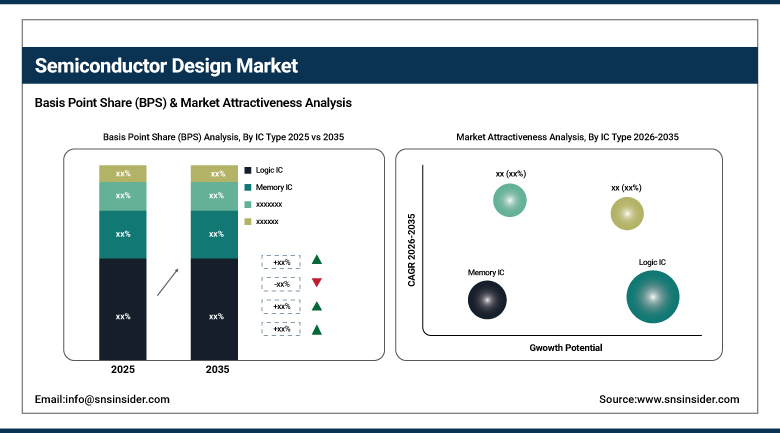
By IC Type, Logic IC dominated the Semiconductor Design Market with a 70.00% share in 2025, while Memory IC is the fastest-growing IC type segment with a CAGR of 12.35% from 2026–2035.
-
By Design Type, Semi-Custom Design (ASIC) dominated the market with a 54.00% share in 2025, while Full-Custom Design is the fastest-growing design type segment with a CAGR of 11.82% from 2026–2035.
-
By Application, Communication dominated the market with a 44.00% share in 2025, while Computing & Data Processing is the fastest-growing application segment with a CAGR of 12.76% from 2026–2035.
-
By End-User, Fabless Semiconductor Companies dominated the market with a 67.00% share in 2025, while Integrated Device Manufacturers (IDMs) are the fastest-growing end-user segment with a CAGR of 11.54% from 2026–2035.
By IC Type, Logic IC Leads While Memory IC Grows Fastest
The Logic IC segment dominated the Semiconductor Design Market in 2025 owing to sustained demand for processors, controllers, and application-specific integrated circuits across virtually every major computing and connectivity application. Chip designers continue prioritizing logic IC development given its central role in AI accelerators, smartphones, and computing platforms. Continued growth in processor complexity and AI accelerator design activity has kept logic IC the largest single revenue contributor within the overall semiconductor design landscape tracked in this report.
The Memory IC segment is the fastest growing in the Semiconductor Design Market owing to surging demand for high-bandwidth memory and advanced DRAM architectures required by generative AI training and inference workloads. Chip designers increasingly prioritize memory-centric design innovation to address bandwidth bottlenecks in AI accelerator platforms. Growing hyperscaler investment in AI infrastructure continues accelerating design activity around next-generation memory architectures across leading semiconductor companies.
By Design Type, Semi-Custom Design Dominates While Full-Custom Records Fastest Growth
The Semi-Custom Design (ASIC) segment dominated the Semiconductor Design Market in 2025 due to its favorable balance of development cost, time-to-market, and performance optimization for a broad range of consumer, communication, and industrial applications. Fabless companies continue favoring semi-custom methodologies to reduce design risk while achieving application-specific performance gains. Widespread availability of mature ASIC design tools and intellectual property libraries has further reinforced this segment’s dominant position across the market.
The Full-Custom Design segment is the fastest growing in the Semiconductor Design Market owing to rising demand for maximum performance and power efficiency among AI accelerator and high-performance computing chip designers unwilling to compromise on cutting-edge specifications. Leading hyperscalers and chip designers increasingly invest in full-custom methodologies to differentiate proprietary AI silicon from merchant alternatives. Growing hyperscaler custom silicon investment continues accelerating growth in full-custom design activity across the industry.
By Application, Communication Leads While Computing & Data Processing Grows Fastest
The Communication segment dominated the Semiconductor Design Market in 2025 due to sustained global demand for smartphones, networking equipment, and 5G infrastructure requiring increasingly sophisticated chip designs. Chip designers continue prioritizing communication-focused design activity given the segment’s scale and recurring device and infrastructure refresh cycles. Sustained global smartphone and telecommunications infrastructure investment has kept this application the largest overall revenue contributor across the market.
The Computing & Data Processing segment is the fastest growing in the Semiconductor Design Market owing to surging demand for AI accelerator, GPU, and cloud server processor design driven by generative AI training and inference workloads. Hyperscale cloud operators and chip designers increasingly prioritize computing-focused design investment to support increasingly large AI model deployments. Accelerating global AI infrastructure investment continues driving sustained growth in computing-oriented semiconductor design demand.
By End-User, Fabless Companies Lead While IDMs Grow Fastest
The Fabless Semiconductor Companies segment dominated the Semiconductor Design Market in 2025 due to the continued dominance of the fabless business model across smartphone, computing, and AI chip design, which relies on third-party foundries for manufacturing while focusing internal resources on design innovation. Fabless companies have built the deepest design expertise and largest customer bases across virtually every major chip category. Sustained fabless industry growth has kept this end-user segment the largest overall contributor to market revenue.
The Integrated Device Manufacturers (IDMs) segment is the fastest growing in the Semiconductor Design Market owing to rising in-house design investment among companies seeking to capture greater value from AI accelerator and memory architecture innovation rather than relying solely on external design partnerships. Growing IDM investment in proprietary AI silicon design capability continues accelerating this segment’s expansion. Rising customer interest in vertically integrated design-to-manufacturing capability continues driving accelerated growth in IDM-led design activity.
Regional Analysis
|
Region |
Major Country |
Share within Region, 2025 (%) |
|---|---|---|
|
North America |
United States |
92.00% |
|
Europe |
Germany |
22.50% |
|
Asia Pacific |
China |
36.00% |
|
Middle East and Africa |
Israel |
29.50% |
|
Latin America |
Brazil |
27.50% |
North America Semiconductor Design Market Insights
North America held the second-largest share of the Semiconductor Design Market in 2025. A deep concentration of leading fabless semiconductor companies, sustained hyperscaler investment in AI accelerator development, and strong federal support for domestic chip design capability under the CHIPS and Science Act continued reinforcing the region’s dominant position. Growing deployment of generative AI-assisted design tools across data center, automotive, and AI accelerator design further strengthened North America’s standing as both the largest and one of the most innovation-driven markets tracked in this report, with continued hyperscaler capital expenditure expected to sustain regional demand through the forecast period.
The United States anchored by its deep concentration of leading fabless semiconductor companies and substantial hyperscaler AI infrastructure investment. Canada added further regional demand through its own growing semiconductor design ecosystem, and that combined strength kept the continent the largest addressable market for semiconductor design activity through the forecast period, with continued AI accelerator design investment expected to sustain regional demand well into the next decade.
Europe Semiconductor Design Market Insights
Europe held a meaningful share of global revenue, supported by strong automotive and industrial semiconductor demand and continued expansion of domestic chip design capability across the region’s major economies. Regulatory momentum around European Chips Act-backed semiconductor investment continued shaping regional development priorities without meaningfully slowing commercialization across the continent, while sustained automotive electrification investment kept the region among the more resilient semiconductor design markets tracked in this report.
Germany led demand of European revenue, supported by its substantial automotive and industrial semiconductor design base. The UK and France contributed substantial additional demand, and continued European investment in automotive electrification and defense electronics should keep regional demand for semiconductor design technology climbing steadily through the forecast period.
Asia Pacific Semiconductor Design Market Insights
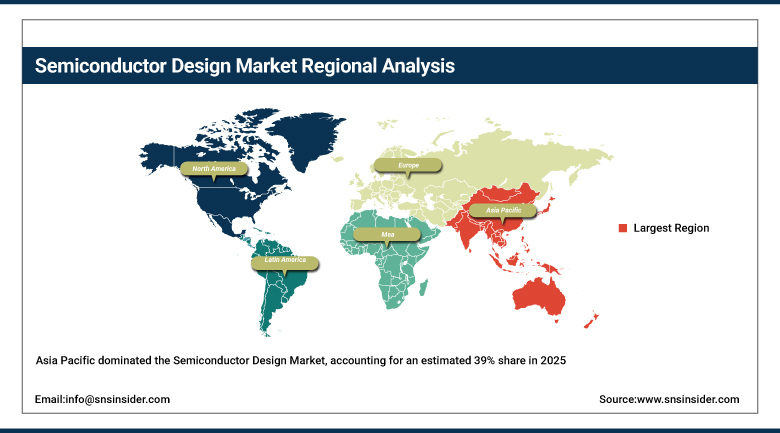
Asia Pacific dominated the Semiconductor Design Market, accounting for an estimated 39% share in 2025, and is expected to remain the fastest-growing region during the forecast period. Growth is supported by a well-established semiconductor ecosystem across China, Taiwan, South Korea, Japan, and India. Rising investments in artificial intelligence chips, advanced semiconductor design, automotive electronics, telecommunications, and consumer electronics are further strengthening regional demand. Additionally, expanding fabrication capabilities, increasing R&D activities, government initiatives, and growing adoption of advanced technologies are expected to reinforce Asia Pacific’s position in the global semiconductor design landscape.
China led the pack, supported by its rapidly expanding domestic fabless semiconductor design ecosystem and substantial government investment in indigenous chip design capability. Taiwan and South Korea contributed meaningful additional demand, with China’s expanding fabless design sector and Taiwan’s advanced foundry-adjacent design ecosystem both reinforcing the region’s position as the fastest-growing semiconductor design market tracked in this report, while Japan and India added further steady regional contribution.
Get Customized Report as per Your Business Requirement - Enquiry Now
MEA and Latin America Semiconductor Design Market Insights
The Middle East and Africa and Latin America both showed steady growth, driven by expanding technology sector diversification investment, growing government focus on domestic semiconductor design capability, and rising demand for locally developed chip design expertise across both regions. As these markets continued building out modern technology sector infrastructure, semiconductor design capability proved a genuinely valuable way to capture value-added economic activity that had traditionally been concentrated in more established design hubs.
Israel led Middle East and Africa demand, supported by the country’s established semiconductor design presence and substantial multinational research and development investment. Saudi Arabia and the UAE contributed further demand through their own technology sector diversification initiatives. In Latin America, Brazil accounted for the largest share of regional revenue, with growing semiconductor design and technology investment continuing to anchor regional demand for chip design capability.
Market Dynamics
Growth Drivers: Rising AI Accelerator Design Investment and Generative AI-Assisted EDA Adoption
The industry is driven by rising demand for AI accelerator and high-performance computing chip design, growing adoption of generative AI-assisted electronic design automation tools, increasing design activity around 5G and automotive electronics, and expanding government-backed investment in domestic chip design capability. As hyperscalers, automakers, and governments increasingly prioritize proprietary, differentiated silicon, the need for expanded design engineering capacity continues driving sustained investment across the semiconductor design industry.
Rising AI data center buildout continues reinforcing this driver, as generative AI training and inference workloads require increasingly sophisticated, custom-optimized chip architectures. Growing automotive demand for advanced driver assistance and centralized compute chipsets continues defining a further layer of sustained demand, and that combination of AI infrastructure investment and automotive semiconductor content growth is exactly what keeps overall demand climbing at such a steady, sustained pace.
Restraints: Rising Design Complexity and Verification Cost Escalation
The escalating engineering effort and verification cost required to design and validate increasingly complex system-on-chip architectures continues posing a genuine restraint on faster market-wide expansion, particularly for smaller fabless companies without the design resources that established semiconductor companies can commit. That complexity has kept advanced chip design activity concentrated among a comparatively small number of well-resourced design teams.
Ongoing shortage of skilled semiconductor design engineers continues posing a further restraint, as demand for chip architects, verification engineers, and physical design specialists has outpaced available talent supply across multiple regions. Regulatory export control complexity around advanced design tools and intellectual property in certain jurisdictions keeps some cross-border design collaboration scenarios more administratively complicated than domestic design activity ever required.
Opportunities: Generative AI-Assisted Design Automation and Domestic Design Capability Expansion
Rising adoption of generative AI-assisted electronic design automation tools represents a genuinely significant opportunity, as chip designers increasingly leverage AI-powered tools to accelerate design cycles and reduce engineering costs. Vendors positioned early in AI-assisted design automation stand to capture meaningful share as this capability continues expanding from traditional manual design workflows into broader AI-augmented engineering practices.
Expanding government investment in domestic chip design capability offers a second substantial opportunity, as nations increasingly prioritize semiconductor design sovereignty alongside manufacturing capability. Vendors positioned early in geographically diversified, policy-supported design talent development stand to capture meaningful share as customers continue diversifying design activity away from historically concentrated design hubs.
Recent Developments:
-
2026: Cadence launched its ChipStack AI Super Agent, an agentic AI solution designed to automate semiconductor design and verification workflows, with reported productivity improvements of up to 10×.
-
2026: Cadence expanded its collaboration with TSMC to support AI-driven semiconductor design across TSMC’s N3, N2, A16, and A14 process technologies, including agent-ready digital and analog design flows.
-
2024: Synopsys enhanced its Synopsys.ai full-stack EDA suite with generative AI-assisted chip design automation to accelerate design cycles for complex SoC projects.
Semiconductor Design Companies are:
-
Qualcomm Incorporated
-
Broadcom Inc.
-
Advanced Micro Devices, Inc. (AMD)
-
MediaTek Inc.
-
Intel Corporation
-
Samsung Electronics Co., Ltd.
-
STMicroelectronics N.V.
-
Infineon Technologies AG
-
NXP Semiconductors N.V.
-
Analog Devices, Inc.
-
Renesas Electronics Corporation
-
Microchip Technology Incorporated
-
onsemi (ON Semiconductor Corporation)
-
Sony Semiconductor Solutions Corporation
-
Marvell Technology, Inc.
-
Realtek Semiconductor Corp.
-
Synopsys, Inc.
-
Cadence Design Systems, Inc.
Semiconductor Design Market Report Scope:
| Report Attributes | Details |
|---|---|
| Market Size in 2025 | USD 25.23 Billion |
| Market Size by 2035 | USD 69.43 Billion |
| CAGR | CAGR of 10.67% From 2026 to 2035 |
| Base Year | 2025 |
| Forecast Period | 2026-2035 |
| Historical Data | 2022-2024 |
| Report Scope & Coverage | Market Size, Segments Analysis, Competitive Landscape, Regional Analysis, DROC & SWOT Analysis, Forecast Outlook |
| Key Segments | • By IC Type (Logic IC, Memory IC, Analog IC, Discrete & Others), • By Design Type (Full-Custom Design, Semi-Custom Design (ASIC), Programmable Logic (FPGA/PLD)) • By Application (Communication, Computing & Data Processing, Consumer Electronics, Automotive, Industrial & Others) • By End-User (Fabless Semiconductor Companies, Integrated Device Manufacturers (IDMs), Foundries) |
| Regional Analysis/Coverage | North America (US, Canada), Europe (Germany, UK, France, Italy, Spain, Russia, Poland, Rest of Europe), Asia Pacific (China, India, Japan, South Korea, Australia, ASEAN Countries, Rest of Asia Pacific), Middle East & Africa (UAE, Saudi Arabia, Qatar, South Africa, Rest of Middle East & Africa), Latin America (Brazil, Argentina, Mexico, Colombia, Rest of Latin America). |
| Company Profiles | NVIDIA Corporation, Qualcomm Incorporated, Broadcom Inc., Advanced Micro Devices, Inc. (AMD), MediaTek Inc., Intel Corporation, Samsung Electronics Co., Ltd., Texas Instruments Incorporated, STMicroelectronics N.V., Infineon Technologies AG, NXP Semiconductors N.V., Analog Devices, Inc., Renesas Electronics Corporation, Microchip Technology Incorporated, onsemi (ON Semiconductor Corporation), Sony Semiconductor Solutions Corporation, Marvell Technology, Inc., Realtek Semiconductor Corp., Synopsys, Inc., Cadence Design Systems, Inc. |

Frequently Asked Questions
The major growth factor is rising AI accelerator design investment, growing adoption of generative AI-assisted design automation tools, and expanding government-backed domestic design capability investment.
The Logic IC segment dominated the Semiconductor Design Market by IC type, representing the largest share of revenue in 2025.
Asia Pacific dominated the Semiconductor Design Market in 2025, holding an estimated 39% share of total global market revenue.
Key opportunities include AI chips, advanced process nodes, chiplet architectures, custom silicon, and growing demand for high-performance computing.
