
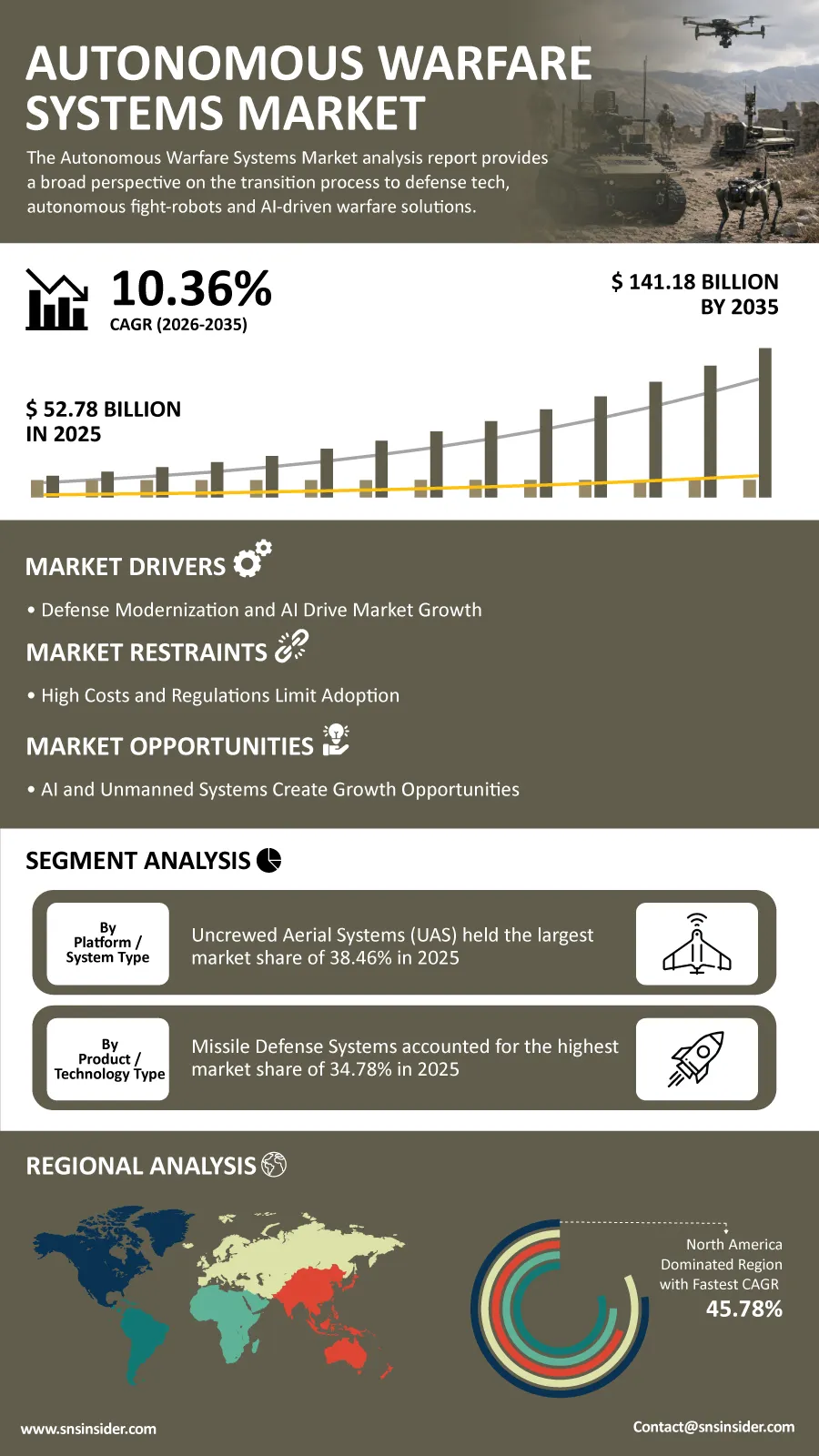
The global Autonomous Warfare Systems Market is expected to witness substantial expansion over the next decade as defense organizations accelerate investments in artificial intelligence, autonomous combat technologies, and next-generation military modernization initiatives. “According to a recent study by SNS Insider, the global Autonomous Warfare Systems Market size valued at USD 52.78 billion in 2025, is anticipated to grow to USD 141.18 billion by 2035, registering a CAGR of 10.36% over the 2026–2035 forecast period.”
Governments in both developed and developing countries are now putting more emphasis on smart defense technologies that can improve their ability to operate without putting their soldiers at risk. Modern use of automated aerial, ground, naval, and even space vehicles is changing modern defense strategies, allowing military forces to perform a range of missions effectively.
In view of the changing nature of geopolitical conflicts, military organizations are increasingly procuring autonomous technologies that would help them perform multi-domain missions. Alongside the progress made in decision-making through artificial intelligence, robotics, sensors, and communications, this is presenting significant opportunities for defense technology manufacturers around the world.
To Get Detailed Insights on the Autonomous Warfare Systems Market – Request a Sample Report
Defense Modernization Programs Accelerate Adoption of Autonomous Technologies
Modernization of the military continues to be one of the most significant catalysts for the future of autonomous warfare systems. More nations are increasing their defense budget for the acquisition of technologies that can help increase situational awareness, precision, and agility in complex combat situations.
The application of artificial intelligence is crucial in modern defense planning for the use of autonomous systems in analyzing the battlefield, making decisions about tactics, and carrying out missions with little human involvement. This is enhancing defense readiness and improving the time taken in executing critical operations.
Collaboration among governments, defense contractors, and technology developers will continue to spur innovation. Investments in navigation, intelligent sensors, cybersecurity, and mission system are likely to propel the industry into the future.
Key Market Insights Highlight Evolving Defense Priorities
Uncrewed Aerial Systems (UAS) emerged as the largest category within platforms, holding 38.46% share of global market revenue in 2025 due to increasing usage of such systems in intelligence, surveillance, reconnaissance, and tactical operations in contemporary armies.
The Space platform segment is expected to witness the highest CAGR of 13.56% over the forecast period owing to growing government investments in autonomous satellite systems, space surveillance, and strategic defense systems.
Amongst types of technology, Missile Defense System contributed 34.78% of the overall market revenue in 2025, as such systems are being increasingly employed in strategic asset protection and fast threat interception. On the other hand, Sensor & Navigation Systems are estimated to show the highest CAGR of 11.34%, owing to growing demand for advanced targeting and autonomous navigation capabilities.
In terms of level of autonomy, Human-in-the-Loop (HITL) system captured 42.31% of the total market revenue in 2025, while Human-on-the-Loop system is anticipated to emerge as the fastest-growing segment in the upcoming years as militaries aim at gaining operational autonomy with supervisory control.
Based on applications, Surveillance & Reconnaissance (ISR) held a 29.87% market revenue share in 2025, while Target Acquisition & Tracking segment is expected to demonstrate the highest growth in 2035 due to development in AI-based targeting technologies.
AI Integration and Multi-Domain Operations Reshape Military Capabilities
Contemporary defense entities are quickly evolving into interconnected battlefields that are able to incorporate autonomous systems for all types of air, land, maritime, cyber, and space theaters of war. Such technologies will help commanders to gain better situational awareness as well as improve coordination within multiple domains of operation.
The increasing use of unmanned platforms will ensure more efficient conduct of risky missions since there will be no need for soldiers and officers to operate in dangerous conditions. Moreover, advancements in the areas of autonomous navigation, edge computing, secure communication, and intelligent mission planning will allow defense units to carry out more complicated missions.
The evolution of the needs of the armed forces makes producers develop scalable autonomous systems that will work well under different operational conditions.
North America Held 45.78% Market Share in 2025; Europe Projected to Register an 11.95% CAGR Through 2035
In 2025, North America held a market share of 45.78%, aided by large defense budgets, high-quality military R&D facilities, and wide-scale use of AI-powered autonomous systems. The dominant market share of North America is being further boosted by continuous financial support and modernization programs.
Europe is expected to demonstrate the highest regional growth rate during 2025-2035, growing at a CAGR of 11.95%. Higher investment in defense modernization programs, cooperation in military programs, and increasing development of autonomous technologies are key factors behind the expansion of Europe's market.
Meanwhile, Asia Pacific continues strengthening its strategic defense capabilities through increased procurement of unmanned platforms, indigenous technology development, and growing investments in robotics, artificial intelligence, and advanced sensing technologies.
Industry Participants Intensify Innovation Across Autonomous Defense Technologies
The competitive landscape remains highly dynamic due to the investments that major defense contractors keep making into artificial intelligence, autonomous missions, robotics, and battlefield technologies. The focus is on innovations that increase mission effectiveness and operational resilience while meeting the changing needs of national security.
Key companies operating in the global Autonomous Warfare Systems Market include Lockheed Martin Corporation, Northrop Grumman Corporation, Raytheon Technologies Corporation, BAE Systems plc, General Dynamics Corporation, Thales Group, Leonardo S.p.A., Elbit Systems Ltd., Boeing Defense, Space & Security, Saab AB, L3Harris Technologies, Israel Aerospace Industries (IAI), Rheinmetall AG, Kongsberg Gruppen ASA, QinetiQ Group plc, Textron Inc., Kratos Defense & Security Solutions, AeroVironment, Inc., Turkish Aerospace Industries (TAI), and Hanwha Defense.
An SNS Insider analyst Santosh Bhul commented, "Growing defense modernization initiatives, rapid advances in artificial intelligence, and expanding adoption of multi-domain autonomous platforms are fundamentally reshaping military operations worldwide. Organizations investing in intelligent autonomy, secure mission systems, and interoperable defense technologies are expected to remain well positioned as global demand for next-generation autonomous warfare capabilities continues to rise."
About the Author

Get in touch




