
According to the latest SNS Insider Precision Machining Market report, the global market is entering into a phase of steady expansion as aerospace, automotive, medical and electronics manufacturers are placing more orders for tight-tolerance parts. Multi-axis machines, automated production cells and digital sourcing platforms are changing the way machined components are made, quoted and delivered.
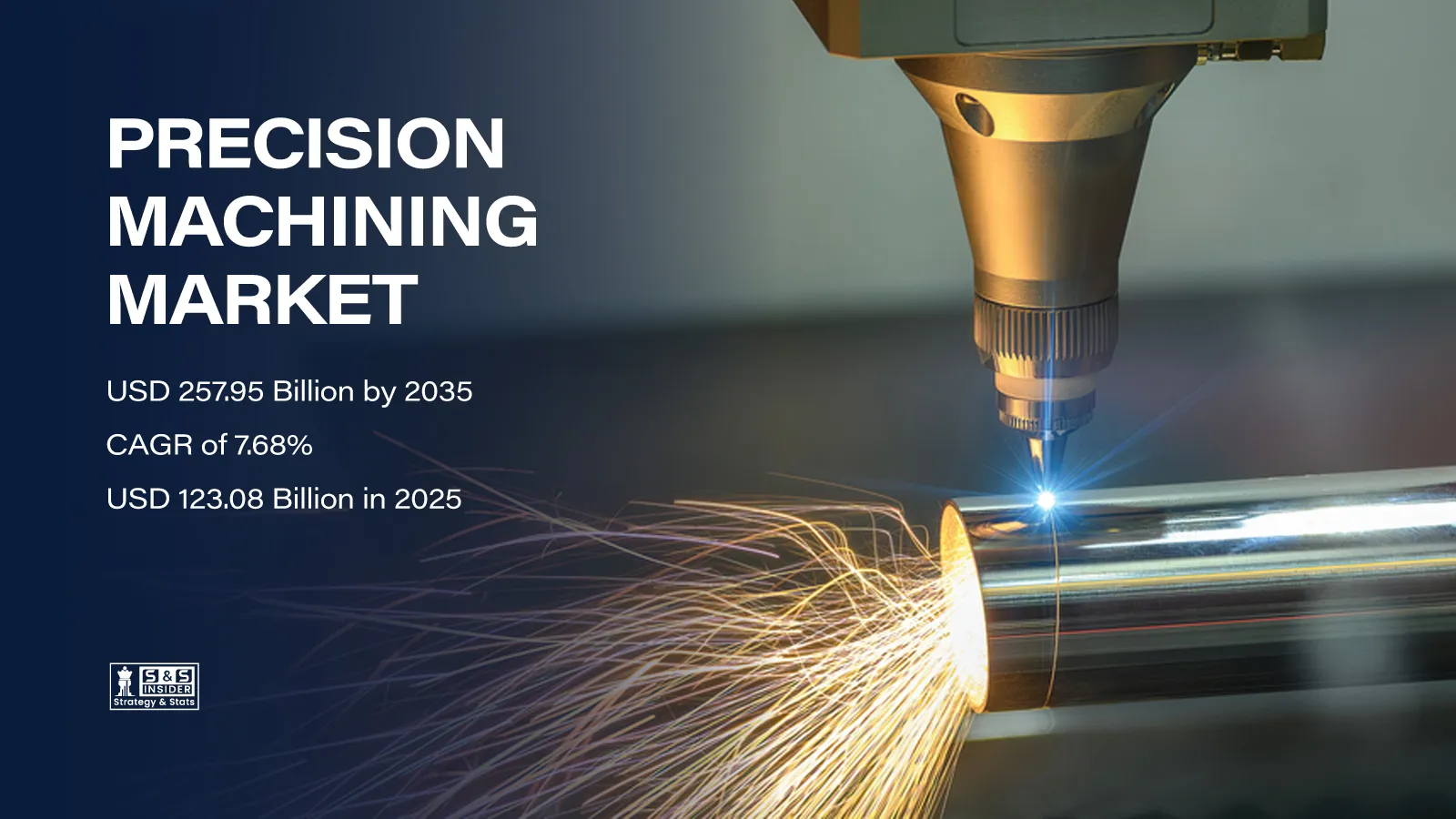
The global precision machining market was valued at USD 123.08 Billion in 2025 and is estimated to reach USD 132.53 Billion in 2026, expanding to USD 257.95 Billion by 2035 at a CAGR of 7.68% during 2026–2035.
Demand is supported by the need for safety-critical parts that must hold tolerances measured in microns. Aircraft, vehicles, medical devices, and semiconductor equipment all depend on qualified machining suppliers, and long approval cycles keep these buyer-supplier relationships stable.
Automation is also gaining ground. Pallet systems, robotic loading and in-process probing allow shops to run shifts unattended, helping them cope with labor shortages and fill orders faster.
The Asia Pacific continues to be the largest regional market and has the greatest growth potential, driven by electric vehicle, electronics and semiconductor equipment manufacturing.
To Get Detailed Insights on the Precision Machining Market – Request a Sample Report
Demand Drivers and Constraints
Primary Demand Drivers
-
Precision component demand: Aerospace, automotive, and medical manufacturers continue to place long-term orders for parts that require tight tolerances and qualified suppliers.
-
CNC automation and AI adoption: Five-axis machining, robotic loading, and software that adjusts feeds, speeds, and tool wear allow shops to raise output without adding skilled labor.
-
Electric vehicle and semiconductor production: Electric drivetrains, battery enclosures, vacuum chambers, and wafer handling parts all require precisely machined components.
-
Reshoring and Industry 4.0 investment: Manufacturers are moving critical part production closer to final assembly and adopting connected machines and digital twins.
-
Defense modernization and medical outsourcing: Defense programs and medical device brands rely on certified machinists, and long qualification periods give suppliers strong revenue visibility.
Potential Growth Constraints
-
Shortage of skilled machinists and programmers.
-
High capital cost of multi-axis and automated equipment.
-
Volatile material prices and trade tariffs.
-
Partial substitution by metal additive manufacturing in selected applications.
Demand Structure by Operation
CNC Machining (2025 Market Share: 72.46%)
In 2025, CNC machining occupied the largest share of the global precision machining market at 72.46%, followed by manual and cam-driven methods. Computer controlled mills and lathes give repeatable tolerances on prototypes, short runs and high volume production. Stored programs cut down on setup time and scrap and enable one operator to supervise multiple machines. Most aerospace, automotive, and medical suppliers qualify their parts on this equipment, which keeps the installed base large and demand steady through 2035.
Current trend: Wider use of multi-axis and mill-turn platforms that finish complex parts in a single setup.
Major trends: Unattended production, robotic part loading, in-process probing, and machine monitoring.
Swiss-Type CNC Machining (Forecast CAGR: 9.54%)
Swiss-type CNC machining is projected to register the fastest growth at a CAGR of 9.54% during 2026–2035. Sliding-headstock lathes hold slender parts close to the cutting tool, which makes them well suited to small, long, and intricate components such as bone screws, connectors, and fuel injection pins. Growth in medical devices, electronics, and miniaturized assemblies is raising demand for this equipment. Shops that add Swiss capacity gain access to high-value, high-volume work that conventional lathes cannot handle efficiently.
Current trend: Rising investment in Swiss-type equipment by medical and electronics suppliers.
Major trends: Micro machining, miniaturized components, and bar-fed automated production.
Demand Structure by Machine Type
Milling (2025 Market Share: 31.20%)
Milling dominated the machine type segment with a 31.20% share in 2025. Mills cut flat, contoured, and pocketed features across nearly every part family, from structural brackets and engine blocks to medical implants and mold bases. Five-axis machines have widened the range of shapes that can be finished in one setup, and machining centers remain the most widely installed equipment in contract shops. This breadth of use keeps milling ahead of turning, grinding, and other methods.
Current trend: Continued adoption of five-axis vertical and horizontal machining centers.
Major trends: Multi-axis milling, automated pallet systems, and adaptive toolpaths.
Laser Machining (Forecast CAGR: 9.48%)
Laser machining is forecast to expand at a CAGR of 9.48% through 2035. Ultrafast lasers cut, drill, and texture hard materials, thin foils, and brittle ceramics without mechanical contact, which suits stents, semiconductor parts, battery electrodes, and fine electronic components. Falling system prices, better beam control, and integration with multi-axis motion are widening adoption among manufacturers who need feature sizes that traditional cutting tools cannot reach.
Current trend: Growing use of laser systems for hard, thin, and brittle materials.
Major trends: Ultrafast lasers, non-contact micro machining, and laser integration with multi-axis motion.
Demand Structure by Material
Metals (2025 Market Share: 76.35%)
Metals held 76.35% of the market in 2025. Aluminum, steel, stainless steel, titanium, and nickel alloys provide the strength, heat tolerance, and wear resistance required by engines, airframes, implants, and industrial equipment. Machining remains the most dependable way to bring cast, forged, or bar stock to final tolerance, and customers hold decades of qualification data on metal parts. These factors keep metals well ahead of plastics and composites across all major end uses.
Current trend: Stable demand for aluminum, stainless steel, and titanium parts.
Major trends: Difficult-alloy machining, tool life optimization, and in-process quality checks.
Composites (Forecast CAGR: 8.58%)
The highest material CAGR through 2035 is anticipated to be seen for composites, at 8.58%. Carbon fiber and glass fiber composites are used more and more in aerospace components, electric vehicles, drones and sports equipment because they reduce weight without compromising rigidity. These materials require special tools and dust control for cutting, drilling and finishing, and suppliers who have that capability are winning orders as designers shy away from metal parts.
Current trend: Rising use of lightweight composite parts in aerospace and electric vehicles.
Major trends: Specialized composite tooling, dust management systems, and finishing automation.
Demand Structure by End Use
Automotive (2025 Market Share: 28.34%)
Automotive accounted for 28.34% of global market revenue in 2025, making it the largest end-use category. Every vehicle contains many machined parts, including engine and transmission components, braking and steering parts, fuel injection items, and a growing number of electric drivetrain housings. High production volumes and tight cost targets make automotive the largest consumer of machining hours, and tier-one suppliers run dedicated high-speed lines to serve it.
Current trend: Steady demand from conventional vehicle programs alongside electric drivetrain components.
Major trends: High-speed production lines, electric vehicle housings, and cost-focused automation.
Aerospace and Defense (Forecast CAGR: 8.94%)
Aerospace and defense is anticipated to record the highest end-use CAGR of 8.94% during 2026–2035. The demand for titanium and nickel alloys is growing for structural fittings, landing gear components, turbine parts and weapon housings as commercial aircraft backlogs, increased engine output and defense programs increase. Certification requirements often restrict competition, which can lead to better pricing and longer contract terms for eligible suppliers.
Current trend: Growing order books at certified aerospace and defense machining suppliers.
Major trends: Titanium and nickel alloy machining, defense capacity expansion, and certified finishing and assembly services.
Key Market Participants
The precision machining market is fragmented, with job shops, vertically integrated contract manufacturers, digital manufacturing platforms, and captive machining units inside large manufacturers.
Key participants include Protolabs, Xometry, Tecomet, Cretex Medical, Cadrex, Fathom Digital Manufacturing, Star Rapid, Micron Manufacturing, NN Inc., Pro-Dex, Oberg Industries, and Sypris Technologies.
Competition centers on tolerance capability, quality certifications, lead time, and material expertise. Recent activity includes Pro-Dex completing its acquisition of Advanced Precision Machining in February 2026, Tecomet completing its merger with Orchid in May 2026, and Fathom Digital Manufacturing announcing three acquisitions in October 2026 to strengthen its aerospace and defense offering.
Regional Market Dynamics
Asia Pacific (2025 Market Share: 41.58%)
Asia Pacific led the global precision machining market with a 41.58% share in 2025 and is expected to grow fastest, at a CAGR of 8.52% through 2035. China anchors regional demand through its large base of machining shops serving vehicles, electronics, and industrial equipment. Japan, South Korea, India, and Taiwan add depth through advanced equipment, semiconductor supply chains, and growing automotive and aerospace programs. Rising wages are pushing manufacturers toward automation, while government incentives support industrial investment.
Direction: Continued leadership and the fastest regional expansion, supported by electronics, electric vehicle, and semiconductor equipment production.
Europe (2025 Market Share: 24.46%)
Europe held 24.46% of the market in 2025, fueled by its long engineering tradition and strong aerospace, automotive, medical, and industrial machinery sectors. Germany is the largest regional demand leader, followed by Italy, France, the United Kingdom, Switzerland and Poland. The region is known for precision work and Swiss-type machining for medical and watch parts. There remain issues with energy costs and skilled labor shortages but defense spending, aircraft production and medical device exports continue to bolster orders.
Direction: Steady growth driven by automation, digital quality control, and demand for traceable aerospace and medical parts.
North America (2025 Market Share: 22.14%)
North America held 22.14% of the global market in 2025. The United States contributes USD 22.45 Billion and is projected to grow at a CAGR of 7.43% during 2026–2035. Region has a strong customer base in aerospace, defense, medical device and energy equipment industries that require qualified machining suppliers. Reshoring, defense spending and commercial aircraft production are providing a steady stream of orders, and labor shortages and metal tariffs are driving shops toward automation and higher-value work.
Direction: Consistent expansion supported by reshoring programs, defense budgets, and aircraft manufacturing.
Overall, the precision machining market is positioned for steady expansion through 2035, with competitive success increasingly determined by automation capability, quality certification, material expertise, and speed of delivery
About the Author

Get in touch




