
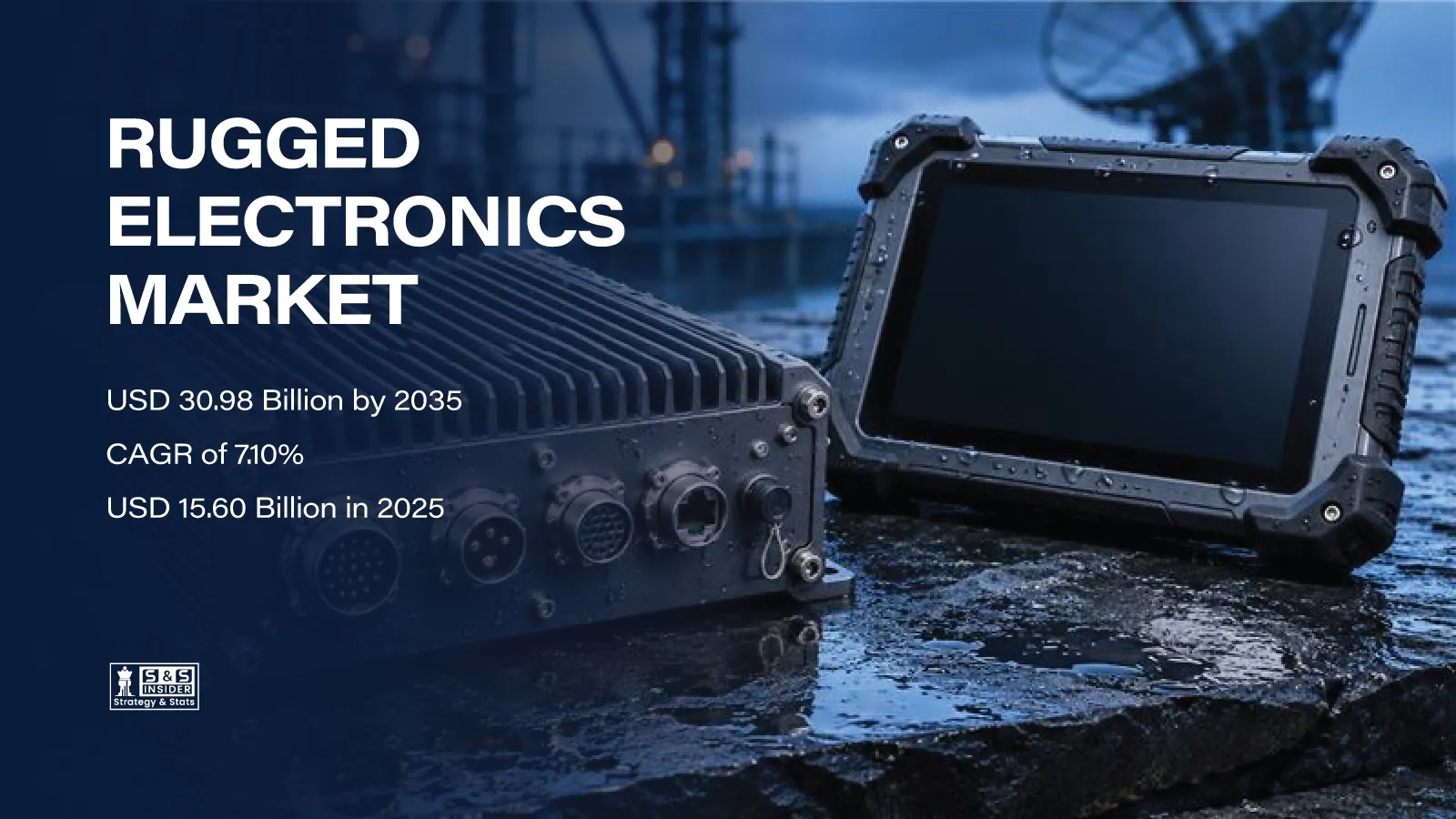
The latest SNS Insider Rugged Electronics Market report shows that the global market is entering a period of steady growth, as armed forces, utilities, logistics companies and industrial operators replace aging field equipment. Increasing defense budgets, the digitization of warehouses and field service, and the emergence of devices with on-board AI are changing the way organizations acquire rugged tablets, laptops, handhelds and embedded computers.
Rugged electronics are tablets, laptops, handhelds, wearables, displays, and embedded computers built to withstand drops, dust, water, vibration, and extreme temperatures. Procurement is shifting toward connected, AI-capable models that let field workers run translation, image inspection, and documentation tools without a network connection.
North America is still the biggest regional market, and the strongest growth potential is in Asia Pacific due to defense investment and factory automation.
To Get Detailed Insights on the Rugged Electronics Market – Request a Sample Report
Primary Demand Drivers
-
Defense budget expansion: Armed forces are buying rugged computers, displays, and communications gear for vehicles, aircraft, ships, and command posts, and contracts often run for many years.
-
European rearmament programs: Higher defense spending and joint procurement financing are increasing orders from regional suppliers and defense primes.
-
Logistics, manufacturing, and field-service digitization: Warehouses, ports, and production lines use rugged handhelds, vehicle terminals, and panel computers to reduce downtime and failure rates.
-
On-device AI refresh cycle: Tablets and laptops with neural processing units are encouraging organizations to replace older Windows 10 machines.
-
Connectivity upgrades: 5G, Wi-Fi 7, and private cellular networks require compatible devices across ports, mines, and campuses.
-
Hazardous-area and public safety demand: Oil and gas sites, chemical plants, and emergency services need certified devices for demanding environments.
Potential Growth Constraints
-
High acquisition cost compared with consumer-grade devices.
-
Integration complexity and limited availability of specialist skills.
-
Budget delays and dependence on government appropriations.
-
Currency swings and tariff pressure on imported components.
Demand Structure by Form Factor
Portable Devices (2025 Market Share: 46.80%)
In 2025, portable devices were the leading form factor, accounting for 46.80% of the global rugged electronics market. The most common products brought into the field are tablets, laptops, handhelds and smartphones. They are carried by large numbers of workers in utilities, logistics companies, the police and the armed services. Replacement demand is steady due to three-to-five year refresh cycles and additional volume from spare units and accessories. Public agency framework agreements are expected to sustain purchasing momentum through 2035.
Current trend: Steady replacement of field devices across public agencies and enterprises.
Major trends: AI-ready tablets and laptops, 5G and eSIM connectivity, and accessory bundles.
Wearable Devices (Forecast CAGR: 9.84%)
The fastest growth is expected to be observed in wearable devices with a CAGR of 9.84% during 2026–2035. Rugged scanners, smart glasses and body-mounted cameras free up workers’ hands in warehousing, maintenance and emergency response. Vendors are adding voice, scanning and augmented reality features that boost productivity in situations where a tablet would be a hindrance. And lighter designs, mounts and charging solutions make wearables easier to use across multiple shifts and locations.
Current trend: Growing use of hands-free devices in logistics and field maintenance.
Major trends: Voice and AR functions, lighter form factors, and multi-shift charging solutions.
Demand Structure by Ruggedness Level
Fully Rugged (2025 Market Share: 46.20%)
Fully rugged devices had a share of 46.20% in 2025. They are dust- and water-sealed, tested for repeated drops and wide temperature ranges, and built to military standards. This is great for defense, utilities, mining, and public safety users. Buyers know it’s worth the higher cost, as one failure in the field could shut down operations or put staff at risk. Accidental damage warranties also help justify the price with finance departments.
Current trend: Fully rugged models remaining the preferred specification for mission-critical work.
Major trends: MIL-STD-810H compliance, IP-rated sealing, and accidental damage warranties.
Ultra-Rugged (Forecast CAGR: 8.92%)
Ultra-rugged devices are expected to grow at a CAGR of 8.92% till 2035. These products operate in extreme shock, vibration and temperature environments and include hazardous area products, avionics and in-vehicle displays. They are designated for defense modernization, offshore energy and space-based uses. “Suppliers market their test results to standards such as MIL-STD-810H and ATEX to win contracts, and the high specs justify premium pricing.
Major trends: Hazardous-area certifications, avionics-grade displays, and published test results.
Demand Structure by Operating System
Windows (2025 Market Share: 51.60%)
Windows accounted for 51.60% of the market in 2025. Windows is still used on rugged laptops, tablets and vehicle computers for enterprise and engineering applications. IT departments love the mature device management and patching tools. The platform has long been relied upon by defense and utility organizations. The newer AI-capable models also employ neural processing units, which supports the next refresh cycle.
Current trend: Continued preference for Windows in enterprise, defense, and utility fleets.
Major trends: Copilot+ devices, neural processing units, and large-scale device management.
Android (Forecast CAGR: 8.74%)
The Android CAGR is projected to be 8.74% between 2026-2035. Android is powering handhelds, wearables and small tablets in warehouses, retail and delivery because of its lower cost, wide app support and simple integration with scanners and cellular modems. More demanding enterprise users can now look at the platform, as vendors guaranty several years of security updates.
Major trends: Longer security update commitments, scanner integration, and compact device designs.
Demand Structure by End Use
Military and Defense (2025 Market Share: 38.40%)
Military and defense accounted for 38.40% of the rugged electronics market in 2025. The armed forces buy ruggedized computers, displays, servers and handhelds for vehicles, aircraft, ships and soldier systems and demand that they meet military environmental and electromagnetic standards. Rising defense budgets in North America, Europe and Asia are supporting programs that will last several years. Recurring revenue after delivery from spares, repairs and upgrade.
Current trend: Multi-year defense programs supporting steady orders.
Major trends: Modular open architectures, shorter refresh cycles, and bundled repair services.
Construction (Forecast CAGR: 9.36%)
Construction is projected to experience the highest end-use growth with a CAGR of 9.36% through 2035. With infrastructure spending on the rise, contractors are deploying rugged tablets and handhelds for site surveys, design reviews, machine control and safety reporting. BIM and drones need equipment that can cope with dust, rain and vibration.” Site managers use mapping software to keep track of progress.
Major trends: BIM integration, drone-based surveying, and mobile mapping tools.
Key Market Participants
The rugged electronics market is moderately concentrated, with device makers, embedded computing suppliers, and defense technology companies competing across different segments.
Key participants include Panasonic, Getac, Zebra Technologies, Dell Technologies, Samsung Electronics, Honeywell, Juniper Systems, Durabook, Kyocera, Crystal Group, MilDef Group, Curtiss-Wright, and Mercury Systems.
Competition increasingly centers on durability, certifications, battery life, support services, and integration with enterprise software. Recent launches include Panasonic's TOUGHBOOK 56 modular laptop, Getac's G140 Copilot+ tablet, Zebra's TC501 and TC701 AI-enabled handhelds, and Dell's Pro Rugged 10 and 12 tablets.
Regional Market Dynamics
North America (2025 Market Share: 40.20%)
North America dominated the global rugged electronics market with a 40.20% share in 2025. The United States is the biggest driver of regional demand, backed by the world’s biggest defense budget and a large base of utilities, public safety agencies and logistics companies. The U.S. market was valued at USD 5.34 Billion in 2025 and is expected to grow at a CAGR of 6.50%. Canada’s contributions are in terms of resource industries and defense and planned increases in defense spending will support this.
Direction: Continued market leadership supported by defense procurement and bulk purchasing by public agencies.
Europe (2025 Market Share: 28.60%)
In 2025, Europe represented 28.60% of the market with Germany leading the region with United Kingdom, France and Italy following. The NATO allies have committed to increase spending on defense and related security issues to 5.00% of GDP by 2035 . An EU regulation provides up to EUR 150 Billion in loans for joint defense purchases . Buyers like suppliers that have local production and security clearances.
Direction: Steady expansion driven by rearmament programs and industrial demand.
Asia Pacific (Forecast CAGR: 8.80%)
Asia Pacific region is expected to witness the fastest regional growth with a CAGR of 8.80% through 2035, and to account for 22.80% share by 2025. China leads regional demand, Japan is second, India third, South Korea fourth and Australia fifth. Japan has approved a defense budget of over JPY 9 Trillion for fiscal 2026, India has approved proposals worth around INR 2.38 Trillion. Demand for panel computers and handhelds comes from factories in China, Taiwan and South Korea.
Direction: Fastest regional expansion supported by defense modernization and factory automation.
Overall, the rugged electronics market is positioned for steady expansion through 2035, with competitive success increasingly determined by durability, certification depth, AI readiness, and integration with enterprise and defense systems
About the Author

Get in touch




