
Unmanned Aerial Systems (UAS) Camera Market Report Scope & Overview:
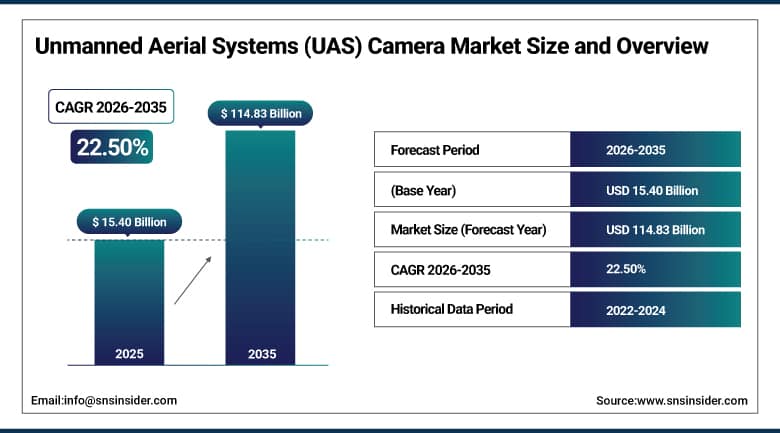
The Unmanned Aerial Systems (UAS) Camera Market was valued at USD 15.40 billion in 2025 and is expected to reach USD 114.83 billion by 2035, growing at a CAGR of 22.50% from 2026–2035.
The market of unmanned aerial systems (UAS) cameras is experiencing robust growth owing to fast development of defense ISR modernization projects, growing use of unmanned aerial vehicles (UAVs) for surveillance purposes in border protection, and growing adoption of aerial imagery services with high resolution in commercial industries like infrastructure monitoring, crop inspection, and disaster management. Increased use of advanced electro-optical/infrared (EO/IR) sensors, thermal cameras, LiDAR mappers, and artificial intelligence-enabled vision analytics is revolutionizing situational awareness and mission performance.’
In March 2025, multiple defense modernization programs across North America and Europe expanded procurement of next-generation UAV payload systems featuring AI-assisted target recognition, multi-sensor fusion (EO/IR + LiDAR), and extended-range real-time video transmission capabilities, strengthening ISR and battlefield intelligence networks.
To Get More Information On Unmanned Aerial Systems (UAS) Camera Market - Request Free Sample Report
Unmanned Aerial Systems (UAS) Camera Market Trends
-
Rising adoption of EO/IR, thermal, and LiDAR multi-sensor payloads is improving UAV imaging precision.
-
Increasing integration of AI-based vision systems is enhancing real-time target detection and tracking.
-
Growing demand for UAV-based ISR and surveillance is driving high-resolution camera deployment.
-
Expansion of edge computing in UAV payloads is reducing latency and improving onboard analytics.
-
Rising use of UAVs in mapping, agriculture, and infrastructure inspection is boosting market demand.
-
Increasing adoption of thermal and infrared cameras is strengthening night and low-visibility operations.
-
Growing shift toward modular and lightweight camera systems is improving UAV mission flexibility.
U.S. Unmanned Aerial Systems (UAS) Camera Market
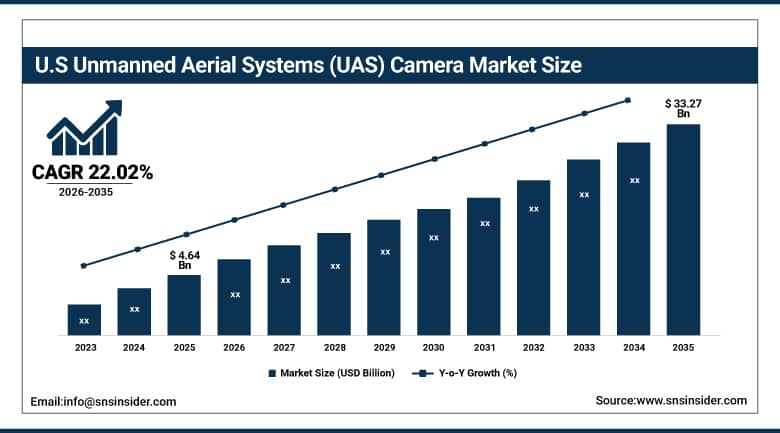
The U.S. unmanned aerial systems (UAS) camera market was valued at USD 4.64 billion in 2025 and is expected to reach USD 33.27 billion by 2035, growing at a CAGR of 22.02% from 2026–2035.
The United States takes the lead in the worldwide market of UAS camera technologies because of its superiority in the implementation of military defense ISR initiatives, UAV payload development, and the significant number of imaging and drone manufacturers like Teledyne FLIR, L3Harris Technologies, Lockheed Martin, and Skydio. Government projects that aim at developing autonomous surveillance cameras of the future and increased procurement of AI-based EO/IR and thermal payloads for surveillance purposes on battlefields and borders will only solidify the market dominance of the USA.
In 2025, U.S. defense agencies expanded procurement contracts for next-generation UAV payload systems incorporating AI-based target recognition, long-range thermal imaging, and real-time multi-stream data fusion capabilities to enhance ISR effectiveness in complex mission environments.
Unmanned Aerial Systems (UAS) Camera Market Segment Analysis
-
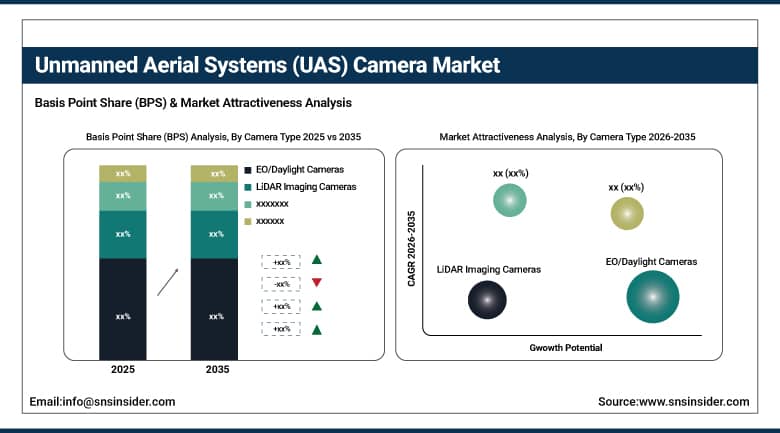
By Camera Type: EO/daylight cameras dominated the camera market with 42.56% share in 2025; lidar imaging cameras fastest growing CAGR.
- By Platform: rotary-wing UAS dominated the camera market with 38.29% share in 2025; hybrid VTOL UAS fastest growing CAGR.
- By Application: intelligence, surveillance & reconnaissance (ISR) dominated the camera market with 34.45% share in 2025; precision agriculture fastest growing CAGR.
- By End User: defense & military dominated the camera market with 40.46% share in 2025; commercial enterprises fastest growing CAGR
By Camera Type, EO/Daylight Cameras segment dominates the unmanned aerial systems (UAS) camera market, lidar imaging cameras expected to grow fastest
EO/Daylight Cameras segment maintained its dominant position in the unmanned aerial systems (UAS) camera Market, accounting for 42.56% of total revenue in 2025. The leadership that drives this technology results from its broad application in defense ISR operations, border patrol duties, and even commercial uses involving imaging through the visible light portion of the spectrum.
LiDAR Imaging Cameras segment is projected to record the highest CAGR from 2026 to 2035. The fast-paced growth is a result of rising needs for high-quality 3D map making, terrain modeling, and infrastructure assessment solutions, as well as a growing application in autonomous navigation systems and geospatial intelligence systems.
By Platform, rotary-wing UAS segment dominates the unmanned aerial systems (UAS) camera market, hybrid VTOL UAS expected to grow fastest
Rotary-Wing UAS segment held the largest share of 38.29% in 2025 for the unmanned aerial systems (UAS) camera market, supported by strong adoption in short-range surveillance, rapid deployment missions, and flexible hovering capabilities essential for ISR and inspection operations.
Hybrid VTOL UAS segment is expected to register the highest CAGR from 2026 to 2035. The growth will be fueled by high demands for extended endurance missions in conjunction with vertical takeoff capabilities, which make them very ideal for large area surveillance and reconnaissance missions.
By Application, intelligence, surveillance & reconnaissance (ISR) segment dominates the unmanned aerial systems (UAS) camera market, precision agriculture expected to grow fastest
ISR segment dominated the unmanned aerial systems (UAS) Camera Market with a 34.45% share in 2025, This is due to the wide adoption of unmanned aerial vehicle imaging solutions in military intelligence operations and border security initiatives. This submarket will benefit from the continuous development of capabilities in the fusion of electro-optical and infrared sensors, real-time data transfer, and AI-based target recognition.
Precision Agriculture segment is projected to grow at the highest CAGR from 2026 to 2035, supported by increasing adoption of UAV imaging for crop monitoring, soil analysis, yield optimization, and resource management, particularly in large-scale farming economies and agri-tech modernization initiatives.
By End User, defense & military segment dominates the unmanned aerial systems (UAS) Camera Market, commercial enterprises expected to grow fastest
Defense & Military segment maintained the dominant position in the unmanned aerial systems (UAS) camera market with a 40.46% share in 2025, powered by continuous modernization efforts in the ISR, tactical reconnaissance, and future battlefield surveillance technologies. The segment continues to exploit the use of sophisticated EO/IR and thermal imaging payloads on MALE and tactical UAVs for highly accurate intelligence gathering operations.
Commercial Enterprises segment is expected to record the highest CAGR from 2026 to 2035, driven by expanding use cases in infrastructure inspection, energy asset monitoring, logistics, and smart city surveillance, supported by declining UAV costs and increasing availability of AI-powered imaging solutions.
Regional Insights:
|
Region |
Major Country |
Share within Region 2025(%) |
|---|---|---|
|
North America |
United States |
87.54% |
|
Europe |
Germany |
34.48% |
|
Asia Pacific |
China |
44.68% |
|
Middle East & Africa |
UAE |
24.82% |
|
Latin America |
Brazil |
46.51% |
North America UAS Camera Market Insights
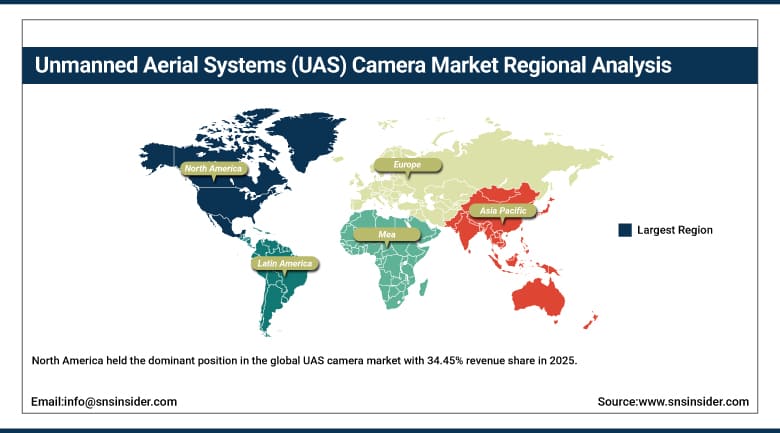
North America held the dominant position in the global UAS camera market with 34.45% revenue share in 2025, motivated by robust defense ISR modernization initiatives, highly developed UAV payload production facilities, and fast implementation of AI-powered EO/IR and thermal imaging technologies. The presence of top UAV and defense imaging firms like Teledyne FLIR, L3Harris Technologies, Lockheed Martin, and Skydio, together with the widespread use of UAVs in surveillance activities for military, homeland security, and commercial infrastructure purposes, is an important factor supporting the growth of the market in this region. The United States accounts for the main driver of growth, aided by huge defense budget allocations and autonomous aerial surveillance system upgrades
Additionally, recent developments such as the U.S. Department of Defense expanding procurement of next-generation AI-enabled UAV imaging payloads featuring real-time object detection and multi-sensor fusion capabilities, and increased integration of edge-computing-based thermal and EO/IR systems in border surveillance programs, are reinforcing technological leadership and accelerating operational deployment across North America.
Get Customized Report as Per Your Business Requirement - Enquiry Now
Asia Pacific UAS Camera Market Insights
Asia Pacific is projected to register the highest CAGR of 23.45% from 2026–2035, stimulated by fast growth in defense unmanned aerial vehicle (UAV) fleets, extensive use of unmanned aircraft systems (UASs) for mapping and surveillance purposes, and rising expenditures in precision farming and smart infrastructural monitoring. Some of the key countries driving the growth in the Asia-Pacific region include China, India, Japan, and South Korea due to their robust UAV manufacturing bases and commercial drone applications.
In addition, recent developments such as China accelerating deployment of AI-powered swarm drone surveillance systems with integrated high-resolution EO/IR payloads for border and maritime monitoring, and India expanding indigenous UAV imaging programs under defense modernization initiatives focusing on ISR and tactical reconnaissance capabilities, are significantly strengthening regional adoption and technological advancement across Asia Pacific.
Europe UAS Camera Market Insights
Continental Europe remains an important part of the global UAS Camera Market owing to its well-regulated industry, high-end capabilities in aerospace production, and growing application of unmanned aerial vehicle inspection and surveillance techniques in various industries. Nations like Germany, the United Kingdom, France, and Italy are at the forefront of this development, especially for the use of LiDAR-based mapping, monitoring the environment, and defense surveillance programs based on NATO guidelines.
Additionally, recent developments such as European defense collaborations accelerating investment in next-generation UAV payload systems with enhanced night vision, hyperspectral imaging, and AI-based target tracking capabilities, and increased deployment of UAV-based infrastructure inspection programs across energy grids and transportation networks, are reinforcing Europe’s position as a technology-driven and compliance-focused UAV imaging market.
Latin America, Middle East & Africa (LAMEA) UAS Camera Market Insights
LAMEA’s UAS camera Market is growing steadily, with growing usage of unmanned aerial vehicle technology in border protection, oil & gas facility monitoring, agricultural efficiency improvement, and development of smart cities. Major countries such as Brazil, Mexico, United Arab Emirates, Saudi Arabia, and South Africa are playing important roles in the market growth, aided by the increasing investment in unmanned surveillance technology and increased use of commercial drones in the monitoring of resources.
In addition, recent developments such as the UAE expanding deployment of AI-enabled UAV surveillance systems for smart city security and critical infrastructure protection, and Brazil increasing use of drone-based EO/IR imaging systems for large-scale agricultural monitoring and environmental management programs, are strengthening UAV imaging adoption and enhancing operational efficiency across the LAMEA region.
Market Dynamics
Growth Drivers: Rapid defense ISR modernization, AI-enabled multi-sensor payload integration, and expanding commercial UAV imaging applications creating a strong structural demand cycle
Key factors contributing to the structural growth of the unmanned aerial systems (UAS) Camera Market include the rapid modernization of ISR initiatives by militaries worldwide. This entails their use of next-generation cameras based on Electro-optical and Infrared, thermal and LiDAR technologies to improve situational awareness, precision targeting, and real-time surveillance capabilities in battlefields. The advanced camera technologies form an integral part of UAVs utilized for border surveillance, reconnaissance and maritime surveillance
Additionally, rapid integration of AI-enabled imaging systems, multi-sensor fusion (EO + IR + LiDAR), and edge-computing capabilities is significantly improving autonomous object detection, tracking accuracy, and real-time decision-making efficiency.
On the commercial side, growing UAV adoption across infrastructure inspection, energy asset monitoring, agriculture analytics, logistics mapping, and disaster response operations is expanding demand for lightweight, high-resolution, and cost-efficient aerial imaging payloads, further accelerating market expansion.
Restraints: High payload cost burden, stringent UAV operational regulations, and cybersecurity/data transmission risks limiting scalable adoption across regions
One of the key factors hindering the growth of the UAS camera industry is the relatively expensive payload systems such as LiDAR technology, hyperspectral cameras, electro-optic/infrared gimbals, and long-range thermal imagers, thereby posing a challenge to the uptake by smaller commercial UAV companies. The complexities in the integration and maintenance of payload equipment raise the overall cost of systems, particularly in multi-sensor combinations. Apart from that, the stringent rules and regulations relating to the use of drones, flight height restrictions, no-fly areas, and cross-border utilization of drones remain major hindrances to mass adoption.
Opportunities: AI-driven autonomous aerial intelligence systems, defense ISR procurement expansion, and industrial-scale UAV imaging adoption across digital ecosystems
An important advantage of the UAS Camera Market is that there would be an increase in the usage of AI-based autonomous imaging payload systems that can provide real-time object detection, threat prediction, and mission modification without any human input, especially in applications such as defense and homeland security. Such smart UAV imaging payloads will mark a new era of ISR missions worldwide. Additionally, defense acquisitions for next-generation UAV ISR systems coupled with growing interest in endurance surveillance drones have led to the demand for imaging payloads.
Recent Developments:
-
2026: Teledyne FLIR expanded its next-generation EO/IR and thermal imaging payload portfolio with upgraded high-resolution sensor modules and enhanced AI-assisted target recognition capabilities, strengthening its position in defense ISR and border surveillance UAV programs across the U.S. and Europe.
- 2026: L3Harris Technologies advanced integration of multi-sensor UAV imaging systems combining EO/IR, hyperspectral, and real-time edge analytics, supporting next-generation military ISR platforms and improving autonomous battlefield intelligence processing for long-endurance UAV missions.
- 2025: DJI introduced upgraded enterprise UAV imaging systems featuring improved 4K/8K stabilized cameras, enhanced low-light performance, and AI-enabled object tracking, expanding adoption across commercial inspection, agriculture monitoring, and infrastructure mapping applications globally.
Unmanned Aerial Systems (UAS) Camera Market Key Players are:
-
DJI
-
Teledyne FLIR LLC
-
L3Harris Technologies Inc.
-
Lockheed Martin Corporation
-
Northrop Grumman Corporation
-
BAE Systems plc
-
Leonardo S.p.A.
-
Thales Group
-
Safran S.A.
-
Elbit Systems Ltd.
-
RTX Corporation (Raytheon Technologies)
-
Collins Aerospace
-
Hensoldt AG
-
Saab AB
-
Parrot SA
-
Autel Robotics
-
Wingtra AG
-
Skydio Inc.
-
AgEagle Aerial Systems Inc.
-
uAvionix Corporation
Unmanned Aerial Systems (UAS) Camera Market Report Scope
| Report Attributes | Details |
|---|---|
| Market Size in 2025 | USD 15.40 Billion |
| Market Size by 2035 | USD 114.83 Billion |
| CAGR | CAGR of 22.50% From 2026 to 2035 |
| Base Year | 2025 |
| Forecast Period | 2026-2035 |
| Historical Data | 2022-2024 |
| Report Scope & Coverage | Market Size, Segments Analysis, Competitive Landscape, Regional Analysis, DROC & SWOT Analysis, Forecast Outlook |
| Key Segments | • By Camera Type (EO/Daylight Cameras, Infrared (IR) Cameras, Thermal Imaging Cameras, LiDAR Imaging Cameras ,Others) • By Platform ( Rotary-Wing UAS,Fixed-Wing UAS, Hybrid VTOL UAS, Nano/Micro UAS,Others) • By Application (Intelligence, Surveillance & Reconnaissance (ISR), Target Acquisition & Fire Control Support, Mapping & Surveying, Border & Homeland Surveillance, Precision Agriculture, Others) • By End User (Defense & Military, Homeland Security Agencies, Commercial Enterprises, Agriculture Sector, Energy & Utilities,Others) |
| Regional Analysis/Coverage | North America (US, Canada), Europe (Germany, UK, France, Italy, Spain, Russia, Poland, Rest of Europe), Asia Pacific (China, India, Japan, South Korea, Australia, ASEAN Countries, Rest of Asia Pacific), Middle East & Africa (UAE, Saudi Arabia, Qatar, South Africa, Rest of Middle East & Africa), Latin America (Brazil, Argentina, Mexico, Colombia, Rest of Latin America). |
| Company Profiles | DJI, Teledyne FLIR LLC, L3Harris Technologies Inc., Lockheed Martin Corporation, Northrop Grumman Corporation, BAE Systems plc, Leonardo S.p.A., Thales Group, Safran S.A., Elbit Systems Ltd., Raytheon Technologies (RTX), Collins Aerospace, Hensoldt AG, Saab AB, Parrot SA, Autel Robotics, Wingtra AG, Skydio Inc., AgEagle Aerial Systems Inc., uAvionix Corporation |
Frequently Asked Questions
