
The global LED drivers market is expected to see substantial growth as energy efficient lighting, smart building controls and automotive lighting technologies change the demand for electronic power management solutions. Governments, commercial property owners and manufacturers are increasingly upgrading conventional lighting systems to LED installations that offer improved energy efficiency, longer operating life and advanced control capabilities.
According to SNS Insider, the LED Drivers Market was valued at USD 21.60 Billion in 2025, is estimated to reach USD 24.24 Billion in 2026 and is forecast to achieve USD 68.29 Billion by 2035, registering a CAGR of 12.20% during 2026–2035.
North America continues to be the largest regional market, while Asia Pacific is expected to see the fastest growth. Opportunities are emerging in wireless lighting controls, compact driver modules and increasingly sophisticated automotive lighting systems for component manufacturers.
To Get Detailed Insights on the LED Drivers Market – Request a Sample Report
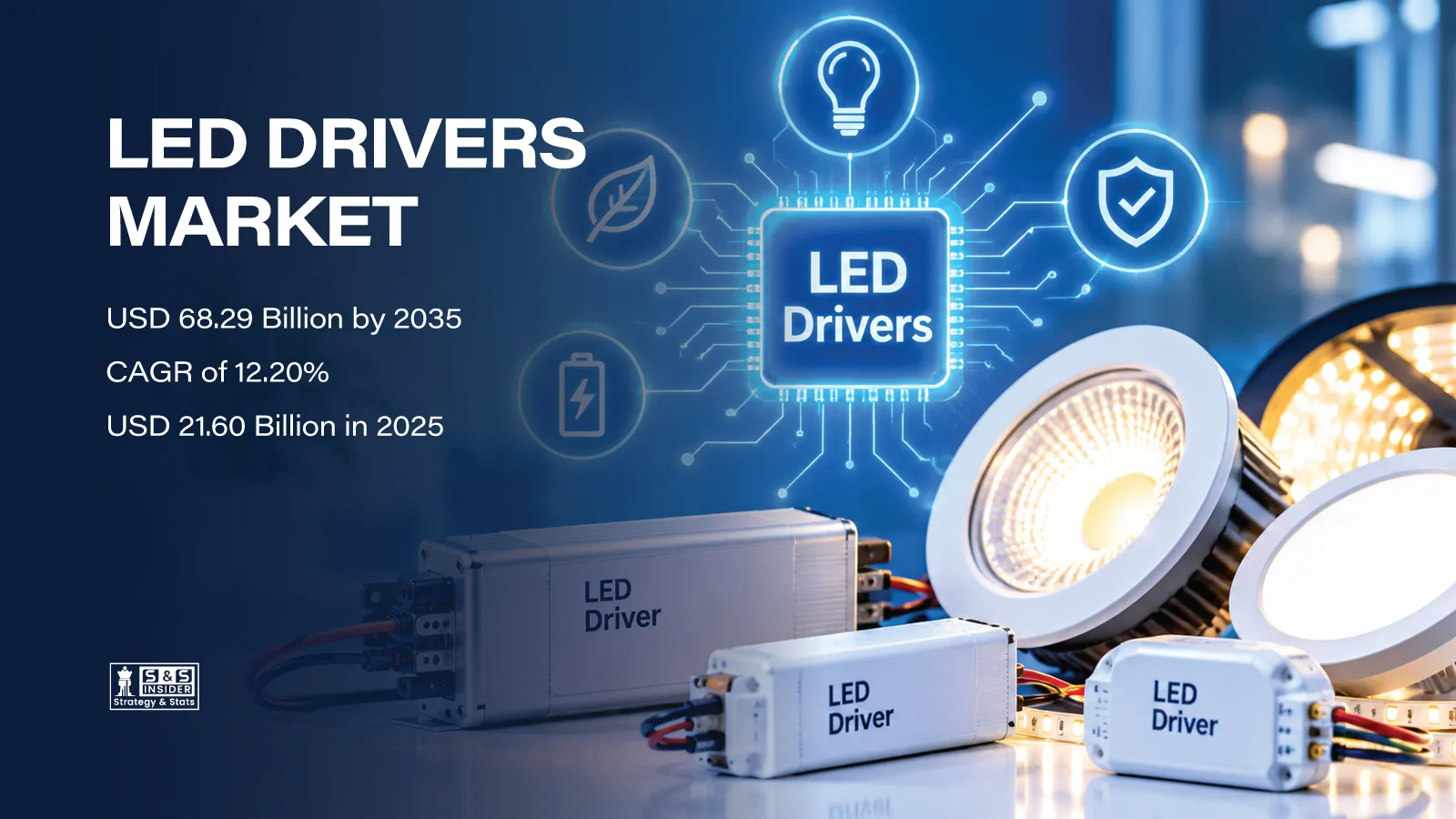
LED Drivers Market Outlook: Intelligent Lighting Reshapes Power Management Demand
LED drivers manage the electrical power delivered to light-emitting diodes, maintaining current or voltage levels to protect lighting systems from detrimental electrical variations. LEDs are becoming more important as the technology moves from simple illumination to connected buildings, automotive displays, industrial facilities and architectural lighting.
More and more commercial building operators are choosing to install dimmable lighting systems that can be adjusted to occupancy, amount of daylight available and the operating schedule they have set. These applications require drivers that can communicate with lighting management networks.
Technological advances in gallium nitride power devices, digital control interfaces and programmable output configurations are also improving driver efficiency and design flexibility. Another source of replacement demand comes from aging lighting installations that require maintenance, upgrades and compatible driver components.
Key Growth Drivers: Lighting Retrofits and Connected Controls Support Market Expansion
The main driver of growth is still energy-efficient lighting replacement. From offices and warehouses to hospitals, educational institutions and residential properties, all are moving away from conventional lighting technologies and adopting LED fixtures to cut down on electricity consumption and maintenance costs.
“Connected drivers become more valuable with the growth of smart building development. DALI-compatible controls, wireless communication and integrated energy monitoring can be used by facility managers to run lighting more efficiently. LEDs are also being used by automotive manufacturers in matrix headlights, rear lighting assemblies, ambient interior systems and vehicle displays.
But fierce price competition on components, volatile semiconductor pricing and complex certification requirements continue to impact supplier profitability. Manufacturers with reliable, programmable and energy-efficient driver solutions are well positioned to benefit from increasing application needs.
LED Drivers Market Segment Analysis
Constant Current Drivers Dominate with 58.40% Market Share in 2025
Constant current drivers dominated the global LED drivers revenue in 2025, with a share of 58.40%. This dominance is due to their widespread use in residential, commercial, and professional lighting. These drivers keep the current through the LED constant even as the voltage across the LED changes. This allows the LED to operate at a constant brightness without thermal damage.
Their suitability for downlights, ceiling panels, industrial luminaires and architectural fixtures fuels demand in building construction and lighting replacement projects. The manufacturers are improving the conversion efficiency, dimming stability and operational reliability to meet the increasing stringency of the lighting specifications .
Current trend: Increasing adoption of high-efficiency constant current drivers in commercial LED fixtures.
Major trends: Low-flicker operation, programmable output current and compact power conversion architectures.
Other Output Types Register the Fastest CAGR of 13.80%
Constant power driver solutions and other output configurations are projected to grow at a CAGR of 13.80% during 2026-2035. Such designs are intended for specialized lighting systems that require variable power delivery, particularly when brightness, color temperature, or operating conditions are in flux.
Configurable LED systems are increasingly used in advanced architectural lighting, hospitality environments and entertainment installations and require greater driver flexibility. Constant voltage drivers remain a mainstay for LED strips, signage and decorative lighting applications.
Current trend: Growing demand for adaptable power supplies in tunable and decorative lighting.
Major trends: Dynamic power regulation, multi-channel control and integrated driver electronics.
Wired Dimming Leads with 62.40% Market Share in 2025
Wired dimming continued to dominate the market, accounting for 62.40% of the market revenue in 2025, owing to the existing lighting control infrastructure and stable communication performance. Lighting control for commercial buildings, industrial facilities and institutional properties is supported by protocols such as DALI, 0–10V and pulse-width modulation.
Wired dimming is particularly appealing when you are doing a renovation and already have the wiring in place, and compatibility can ease installation. Commercial customers want predictable performance, too, and integration with centralized building management systems.
Current trend: Continued deployment of wired dimming in commercial lighting modernization.
Major trends: DALI interoperability, centralized lighting automation and energy monitoring integration.
Wireless Control Records the Fastest CAGR of 19.20%
The wireless control segment is anticipated to grow at a CAGR of 19.20% from 2026 to 2035 and is expected to be the fastest growing control type. Wireless technologies including Bluetooth and Zigbee enable lighting changes without having to install extensive additional control wiring.
That flexibility is useful in existing buildings, where occupants are coming to expect smartphone control, automated scheduling and occupancy-based lighting. Wireless-to-wired gateways also allow for gradual modernization of older lighting networks.
Current trend: Increasing adoption of wireless-enabled LED drivers in smart building retrofits.
Major trends: Connected lighting ecosystems, sensor integration and remote energy management.
External Standalone Drivers Hold 46.80% Market Share
The external standalone drivers held a market share of 46.80% in 2025, as they are serviceable and offer flexibility and compatibility with various luminaire designs.
By separating the driver from the LED fixture, maintenance teams are able to replace damaged power components without the need to change the complete lighting assembly. This configuration is still very useful in commercial buildings, factories, warehouses and outdoor lighting systems.
Current trend: Increasing preference for replaceable and standardized driver assemblies.
Major trends: Modular power supplies, improved thermal management and extended equipment service life.
Compact Modules Grow at 14.60% CAGR Through 2035
Compact driver modules are projected to achieve a 14.60% CAGR during 2026–2035, supported by demand for slim luminaires, automotive interiors and space-constrained electronic products.
Advances in semiconductor integration allow manufacturers to reduce component dimensions while maintaining efficient electrical conversion. Architectural lighting designers increasingly favor miniature modules that can be incorporated into discreet fixtures and narrow lighting profiles.
Current trend: Rising use of miniaturized driver modules in architectural and automotive applications.
Major trends: Gallium nitride integration, high-power-density designs and advanced thermal optimization.
General Lighting Dominates with 54.20% Market Share in 2025
General lighting accounted for 54.20% of global market revenue in 2025, supported by substantial demand from residential, commercial and industrial illumination.
Building modernization programs, new construction and electricity-saving initiatives continue to support installation volumes. Growing adoption of dimmable LED systems and smart home platforms is also increasing demand for drivers with advanced operating functions.
Current trend: Widespread replacement of conventional lighting with controllable LED systems.
Major trends: Smart building integration, energy-efficient retrofits and connected residential lighting.
Automotive Lighting Expands at the Fastest CAGR of 15.80%
Automotive lighting is expected to register a 15.80% CAGR between 2026 and 2035, reflecting rising electronic content in passenger and commercial vehicles.
Matrix headlights, adaptive front-lighting systems, digital displays and ambient interior lighting require increasingly sophisticated driver integrated circuits. Manufacturers must also satisfy automotive reliability requirements related to temperature, vibration and electrical performance.
Current trend: Increasing LED channel integration across vehicle lighting and display systems.
Major trends: Adaptive headlights, dynamic lighting effects and intelligent automotive driver electronics.
Regional Analysis: North America Leads as Asia Pacific Accelerates
North America Leads with 31.20% Market Share in 2025
North America accounted for 31.20% of the global LED drivers market in 2025, making it the leading regional market. The United States and Canada benefit from established commercial building infrastructure, lighting renovation activity and demand for advanced lighting control systems.
The U.S. LED Drivers Market was valued at USD 5.73 Billion in 2025 and is projected to grow at 11.80% CAGR during 2026–2035. Commercial retrofits, automotive lighting and smart building investments support continuing demand for reliable driver solutions.
Direction: North America will prioritize connected lighting modernization, advanced controls and replacement of aging infrastructure.
Asia Pacific Holds 30.40% Share and Fastest 15.00% CAGR
Asia Pacific accounted for 30.40% of global revenue in 2025 and is expected to register fastest regional growth of 15.00% CAGR over 2035. China, India, Japan, South Korea, and Southeast Asian economies contribute through manufacturing of lighting, producing electronics, developing automotive, and expanding urban infrastructure.
China has a large manufacturing ecosystem that makes the drivers, whereas in India and Southeast Asia, demand is generated through public lighting projects and residential construction. Japan and South Korea are enhancing regional opportunities via automotive electronics and advanced display technologies.
Direction: Asia Pacific will lead incremental expansion through manufacturing scale, urbanization and intelligent lighting adoption.
Europe Accounts for 26.40% Market Share
Europe held 26.40% of the LED drivers market in 2025, supported by Germany, the United Kingdom, France, Italy and the Netherlands. Regional energy efficiency regulations and building renovation initiatives encourage the transition toward modern LED systems.
Demand for professional lighting, programmable controls and environmentally responsible electronic components supports advanced driver adoption. Established European lighting technology companies also contribute to product innovation and export activity.
Direction: European growth will emphasize energy efficiency, regulatory compliance and sophisticated lighting control technologies.
Latin America Represents 6.60% Market Share
Brazil, Mexico, Argentina, Colombia and Chile were the key national markets. Latin America accounted for 6.60% of the global market revenue in 2025. Commercial construction, upgrades to street lighting and the production of automotive components feed regional driver demand.
Mexico has electronics and automotive manufacturing links and Brazil has commercial illumination and infrastructure modernization opportunities.
Direction: Regional expansion will follow public lighting investments, commercial retrofits and automotive manufacturing activity.
Middle East & Africa Holds 5.40% Market Share
The Middle East & Africa accounted for 5.40% of the global LED drivers market in 2025. Saudi Arabia, the United Arab Emirates, Qatar, South Africa and Egypt are contributing through construction development, smart city initiatives and commercial infrastructure projects.
Large hospitality developments, urban lighting modernization and energy efficiency investments need to rely on LED power management systems. International manufacturers often source the region through local distributors and project contractors.
Direction: Growth will be supported by smart city development, commercial construction and public lighting modernization.
Competitive Landscape: Smart Controls and Driver Efficiency Shape Market Competition
The LED drivers industry features semiconductor manufacturers, specialized power supply producers and established lighting technology companies.
Major participants include Texas Instruments, STMicroelectronics, NXP Semiconductors, Infineon Technologies, onsemi, Signify, ams OSRAM, MEAN WELL, Inventronics, Tridonic and Delta Electronics.
Competition increasingly focuses on power conversion efficiency, operating reliability, dimming performance, connectivity and compliance with international safety requirements.
In July 2026, Signify announced that it would launch Xitanium as a standalone OEM driver brand in August 2026. To meet the growing demand for programmable commercial lighting solutions, MEAN WELL also released DALI-2 compatible constant voltage drivers in March 2026. High value applications are expected to be dominated by suppliers who have integrated controls, compact designs and reliable technical support.
LED Drivers Market Outlook Through 2035
The global LED drivers market is expected to see substantial growth as traditional lighting infrastructure adopts intelligent, energy-efficient systems.
Particularly strong opportunities will be provided by wireless controls, compact driver modules and automotive lighting technologies while general lighting and constant current drivers will remain significant contributors to revenue.
Growth will depend increasingly on manufacturers’ ability to combine electrical efficiency, digital connectivity and long-term reliability. As the global revenue is predicted to reach USD 68.29 Billion by 2035, LED drivers will continue to be crucial for modern lighting systems, enabling the broader transition to connected buildings, smart vehicles and sustainable energy usage.
About the Author

Get in touch




