
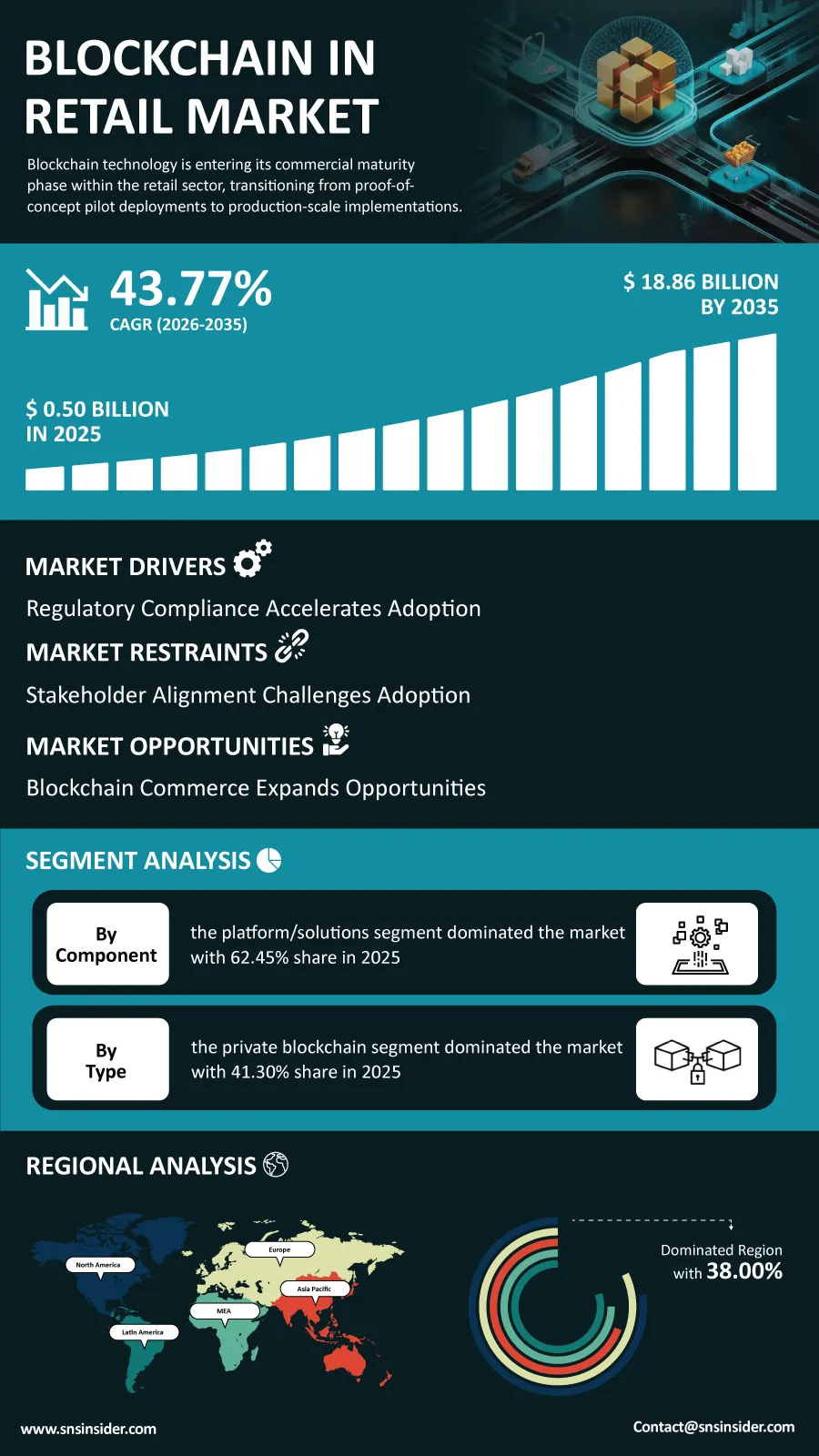
The global Blockchain in Retail Market is facing a phase of brisk commercial execution, with retailers progressively deploying distributed ledger technologies for better product traceability, enhanced visibility across the supply chain and improved customer confidence. “According to a recent study by SNS Insider, the global Blockchain in Retail Market size valued at USD 0.50 billion in 2025, is anticipated to grow to USD 18.86 billion by 2035, registering a CAGR of 43.77% over the 2026–2035 forecast period.”
Retail businesses are going beyond pilot blockchain projects to enterprise-level deployments for inventory tracking, product authentication, digital record management and regulatory compliance. With consumers wanting to know more about where their products come from and how authentic they are, retailers are harnessing tech that creates secure, tamper-resistant records along the supply chain.
The increasing regulatory requirements for food safety, pharmaceutical traceability and sustainable sourcing also supports the adoption of the market. Retailers are incorporating blockchain with cloud platforms, enterprise resource planning systems and AI-powered analytics to digitize operations, which is evolving collaboration and cooperation between manufacturers, distributors, logistics providers and suppliers.
To Get Detailed Insights on the Blockchain in Retail Market – Request a Sample Report
Product Transparency and Regulatory Compliance Create Long-Term Growth Opportunities
Retailer investments in blockchain infrastructure to bolster operational resilience and enhance customer trust through transparency of the product journey Immutable digital records allow organizations to verify the source of information, decrease the risk of counterfeit and respond quickly to recalls, compliance audits, and product quality investigations.
In addition to supply chain visibility, retailers are also deploying blockchain applications in customer engagement initiatives such as digital loyalty programs, secure payments, warranty points and authenticated ownership records for premium merchandise. This has allowed companies to separate their brands, and build new revenue streams for themselves in an omnichannel retail environment.
Meanwhile, the further evolution of enterprise blockchain platforms, smart contracts, and cloud-native deployment models is helping to simplify implementations and making adoption easier for the retailers looking for scalable and cost-effective digital transformation solutions.
Key Market Insights Highlight Shifting Demand Patterns
On the basis of component, platform and solutions is expected to dominate global market revenue in 2025, accounting for over 62.45% due to high enterprise demand for blockchain infrastructure, distributed ledger platforms and development environments supportive of integrating retail operations. Services is the fastest growing segment during period 2023-2035 as consultative, integration, and solution customization requirements start to grow and organizations require more managed blockchain services.
According to the report, by type, private blockchain is expected to account for 41.30% of global market revenue in 2025 owing to their ability to offer secure permissioned environments for enterprise retail networks. Retailers, manufacturers and logistics partners will also increasingly work together within shared digital ecosystems that increase transparency and operational efficiency fuelling growth in consortium blockchain, the fastest-growing segment over the forecast period.
On the basis of deployment mode, on-premise solutions dominated the market as they held largest revenue share (54.78%) in 2025 as many large retailers still prefer direct control over sensitive operational data and enterprise infrastructure. The fastest growth through 2035 is expected for cloud-based deployments as companies look to greater scalability, lower implementation costs, and easier system integration. By application, the global revenue share of supply chain management was 36.92% in 2025 and food safety management will be the most rapidly growing application due to ever-expanding traceability regulations and increasing consumer expectations for safe foods globally.
Enterprise Blockchain Platforms Accelerate Retail Digital Transformation
As organizations build next-generation retail processes by modernizing procurement, inventory management, logistics and customer engagement, blockchain technology is emerging as a foundational layer in their infrastructure. In this regard, across complex retail supply chains, artificial intelligence, Internet of Things devices, cloud computing and block chain are being implemented in combination to provide real-time visibility.
Constantly copy and paste data for processing is a serious challenge for this process because it results in big inefficiencies leading to increased costs during supply chain operations, automation of transactions & auditing are vitally longer processes as manufacturers need to constantly create invoices manually while blockchain minimizes any manual operation required as its more streamlined giving rise to trust in the entities involved. These innovations are fast-tracking adoption at the enterprise level while enabling long-term digital transformation efforts.
North America Held Approximately 38.00% of the Blockchain in Retail Market Share in 2025; Asia Pacific Projected to Register the Fastest CAGR Through 2035
Due to the mature retail technology ecosystem, early enterprise blockchain deployments, and increasing regulatory focus on food and pharmaceutical traceability, North America is expected to capture approximately 38.00% of market revenue globally in 2025. Massive investments in secure supply chain infrastructure and enterprise digital transformation initiatives fuel the United States' ongoing dominance of regional adoption.
Asia Pacific is expected to be the fastest growing regional market till 2035 due to rapid rise in e-commerce activity, government-backed blockchain initiatives, and raising investments by retailers on technology infrastructure in China, India, Japan, South Korea and Southeast Asia. The rise in consumer preference for product authenticity and supply chain transparency is again benefiting regional market growth.
Europe remains well-positioned as a leader in the global blockchain in retail ecosystem, thanks to regulatory frameworks driving product traceability, digital product passports and improved transparency across supply chains. At the same time, Latin America and the Middle East are consistently advancing their blockchain ecosystems, with retailers using them to improve logistics modernization, track food safety monitoring compliance and digitize commerce capabilities.
Industry Participants Focus on Secure Retail Ecosystems and Supply Chain Innovation
The competitive landscape is still in high flux, with top players like IBM and Amazon investing in enterprise blockchain platforms, cloud integration and next generation intelligent support solutions for the retail sector as well as digital trust technologies. A major focus for vendors is the strategic partnerships, product innovation and platform interoperability needed to streamline blockchain deployment that optimizes operational efficiency; improves regulatory compliance and strengthens customer confidence among retailers.
Key companies operating in the global Blockchain in Retail Market include IBM Corporation, Oracle Corporation, SAP SE, Amazon Web Services Inc., Microsoft Corporation, Hyperledger Foundation, Accenture PLC, Infosys Ltd., Wipro Ltd., Cognizant Technology Solutions Corp., VeChain Foundation, OriginTrail, Provenance Ltd., TraceLink Inc., OpenSC Pty Ltd., Everledger Ltd., Mojix Inc., ripe.io, TE-FOOD International GmbH, and Blockverify Ltd.
An SNS Insider analyst Sakshi Kale commented, “Retail blockchain is evolving into a strategic enterprise technology as organizations prioritize transparency, compliance, and digital trust across increasingly complex supply chains. Companies investing in scalable blockchain platforms, intelligent traceability solutions, and collaborative digital ecosystems will be well positioned to capitalize on the next phase of retail transformation.”
About the Author

Get in touch




