
Blockchain in Retail Market Report Scope & Overview:
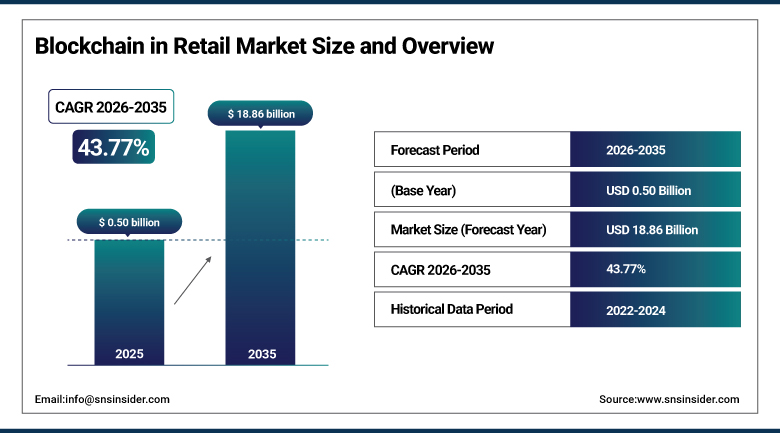
The Blockchain in Retail Market was valued at USD 0.50 Billion in 2025 and is expected to reach USD 18.86 Billion by 2035, growing at a CAGR of 43.77% from 2026 to 2035.
Blockchain technology is entering its commercial maturity phase within the retail sector, transitioning from proof-of-concept pilot deployments to production-scale implementations. The commercial case for blockchain in retail has been substantially strengthened by documented production deployments at scale. Walmart's mandate requiring its leafy green and berry suppliers to implement blockchain-based traceability through IBM Food Trust demonstrated that food safety investigation time could be reduced from seven days to 2.2 seconds when farm-to-shelf product journey data is recorded on an immutable shared ledger accessible to all supply chain participants. This 99.99% reduction in traceability response time represents a food safety and brand liability management capability. Similar documented outcomes across luxury goods anti-counterfeiting, pharmaceutical serialization, and cross-border trade finance are building the enterprise ROI case that moves retail blockchain adoption from innovation budgets to operational capital programmes.
Oracle launched its Oracle Retail Blockchain Module in February 2025, integrating natively with Oracle Fusion Cloud to allow retailers to securely trace products from source to shelf and reduce fraud in gift-card and return systems. The module's native cloud integration eliminated the bespoke middleware enabling Oracle's large retail enterprise customer base to deploy blockchain-based product traceability and fraud prevention without requiring specialist blockchain engineering teams or infrastructure outside the existing Oracle Cloud environment.
Market Size and Forecast
- Market Size in 2026E: USD 0.72 Billion
- Market Size by 2035: USD 18.86 Billion
- CAGR: 43.77% from 2026 to 2035
- Fastest Growing Region: Asia Pacific
- Largest Region: North America
To Get more information Blockchain in Retail Market - Request Free Sample Report
Blockchain in Retail Market Trends
- Enterprise software vendors are embedding blockchain capabilities into retail platforms, reducing adoption complexity for retailers significantly.
- Food traceability regulations are accelerating blockchain adoption across retail supply chains for compliance and transparency requirements.
- Blockchain-based loyalty programmes enable interoperable rewards, real-time settlement, and fraud-resistant customer engagement systems.
- Consortium blockchain networks are gaining traction as retailers and suppliers collaborate through shared trusted ledger infrastructures.
- NFT-based authenticity certificates are emerging in luxury retail for secure product provenance and secondary market verification.
The U.S. Blockchain in Retail Market Outlook
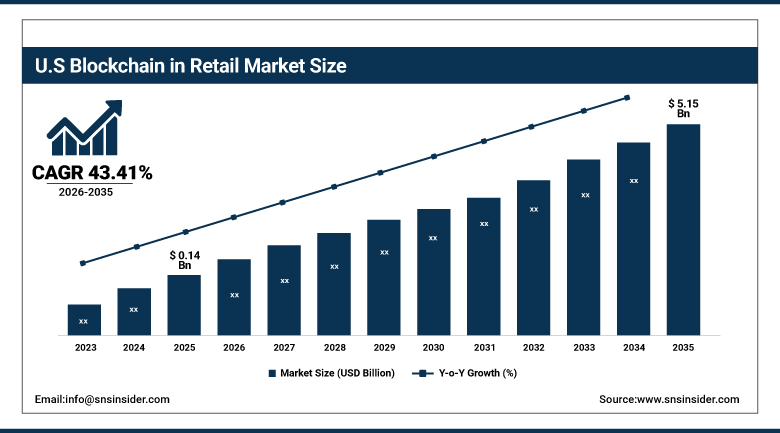
The U.S. blockchain in retail market was valued at USD 0.14 Billion in 2025 and is expected to reach USD 5.15 Billion by 2035, growing at a CAGR of 43.41% from 2026 to 2035.
The United States is the world's most commercially advanced blockchain in retail market, driven by the early and large-scale deployments of Walmart's IBM Food Trust supply chain traceability programme, the DSCSA pharmaceutical distribution serialization compliance framework. U.S. consumer awareness of food safety incidents, product authenticity concerns in luxury and health supplement categories, and growing demand for ingredient and sourcing transparency in both food and personal care categories create a commercially receptive retail consumer environment for blockchain-backed product provenance claims. Federal regulatory action under FSMA 204 and state-level food traceability mandates create additional compliance-driven adoption momentum that supplements commercial-case-driven investment.
In April 2025, SAP launched a number of innovations utilizing blockchain technology in SAP Business Network for Retail which made possible secure exchange of product lifecycle data among various parties to gain greater visibility and omnichannel fulfillment in their enterprise retail clients. With the integration of blockchain technology in SAP retail procurement and inventory management solutions, SAP was able to help enterprises break down the challenge of change management that previously hampered the adoption of blockchain technology.
Blockchain in Retail Market Segment Analysis
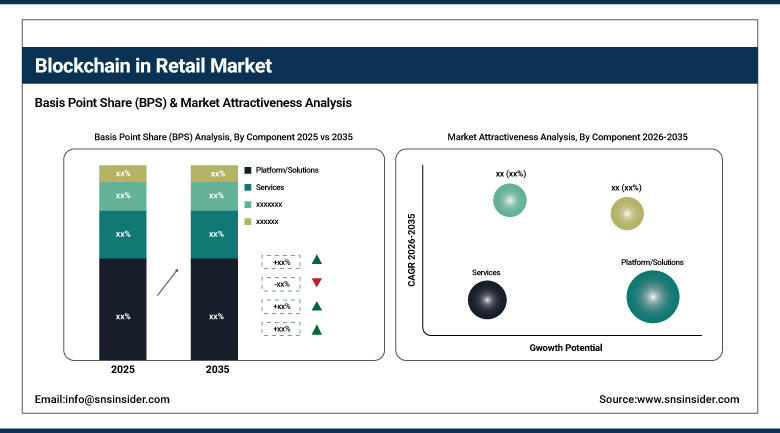
- By Component, the platform/solutions segment dominated the market with 62.45% share in 2025, while the services segment is the fastest growing at a CAGR of 46.10% during 2026 to 2035.
- By Type, the private blockchain segment dominated the market with 41.30% share in 2025, while the consortium blockchain segment is the fastest growing type with a CAGR of 45.85%.
- By Deployment Mode, the on-premise segment dominated the market with 54.78% share in 2025, while the cloud-based segment is the fastest growing with a CAGR of 47.20%.
- By Application, the supply chain management segment dominated the market with 36.92% share in 2025, while the food safety management segment is the fastest growing application with a CAGR of 45.23%.
By Component, platform/solutions dominate, services grow fastest
In terms of market revenue generated in 2025, Platform and solutions contributed to 62.45% of the blockchain in retail industry market revenue as they offer the necessary distributed ledger technology, smart contracts environment, and APIs that facilitate the development and operation of blockchain applications in the retail industry. Some of the leading platform vendors include IBM Blockchain, Hyperledger Fabric, ConsenSys Quorum, and AWS Managed Blockchain who contribute to the majority of revenue generation based on the licensing fees per node and transactions as well as cloud infrastructure costs associated with their networks. The predictability of platform revenue can be attributed to the long-term business contracts involved in implementing retail blockchain projects.
The services segment is expanding rapidly, recording a CAGR of 46.10% fueled by the increasing need for services such as consultation, system integration, blockchain education, and network management in the development and execution of blockchain technologies in a complex environment made up of numerous supply chain stakeholders. The challenges associated with integration of blockchain node connections through various suppliers, customization of the smart contract code based on retail specifications, and data flows from blockchain into ERP and retail management platforms are driving the need for professional services in the space.
By Application, supply chain management dominates, food safety management grows fastest
Supply chain management accounted for 36.92% of blockchain in retail market revenue in 2025, reflecting its status as the most commercially mature and broadly validated retail blockchain application category. Blockchain-based supply chain systems provide end-to-end visibility from raw material origin through manufacturing, logistics, and retail distribution to point of sale, creating an immutable audit trail that enables fraud detection, authenticity verification, regulatory compliance documentation, and consumer transparency communication whose combined value across these use cases justifies enterprise investment.
The field where management of food safety is witnessing the maximum growth is food safety management, which has been experiencing a CAGR of 45.23%. This increase can be attributed to the fact that January 2026 is the deadline for the FDA's FSMA Rule 204, according to which all recordable data will be maintained for all high-risk foods.
Regional Analysis
|
Region |
Major Country |
Share within Region, 2025 (%) |
|---|---|---|
|
North America |
United States |
84.73% |
|
Europe |
United Kingdom |
28.47% |
|
Asia Pacific |
China |
38.47% |
|
Middle East & Africa |
UAE |
22.84% |
|
Latin America |
Brazil |
43.84% |
North America Blockchain in Retail Market Insights
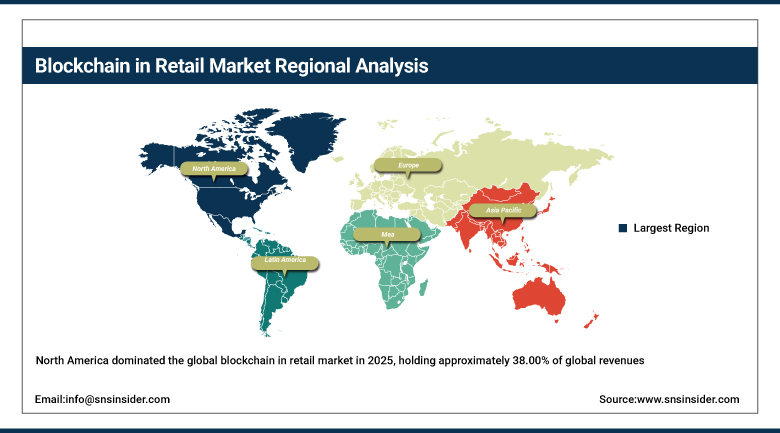
North America dominated the global blockchain in retail market in 2025, holding approximately 38.00% of global revenues. The United States accounts for approximately 84.73% of regional revenue through its large-scale enterprise retail blockchain deployments, the regulatory compliance demand created by FSMA 204 and DSCSA pharmaceutical traceability requirements, and the concentration of major retail technology platform vendors whose enterprise customer relationships facilitate large-scale adoption. Canada contributes supplementary demand through its food retail sector's growing traceability investment and its pharmaceutical distribution sector's adoption of blockchain-based serialization solutions aligned with U.S. DSCSA compliance requirements.
Get Customized Report as per Your Business Requirement - Enquiry Now
Europe Blockchain in Retail Market Insights
Europe had around 26.00% of the world blockchain in retail revenue market share in 2025. This was driven by various policies by the EU such as the Farm to Fork strategy that demands transparency in food supply chains, the Falsified Medicines Directive that requires pharmaceutical companies to adopt serialization solutions for their products, and the EU Digital Product Passport rule that calls for supply chain data of batteries, electronics, and textiles by 2027 and 2030, respectively. The Digital Product Passport alone is expected to drive multi-billion-euro enterprise investment in supply chain data infrastructure across EU manufacturing and retail sectors during the 2026 to 2030 implementation period. The United Kingdom accounts for approximately 28.47% of European revenues through its food safety regulatory framework, luxury goods anti-counterfeiting market, and its position as a leading European market for enterprise blockchain technology adoption across retail and supply chain applications.
Asia Pacific Blockchain in Retail Market Insights
Asia Pacific is the fastest-growing regional blockchain in retail market with a CAGR of approximately 45.23% through 2035. China accounts for approximately 38.47% of Asia Pacific revenues through government-supported blockchain development programmes including the national blockchain service network infrastructure, rapidly growing e-commerce sector traceability requirements from Alibaba and JD.com supply chain programmes, and domestic retail technology companies whose blockchain platform development is serving both domestic and international retail customers at cost points more competitive than Western alternatives. India, South Korea, Japan, Singapore, and Southeast Asian markets contribute growing regional demand as e-commerce expansion, food safety awareness, and luxury goods market development create commercial blockchain adoption incentives across the region's retail ecosystem.
MEA & Latin America Blockchain in Retail Market Insights
Middle East and Latin America are growing blockchain in retail markets where expanding e-commerce infrastructure, food safety regulatory development, and luxury goods market growth are creating commercial blockchain adoption opportunities. The UAE leads MEA revenues at approximately 22.84% of the regional total through its government blockchain initiative including the Dubai Blockchain Strategy and its concentration of global luxury retail and international food distribution operations. Brazil leads Latin American revenues at approximately 43.84% of the regional total through its large e-commerce sector, food export traceability requirements for its agricultural commodity exports to European and Asian markets, and the growing pharmaceutical distribution blockchain adoption driven by ANVISA regulatory requirements.
Market Dynamics
Growth Drivers: Regulatory food and pharmaceutical traceability mandates and consumer demand for product authenticity transparency are creating sustained blockchain adoption.
The development of the blockchain technology in the retail market is built upon the alignment between the need to comply with regulatory demands and commercial drivers to build customer trust. The Food Safety Modernization Act (FSMA) Rule 204 regulations for food traceability starting from January 2026 have become the most commercially significant single event in the history of the blockchain food retail market, as it becomes necessary to document all supply chains through digital technologies, which are more efficient in this task than conventional databases. Consumer readiness to spend money on authenticated and source transparent products, observed in the luxury goods, organic food, and sustainability certified cosmetics markets, represents the commercial driver for using blockchain technologies independent of regulatory demands.
Restraints: Multi-stakeholder coordination complexity and the need for universal supplier adoption constrain the pace of blockchain retail network development.
Retail blockchain networks deliver their characteristic value only when all relevant supply chain participants, including suppliers, manufacturers, logistics providers, and customs authorities, are enrolled and actively contributing transaction data to the shared ledger. Convincing the full diversity of a retail supply chain to adopt blockchain-compatible systems, including small-scale farmers in emerging markets, family-owned garment manufacturers, and independent logistics operators whose technology capabilities and investment budgets may be limited, requires substantial supplier onboarding investment and sustained change management that constrains network development timelines. Interoperability between different retail blockchain platforms remains an unresolved challenge as the proliferation of incompatible proprietary and consortium blockchain networks creates fragmentation that limits data portability and constrains the network effects that drive blockchain's commercial value proposition.
Opportunities: Tokenized loyalty programmes and NFT-based product authenticity certificates represent high-value commercial innovation opportunities.
Tokenized loyalty programmes on blockchain networks offer a fundamentally more flexible and fraud-resistant loyalty architecture than conventional points databases whose vulnerability to fraud, inability to support cross-retailer exchange, and instant redemption limitations create persistent consumer dissatisfaction and operational cost. Blockchain loyalty tokens that settle instantly, transfer between participating retail programmes at fixed exchange rates, and maintain tamper-resistant balance records can deliver measurably superior consumer experience and lower operational fraud cost simultaneously. NFT-based product authenticity certificates that transfer with luxury goods, collectibles, and premium apparel through secondary market transactions represent an emerging blockchain retail application whose commercial traction in the luxury resale market is creating genuine consumer demand for blockchain-authenticated product ownership documentation.
Recent Developments:
- 2025: Oracle launched its Oracle Retail Blockchain Module integrating natively with Oracle Fusion Cloud, enabling retailers to trace products from source to shelf and reduce fraud in gift-card and return systems, dramatically lowering the technical complexity barrier for enterprise retail blockchain adoption within existing Oracle Cloud environments.
- 2025: SAP introduced blockchain-enabled capabilities within SAP Business Network for Retail enabling secure multi-party product lifecycle data sharing to enhance transparency and optimize omnichannel fulfilment across its enterprise retail customer base through native integration with existing SAP operational systems.
- 2024: IBM Food Trust expanded its blockchain food traceability network to additional food categories and geographies, with participating retailers and food processors demonstrating continued production-scale deployment of the platform across leafy greens, fresh produce, and packaged food supply chains globally.
Blockchain in Retail Market key players are:
- IBM Corporation (Food Trust)
- Oracle Corporation
- SAP SE
- Amazon Web Services Inc.
- Microsoft Corporation
- Hyperledger Foundation
- Accenture PLC
- Infosys Ltd.
- Wipro Ltd.
- Cognizant Technology Solutions Corp.
- VeChain Foundation
- OriginTrail (Trace Alliance)
- Provenance Ltd.
- TraceLink Inc.
- OpenSC Pty Ltd.
- Everledger Ltd.
- Mojix Inc.
- ripe.io
- TE-FOOD International GmbH
- Blockverify Ltd.
Block Chain in Retail Market Report Scope:
| Report Attributes | Details |
|---|---|
| Market Size in 2025 | USD 0.50 Billion |
| Market Size by 2035 | USD 18.86 Billion |
| CAGR | CAGR of 43.77% From 2026 to 2035 |
| Base Year | 2025 |
| Forecast Period | 2026-2035 |
| Historical Data | 2022-2024 |
| Report Scope & Coverage | Market Size, Segments Analysis, Competitive Landscape, Regional Analysis, DROC & SWOT Analysis, Forecast Outlook |
| Key Segments | • By Component (Platform/Solutions, Services) • By Type (Public Blockchain, Private Blockchain, Consortium Blockchain) • By Deployment Mode (On-Premise, Cloud-Based) • By Application (Supply Chain Management, Food Safety Management, Loyalty & Rewards Management, Payments & Smart Contracts, Anti-Counterfeiting, Identity Management, Others) |
| Regional Analysis/Coverage | North America (US, Canada), Europe (Germany, UK, France, Italy, Spain, Russia, Poland, Rest of Europe), Asia Pacific (China, India, Japan, South Korea, Australia, ASEAN Countries, Rest of Asia Pacific), Middle East & Africa (UAE, Saudi Arabia, Qatar, South Africa, Rest of Middle East & Africa), Latin America (Brazil, Argentina, Mexico, Colombia, Rest of Latin America). |
| Company Profiles | IBM Corporation (Food Trust), Oracle Corporation, SAP SE, Amazon Web Services Inc., Microsoft Corporation, Hyperledger Foundation, Accenture PLC, Infosys Ltd., Wipro Ltd., Cognizant Technology Solutions Corp., VeChain Foundation, OriginTrail (Trace Alliance), Provenance Ltd., TraceLink Inc., OpenSC Pty Ltd., Everledger Ltd., Mojix Inc., ripe.io, TE-FOOD International GmbH, Blockverify Ltd. |
Frequently Asked Questions
The blockchain in retail market is expected to grow at a CAGR of 43.77% from 2026 to 2035.
The blockchain in retail market was valued at USD 0.50 Billion in 2025.
Food traceability regulations, authenticity demand, embedded enterprise blockchain platforms, and anti-counterfeiting capabilities are driving retail blockchain adoption.
The supply chain management segment dominated the blockchain in retail market with 36.92% share in 2025.
North America dominated the blockchain in retail market in 2025, holding approximately 38.00% of global revenues.
