
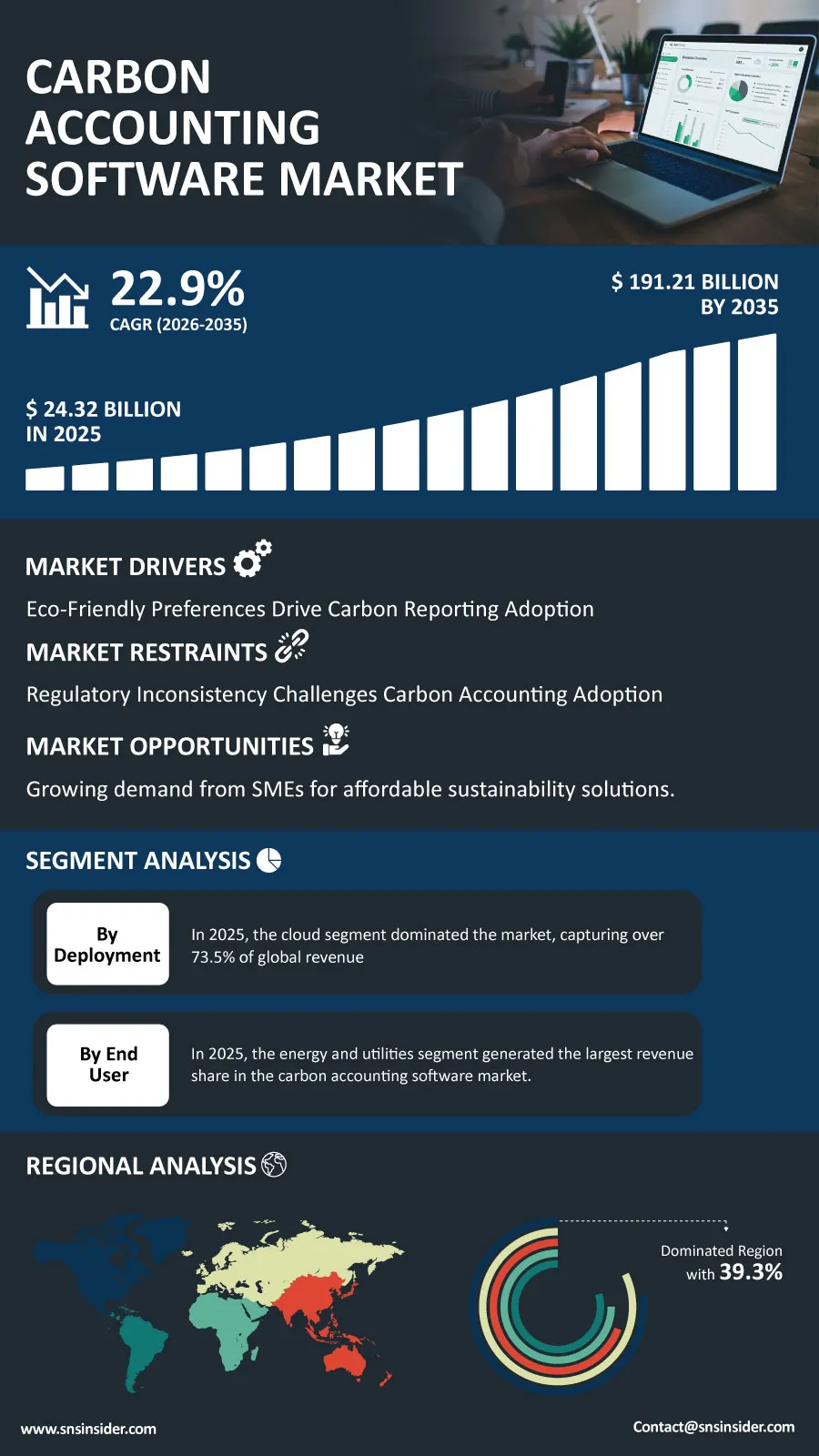
The global Carbon Accounting Software Market is witnessing strong momentum as organizations strengthen their environmental reporting capabilities and accelerate investments in sustainability technologies. “According to a recent study by SNS Insider, the global Carbon Accounting Software Market size valued at USD 24.32 billion in 2025, is anticipated to grow to USD 191.21 billion by 2035, registering a CAGR of 22.9% over the 2026–2035 forecast period.”
The increased adoption of carbon accounting platforms within the corporate sustainability framework has been witnessed due to the implementation of stricter climate policies by governments and demands from investors for more transparency in environmental performance. The use of modern software platforms enables corporations to track and manage greenhouse gas emissions along with decarbonizing activities.
The use of sustainability platforms that use technology, along with the developments in AI, cloud computing, and automated reporting, has allowed companies to manage emissions more easily and provide accurate information about their environment. This is necessary because sustainability reporting has shifted from being voluntary to a business necessity.
To Get Detailed Insights on the Carbon Accounting Software Market – Request a Sample Report
Regulatory Compliance and Corporate Sustainability Initiatives Create Long-Term Growth Opportunities
Enterprises across the globe have been making increased investments in solutions for carbon accounting because of stringent environmental regulation and changing ESG reporting requirements. Enterprises are also in need of systems which would offer them real-time emissions transparency, help in reporting emissions efficiently, and assist in achieving their science-based climate goals.
Moreover, artificial intelligence and machine learning techniques are being used to increase the effectiveness of these applications as they help in calculating emissions automatically, recognize areas where emissions can be cut down, and help in offering sustainable predictions.
There are growing congruences between corporate sustainability goals and investor needs that are providing more avenues for software providers. Companies are deploying digital carbon management tools in order to build trust with stakeholders and improve their ESG metrics and climate commitments.
Key Market Insights Highlight Evolving Adoption Patterns
Based on deployment, the cloud segment accounted for over 73.5% of global market revenue in 2025 owing to its scalability, remote accessibility, and lower infrastructure requirements. The on-premises segment is projected to witness the fastest growth through 2035 as organizations with stringent security and compliance requirements continue investing in dedicated deployment environments.
By enterprise size, large enterprises represented approximately 53.2% of market revenue in 2025 due to their extensive sustainability programs and complex global operations. Small and medium-sized enterprises (SMEs) are expected to register the fastest expansion during the forecast period as affordable cloud-based solutions improve accessibility and regulatory compliance becomes increasingly important.
In terms of end use, the energy & utilities sector generated the largest market share in 2025 because of its high emissions footprint and strict environmental reporting obligations. The transportation & logistics segment is anticipated to experience the fastest growth through 2035 as organizations accelerate fleet decarbonization and sustainable supply chain initiatives.
AI-Powered Sustainability Platforms Accelerate Digital Transformation
The carbon accounting software industry keeps on advancing through incorporating AI, predictive analysis, and automation into sustainability management solutions. Advanced software applications have allowed organizations to become more precise about their emissions, automate the process of reporting, and get actionable recommendations that will facilitate carbon reductions.
Increasing incorporation into ERP systems, SCM software, and ESG reporting will allow companies to create unified sustainability ecosystems. Such digitalization solutions will increase efficiency of operations and provide CEOs with an understanding of environmental performance.
North America Held 39% of the Carbon Accounting Software Market Share in 2025; Asia Pacific Projected to Register the Fastest CAGR Through 2035
North America captured a share of 39.3% in 2025 within the Carbon Accounting Software Market value because of the presence of robust regulations, increased usage of ESG, and companies investing in sustainability technology. The United States is still the key regional market as companies are initiating carbon disclosures in various sectors, including energy, manufacturing, financial services, and technology.
Asia Pacific is anticipated to have the highest growth rate during the forecast period, owing to strict climate policies and encouragement by governments to increase emissions disclosure by companies. Rapid industrialization, rising sustainability activities, and digital transformation of enterprises will result in high uptake of software in the region.
Europe is still an important market since it is characterized by climate laws and compulsory sustainability reporting for companies. There have been several regulatory updates aimed at making organizations adopt carbon accounting systems.
Industry Participants Focus on AI Innovation and Sustainability Management
The competitive landscape remains highly dynamic as software providers continue investing in intelligent emissions tracking, cloud-native sustainability platforms, and advanced analytics capabilities. Strategic product innovation, platform integration, and partnerships are enabling vendors to deliver comprehensive carbon management solutions that address evolving regulatory and business requirements.
Key companies operating in the global Carbon Accounting Software Market include Climate Vault, Carbon Tracker, Persefoni, Climate Neutral Group, Watershed, Climate Analytics, Climate Action Tracker, Coolset, Normative, Plan A, Emitwise, Sinai Technologies, Vaayu, Greenly, Sustain Life, Pledge, Sphera, Intelex Technologies, Net0, and Evalue8 Sustainability.
An SNS Insider analyst Sakshi Kale commented, "The growing convergence of regulatory compliance, ESG reporting, and corporate net-zero strategies is transforming carbon accounting software into a strategic enterprise technology. Organizations investing in AI-enabled sustainability platforms and automated emissions management solutions will be better positioned to strengthen environmental performance and meet evolving global climate expectations."
About the Author

Get in touch




