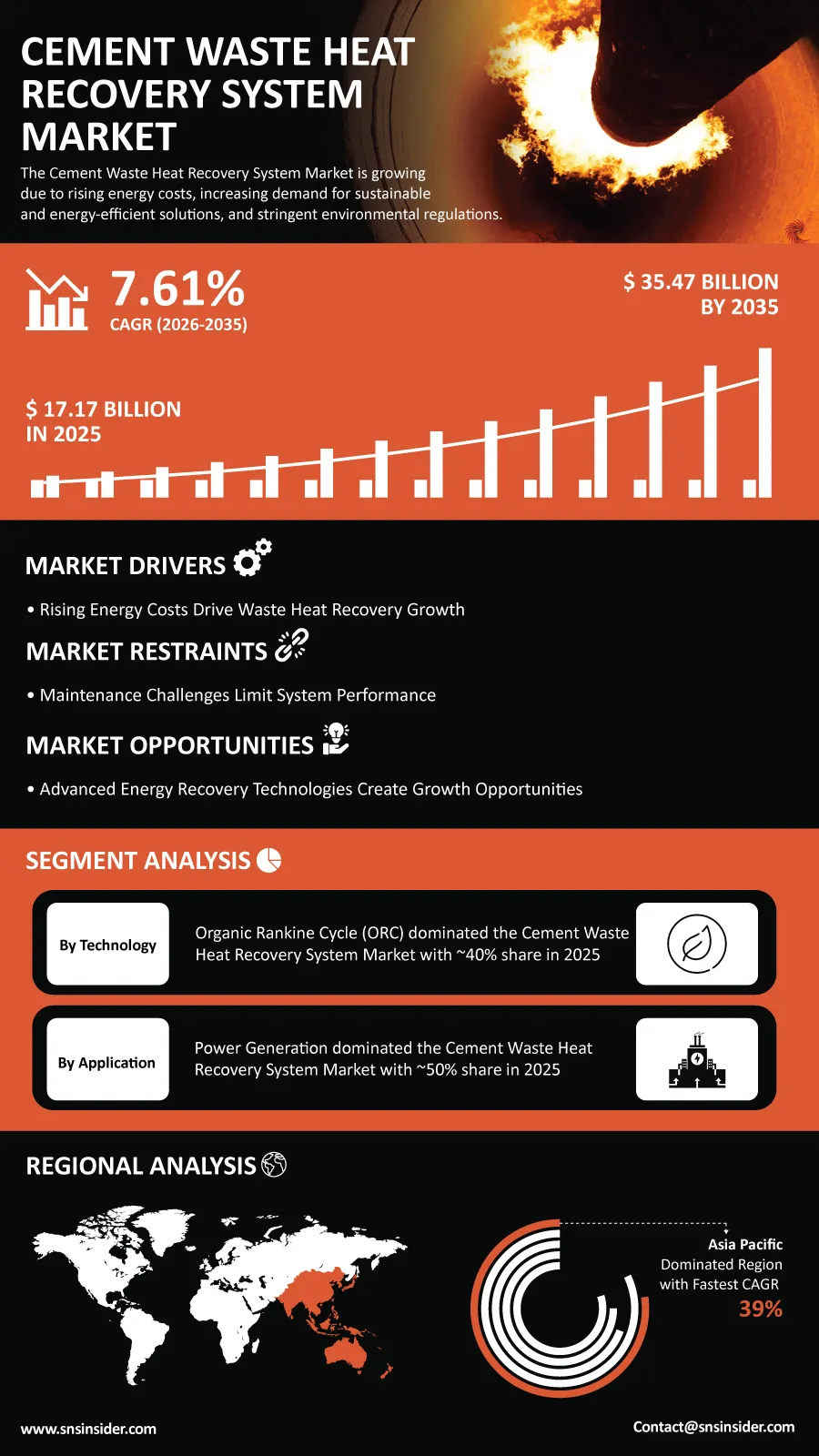
The global Cement Waste Heat Recovery System Market is expected to witness robust growth over the next decade as cement manufacturers intensify efforts to improve energy efficiency, reduce carbon emissions, and strengthen operational sustainability. “According to a recent study by SNS Insider, the global Cement Waste Heat Recovery System Market size valued at USD 17.17 billion in 2025, is anticipated to grow to USD 35.47 billion by 2035, registering a CAGR of 7.61% over the 2026–2035 forecast period.”
As energy costs rise, new environmental regulations come into force, and there is increased focus on efficiency among industry players, there is now an increasing need for cement plants to implement technologies which can effectively harvest waste heat to produce electricity. With rising ambitions toward energy efficiency and carbon reduction, cement makers have now started to include waste heat recovery systems in their production infrastructure.
Furthermore, industrial modernization programs underway in advanced countries as well as developing nations have contributed greatly towards the adoption of thermal energy recovery systems. The cement industry is focusing heavily on implementing systems which increase efficiency as well as reduce reliance on traditional power sources.
To Get Detailed Insights on the Cement Waste Heat Recovery System Market – Request a Sample Report
Industrial Decarbonization Accelerates Adoption of Energy Recovery Technologies
The cement manufacturing sector is one of the largest consumers of energy in the world. The waste heat recovery technology allows cement manufacturers to convert the waste heat into electricity, thus enhancing their performance while meeting their environmental goals.
The construction of infrastructures around the world increases the capacity of cement production, thereby increasing the need for efficient energy use systems. Meanwhile, government policies aimed at ensuring cleaner industrial activities and reduction of greenhouse gases are increasing the adoption of such systems.
Innovations in the field of thermal engineering and advanced digital control systems have been boosting the efficiency of the waste heat recovery system.
Key Market Insights Highlight Evolving Investment Priorities
Among available technologies, Organic Rankine Cycle (ORC) systems accounted for approximately 40% of global market revenue in 2025 due to their ability to efficiently recover low- and medium-temperature waste heat generated during cement manufacturing.
Thermoelectric Generator (TEG) technology is expected to register the fastest growth throughout the forecast period as advancements in materials and compact system design expand its suitability across diverse industrial applications.
Power generation remained the leading application, representing nearly 50% of market revenue in 2025 as cement producers increasingly convert recovered thermal energy into on-site electricity to reduce dependence on external power supplies.
District heating is anticipated to emerge as the fastest-growing application as industrial facilities explore broader utilization of recovered thermal energy beyond electricity generation.
By end use, cement manufacturing facilities accounted for nearly 65% of total market revenue during 2025, reflecting widespread adoption across large-scale production plants. Meanwhile, industrial facilities outside the cement sector are projected to experience the strongest growth as waste heat recovery technologies gain acceptance across additional energy-intensive industries.
Electricity generation represented approximately 55% of waste heat utilization during 2025, while hot water and steam production are expected to expand steadily as manufacturers pursue greater operational flexibility.
Energy Efficiency and Sustainability Continue to Shape Industry Strategy
Energy efficiency is one such measure that has been incorporated within the cement sector through long-term investment policies. Apart from fuel savings, the adoption of waste heat recovery technologies helps to minimize risks posed by unstable energy costs and increases efficiency.
Technologies such as predictive maintenance and intelligent process optimization are improving the effectiveness of these systems by ensuring optimal use of energy and minimal maintenance.
Given the stringent compliance measures that have been set globally in regard to environment protection, energy-efficient production facilities are going to be of utmost importance to cement manufacturers in the years to come.
Asia Pacific Accounted for 39% Market Share in 2025; North America and Europe Continue Expanding Through Industrial Modernization and Low-Carbon Manufacturing
Asia Pacific accounted for around 39% of total global revenue generated from Cement Waste Heat Recovery Systems Market in 2025. Rapid industrialization, growth in infrastructural construction, increase in production capacity of cement along with governmental incentives to adopt energy efficient production methods make the region the biggest market in the world.
Healthy growth in North America and Europe is being observed owing to the presence of strict regulatory frameworks and industrial upgrading efforts, alongside growing adoption of eco-friendly manufacturing processes.
Latin America and Middle East & Africa are gradually adopting waste heat recovery systems in their cement production plants due to sustainable industrial development policies pursued by governments.
Industry Participants Focus on Advanced Recovery Technologies
Competition across the global Cement Waste Heat Recovery System Market continues to intensify as leading companies expand their portfolios with higher-efficiency recovery technologies, digital performance management platforms, and modular energy solutions. Strategic partnerships with cement manufacturers, continued investment in research and development, and deployment of next-generation thermal recovery technologies remain key competitive priorities.
Key companies operating in the global Cement Waste Heat Recovery System Market include Siemens Energy, Mitsubishi Heavy Industries Ltd., Thermax Limited, Kawasaki Heavy Industries Ltd., AURA, Bosch Industriekessel GmbH, Climeon, CTP TEAM S.R.L, Cochran, Forbes Marshall, IHI Corporation, John Wood Group PLC, Promec Engineering, Sofinter S.p.A, Turboden S.p.A., Sinoma Energy Conservation, CITIC Heavy Industries, Kesen Kenen, Boustead International Heaters, and Exergy International.
An SNS Insider analyst commented, "Industrial decarbonization, rising energy costs, and stronger sustainability commitments are reshaping investment priorities across the cement sector. Companies that deliver highly efficient, reliable, and digitally optimized waste heat recovery solutions are expected to benefit from accelerating global demand as manufacturers pursue cleaner and more cost-effective production operations.
About the Author

Get in touch