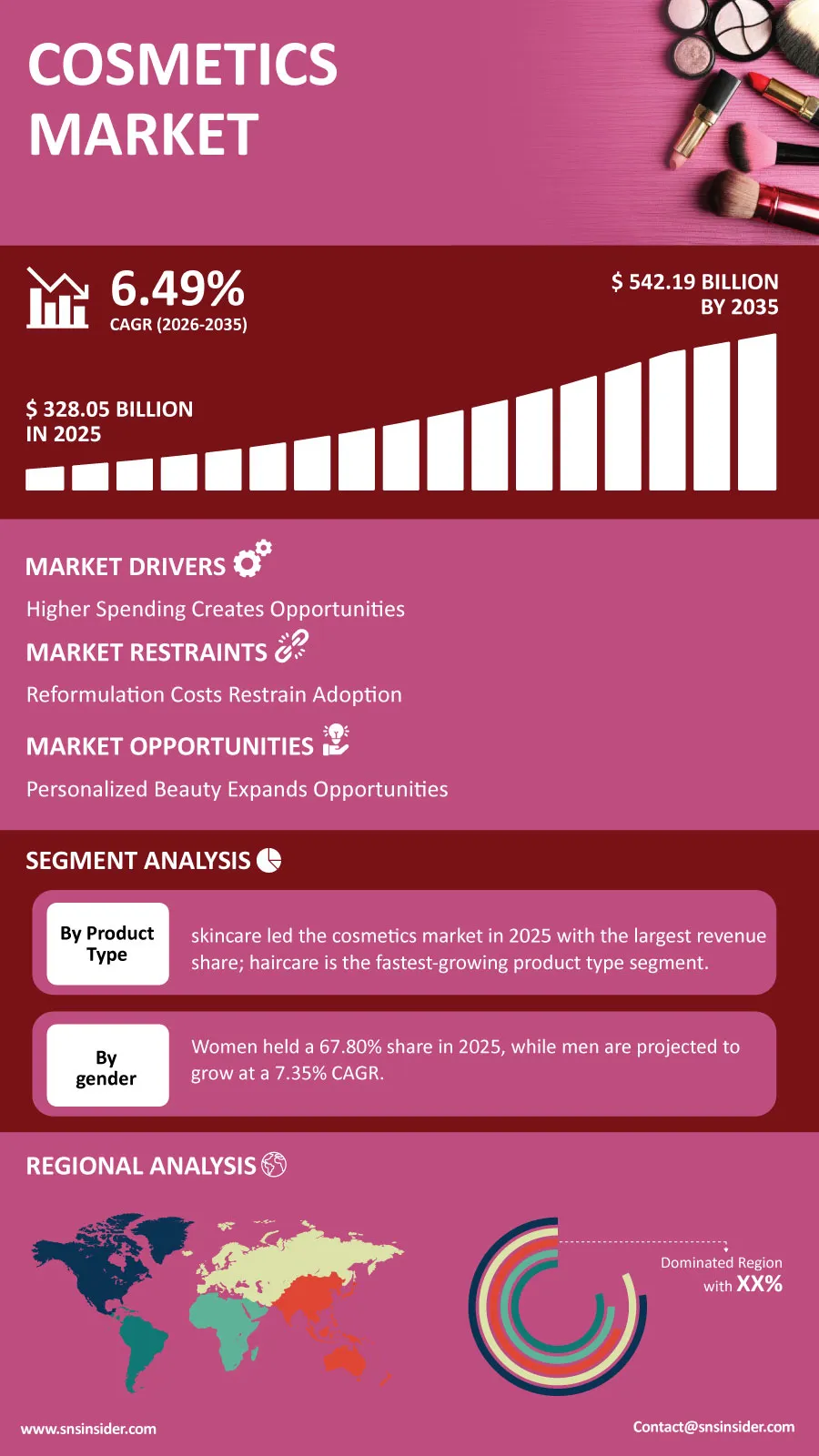
The global Cosmetics Market is entering into a new era of growth due to the consumer preference towards skin care, wellness, and customized beauty products. “According to a recent study by SNS Insider, the global Cosmetics Market size valued at USD 328.05 Billion in 2025, is anticipated to grow to USD 542.19 Billion by 2035, registering a CAGR of 6.49% over the 2026–2035 forecast period.”
The beauty product has transitioned from an appearance-oriented purchase to a staple and essential element in daily self-care among different consumer demographics. Shifting disposable incomes, increasing awareness of skincare benefits and greater access to premium beauty products continues to sustain high levels of demand across skincare, haircare, fragrances and color cosmetics. Further, digital platforms have changed how products are discovered and also made it easier for consumers to explore new brands, compare ingredients in a better way, and choose what they want to buy in less time.
Manufacturers constantly invest in R&D, biotech, and digitalization to bring Products that combine Performance with Sustainability. Powered by advances in A., ingredient research and personalized skincare technology, brands can now create bespoke beauty experiences that increase performance and strengthen customer loyalty.
To Get Detailed Insights on the Cosmetics Market – Request a Sample Report
Sustainable Beauty and Personalized Skincare Open New Growth Opportunities
Driven by the growing consumer preference for sustainable beauty products, manufacturers are adopting recyclable packaging, refillable formats, bio-based ingredients and water-efficient formulations at a rapid pace. Sustainability transitioning into one of the most important purchasing decision driver, especially for younger consumers that are challenging their brands to act sustainably and put environmental responsibility on the same level as product functionality.
Meanwhile, skin diagnostics with artificial intelligence, personalized product recommendations and customized cosmetic formulations are opening new business avenues. Beauty firms are capitalizing on digital technologies for personalized skincare offerings that facilitate greater consumer engagement while strengthening both current and future brand retention both online and offline.
Key Market Insights Highlight Shifting Consumer Preferences
By product type, Skincare dominated the largest share of market revenue in 2025 and is estimated to maintain its dominance throughout the forecast period owing to an increased consumer awareness regarding preventive skincare as well as healthy aging. Haircare, led by the demand for targeted scalp treatments and premium hair repair products, with haute-couture-style personalization, is forecast to be the strongest performing segment CAGR 3.8% through 2035.
Based on ingredient type, Synthetic ingredients accounted for nearly 52.60% of the global market revenue in 2025, driven by its formulation consistency and stability as well as variety across various cosmetic categories. By ingredient type, the natural and organic ingredients segment is expected to register the fastest growth over the forecast period as consumers are actively looking for natural and ayurvedic cosmetic formulations.
By distribution channel, Supermarket & Hypermarket held around 36.50% share of revenue in 2025 owing to high product availability and wide retail networks. Through to 2035, online channels are likely to accelerate the most rapidly as avenues such as social commerce, influencer marketing and direct-to-consumer continue to transform global beauty retail.
AI Innovation and Ingredient Science Transform Product Development
Technology has revolutionized the product development process in the cosmetic industry. Many companies are now using artificial intelligence in formulating cosmetics to ensure that the development process takes the least amount of time.
Biotechnology, peptide science, microbial formulations, and scientifically proven active ingredients have been contributing in the introduction of next generation skincare products. In addition to that, virtual beauty consultations, digital skin analysis, and augmented reality are helping in improving customers' experiences.
Asia Pacific Accounts for Largest Regional Revenue in 2025, Expected to Remain Fastest-Growing Through 2035
Asia Pacific continues to be the largest regional market in 2025 and is also expected to post fastest growth during the period 2035. Robust regional demand in China, South Korea, Japan and India continues to be supported by expanding middle-class populations; rising awareness of beauty among consumers; well-established e-commerce ecosystems; and ongoing product innovation. The rising influence of K-beauty and J-beauty trends on a global scale is also driving skin care premiumization in other international markets.
North America is still a primary region due to high luxury beauty spending, well-developed retail channels and increased use of clean beauty products. Europe remains a steady growth driver at the customer level, through product innovation geared towards sustainability and strict regulations for cosmetic safety, while growth in Latin America and the Middle East is predominantly driven by rising disposable incomes, increasing urban populations, and entering deeper into digital penetration.
Industry Leaders Strengthen Competitive Position Through Innovation and Sustainability
The competitive dynamics are extremely fluid as companies around the world double down on investments in R&D, sustainable sourcing of cosmetics-grade raw materials, digital sales channels and premium products. Businesses also bolster partnerships with technology providers, ensure supply chain transparency along the protein value chain, and launch new formulations based on science to satisfy changeless consumer demands.
Key companies operating in the global Cosmetics Market include L’Oréal S.A., The Estée Lauder Companies Inc., Unilever plc, Procter & Gamble Company, Shiseido Company Limited, LVMH Moët Hennessy Louis Vuitton SE, Coty Inc., Revlon Inc., Henkel AG & Co. KGaA, Beiersdorf AG, Amorepacific Corporation, LG H&H Co., Ltd., Natura & Co (Avon), Mary Kay Inc., Chanel Ltd., Kao Corporation, Johnson & Johnson Services Inc., Colgate-Palmolive Company, Clarins Group, and Inter Parfums Inc.
An SNS Insider analyst Himanshu Sharma commented, "The cosmetics industry is undergoing a profound transformation as artificial intelligence, clean beauty innovation, and personalized skincare solutions reshape consumer expectations. Companies that successfully combine scientific innovation, sustainable manufacturing, and digitally connected customer experiences will be best positioned to capture long-term growth opportunities across both mature and emerging beauty markets."
About the Author

Get in touch