
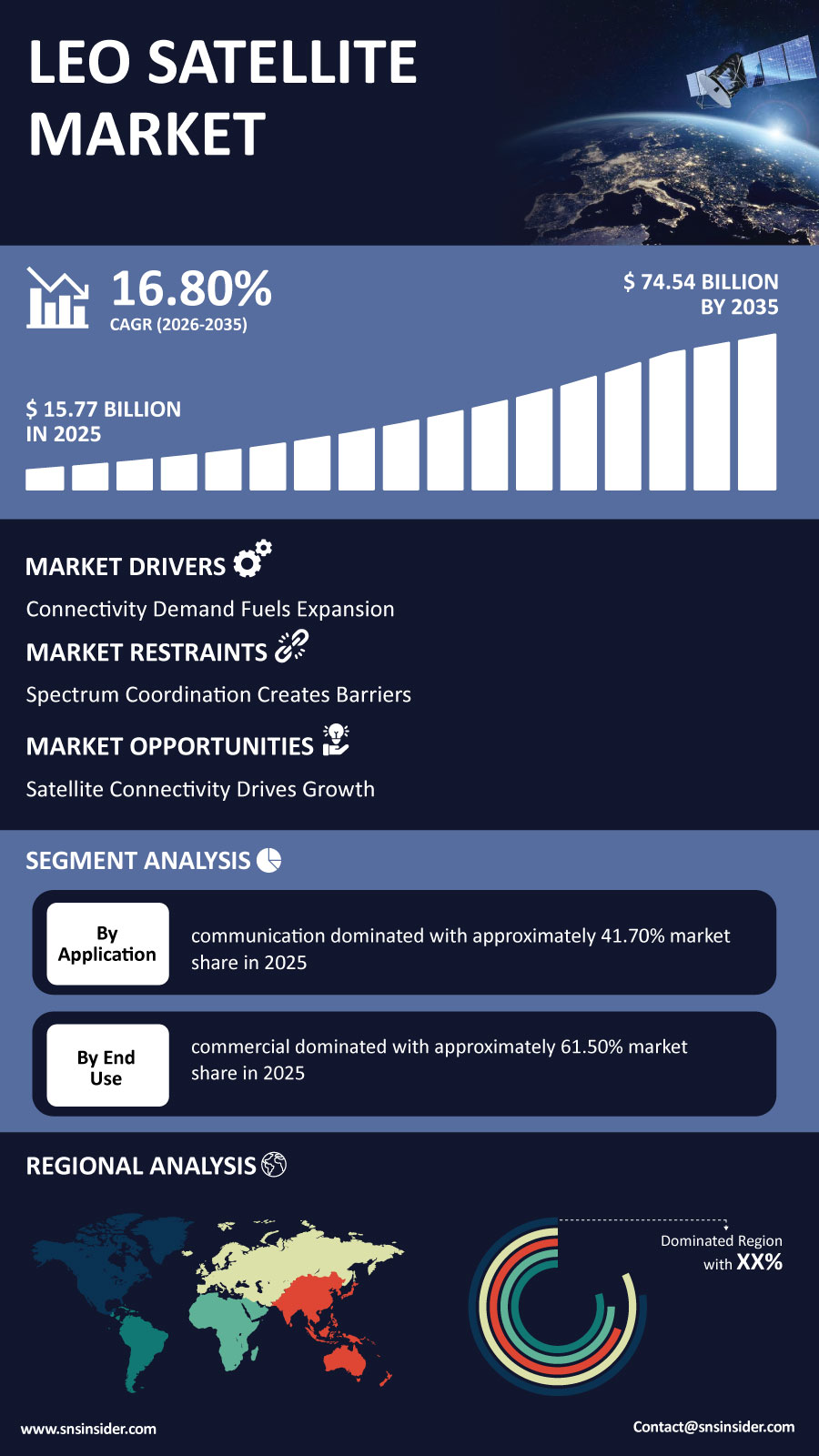
The global LEO Satellite Market is entering a phase of rapid expansion as demand for high-speed connectivity, real-time Earth observation, and next-generation space-based communication services continues to accelerate worldwide. According to a recent study by SNS Insider, the global LEO Satellite Market size valued at USD 15.77 billion in 2025, is anticipated to grow to USD 74.54 billion by 2035, registering a CAGR of 16.80% over the 2026–2035 forecast period.
Increases in satellite constellation spending, development in reusable rocket technology, and reduced costs of deployment are changing the commercial space business. The government and private sector players are building satellite networks to enhance internet coverage, boost their national security abilities, and meet needs in big-data applications.
Additionally, the fast developments in satellite miniaturization, on-board processing capabilities, and launch facilities are increasing the availability of LEO satellites to communication firms, Earth observation businesses, and military institutions.
To Get Detailed Insights on the LEO Satellite Market – Request a Sample Report
Expanding Satellite Constellations Unlock New Growth Opportunities
The global demand for connectivity solutions in far-flung areas, marine activities, air transport, and underserved areas will keep driving investments in large LEO constellations. Private companies are scaling up their constellation systems to offer broadband services as well as enable enterprise connections.
Furthermore, greater adoption of sophisticated satellite technologies such as electric propulsion, AI-powered onboard computing, and modern payload platforms is enhancing efficiency as well as increasing mission lifespan. Such developments will boost the commercial prospects of large-scale satellite constellations and open up new possibilities in the telecommunications, earth observation, and defense industries.
Greater cooperation between governments, launch service providers, and satellite builders is contributing towards market growth through the development of infrastructure and commercial programs.
Key Market Insights Highlight Shifting Demand Patterns
By propulsion type, electric propulsion systems segment held approximately 58.30% of global market revenue in 2025 due to their superior fuel efficiency and suitability for long-duration constellation operations. Liquid fuel propulsion is projected to register the fastest growth, expanding at a CAGR of 17.85% through 2035 as demand increases for satellites requiring enhanced orbital maneuverability and mission flexibility.
Based on application, communication satellites segment led with 41.70% of market revenue in 2025, supported by expanding broadband connectivity services and commercial satellite networks. Earth observation and remote sensing are forecast to witness the fastest growth at a CAGR of 18.35% as governments and enterprises increase investments in geospatial intelligence, disaster monitoring, environmental analysis, and infrastructure management.
By end use, commercial organizations segment dominated with approximately 61.50% of market revenue in 2025, reflecting growing adoption across telecommunications, enterprise connectivity, and digital infrastructure projects. Government and defense applications are projected to record the fastest growth through 2035 as countries continue strengthening secure communications, surveillance capabilities, and national space programs.
Advanced Space Technologies Continue to Reshape Global Connectivity
The industry of Low Earth Orbit (LEO) satellites continues to develop at a fast pace, with satellite operators incorporating AI and edge computing technology into their satellite platforms. The adoption of such innovations allows for more efficient processing of information on-board and for decreased communication latency.
There is a growing need for the development of satellite services used in precision farming, environmental observations, disasters prevention and response, maritime communications, aircraft communications, and military reconnaissance. As digital economies grow, satellite infrastructure becomes a significant part of communication networks.
North America Leads the LEO Satellite Market as the U.S. Holds 68% Regional Share; Asia Pacific Grows at 18.34% CAGR
North America will continue to be the largest regional market during the forecast period due to substantial commercial investments, high-launch capability, and presence of leading satellite manufacturers/constellations. Continuous innovations in reusable launch systems along with increase in government spending on such programs add on to regional dominance.
The Asia-Pacific region is estimated to become the fastest-growing regional market over the forecast period with a CAGR of around 18.34% till 2035. Increasing investment in satellite projects of individual countries, commercial space development, more launches, and increasing demands of broadband internet are fuelling the market growth.
As countries continue strengthening domestic space capabilities and satellite manufacturing infrastructure, regional demand for LEO satellite technologies is expected to accelerate significantly.
Industry Participants Focus on Innovation and Constellation Expansion
Competition across the LEO satellite market continues to intensify as companies expand constellation deployments, develop advanced satellite platforms, and invest in next-generation communication technologies. Industry participants are emphasizing launch efficiency, onboard intelligence, scalable manufacturing, and integrated connectivity solutions to support the growing demand for global broadband and Earth observation services.
Key companies operating in the global LEO Satellite Market include SpaceX (Starlink), Amazon (Project Kuiper), Eutelsat/OneWeb, Telesat (Lightspeed), Planet Labs PBC, Airbus Defense and Space, Thales Alenia Space, Boeing, Lockheed Martin Corporation, Northrop Grumman, Iridium Communications Inc., Globalstar, Inc., AST SpaceMobile, Maxar Technologies Inc., Kepler Communications, NanoAvionics, Kongsberg NanoAvionics, Spire Global, Satellogic, and Tyvak Nano-Satellite Systems.
An SNS Insider analyst Sushant Kadam commented, “The rapid expansion of commercial satellite constellations, continuous reductions in launch costs, and growing demand for global connectivity are reshaping the space economy. Organizations investing in advanced satellite technologies, scalable deployment capabilities, and innovative communication services will be well positioned to benefit from the market's long-term growth trajectory.”
About the Author

Get in touch




