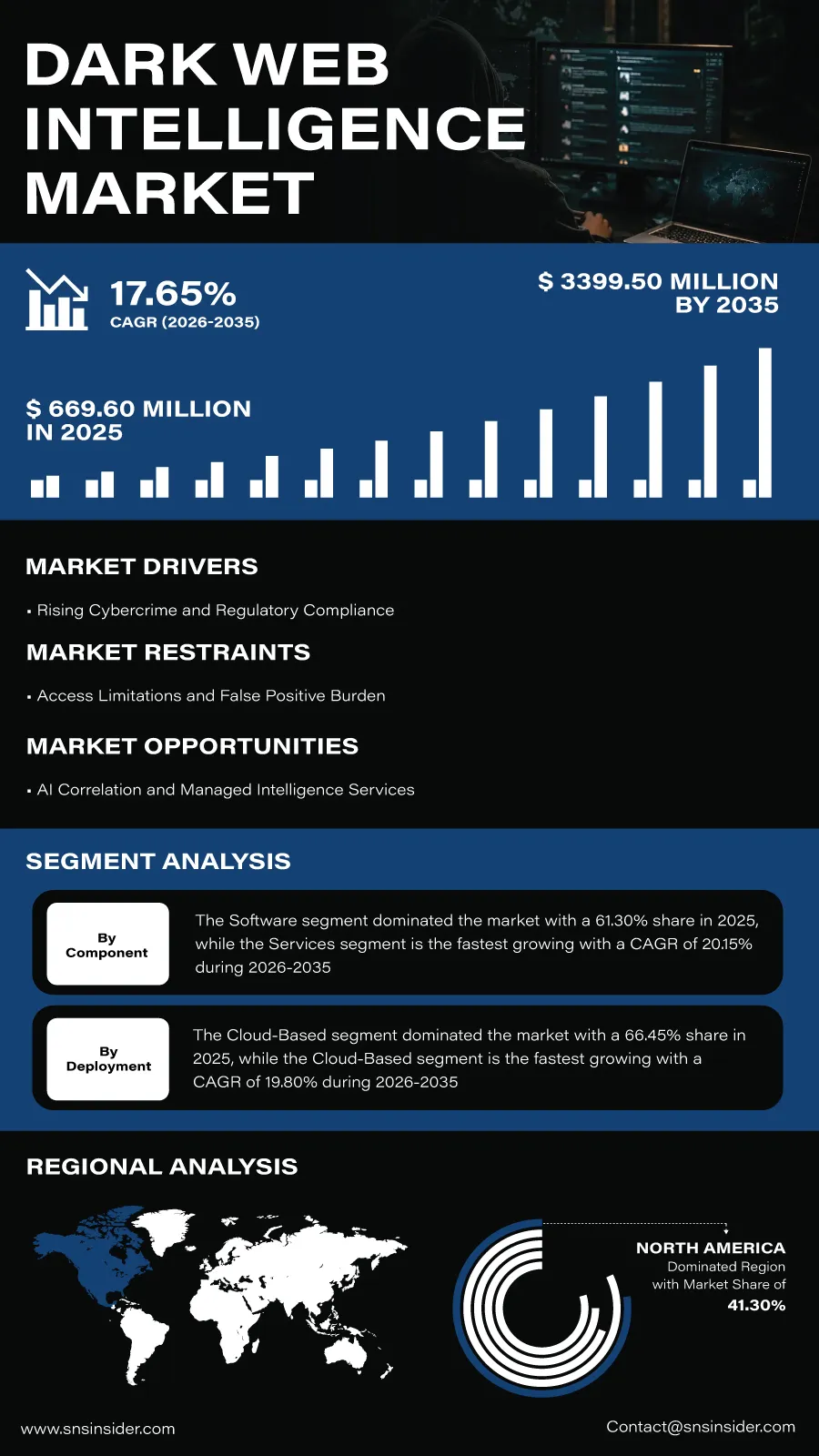
The Dark Web Intelligence Market is driven by the rising frequency of cyberattacks, increasing data breaches, growing ransomware threats, and the need for proactive threat detection and real-time monitoring of cybercriminal activities. “According to a recent study by SNS Insider, the global Dark Web Intelligence Market, valued at USD 669.60 million in 2025, is projected to reach USD 3,399.50 million by 2035, registering a CAGR of 17.65% across the 2026-2035 forecast period.”
Dark web intelligence platforms collect and analyze activity from criminal forums, marketplaces, and encrypted channels so security teams can learn of a breach, a leaked credential, or a planned attack early. Vendors increasingly pair automated collection with analysts who hold access to closed communities.
To Get Detailed Insights on the Dark Web Intelligence Market – Request a Sample Report
Rising Cybercrime and Regulatory Compliance Fuel Growth
The rise in cybercrime and the growing sophistication of cyber threats continue to widen demand as ransomware groups and access brokers trade stolen data in underground channels. Regulatory compliance requirements reinforce this trend by rewarding early detection of exposed data.
Providers are responding with AI that correlates underground signals with enterprise attack surface data, and with integrations that push alerts directly into SIEM and SOAR platforms.
Segment Findings Point to a Market in Transition
Software led the market in 2025 with a 61.30% share, while services are growing fastest at a 20.15% CAGR. Cloud Deployment Segment has a 66.45% share and also shows the highest growth rate of 19.80%. Large organizations form 66.90% of the total market, although small and medium organizations show the highest growth rate of 19.35%.
Data leak and credential monitoring leads by application at a 31.75% share, while threat actor tracking is growing fastest at 22.10%. BFSI leads by end user at 29.60%, with healthcare growing fastest at 21.25%.
North America Leads, Asia Pacific Set to Grow Fastest
The North American region held the biggest market share in terms of revenue in the year 2025, holding 41.30%, owing to the presence of several target industries and vendors in the region. The United States formed a major portion of this regional market.
The APAC region is expected to grow at the highest CAGR of around 21.95% until 2035, due to the high digitization rates in China, India, Japan, and South Korea and the increasing cybercrime in the region. Europe will continue to play an important role, while LATAM and MEA regions will also show good growth rates.
Consolidation and Formal Evaluation Reshape Competitive Dynamics
Competition increasingly centers on collection depth and analytic quality, as payment networks and security platforms acquire intelligence providers and analyst firms begin formally ranking vendors. Mastercard's acquisition of Recorded Future and Gartner's first Magic Quadrant for the category illustrate the shift.
Some of the major companies operating in the global dark web intelligence market include Recorded Future, CrowdStrike Holdings, Inc., Flashpoint, ZeroFox Holdings, Inc., Google LLC, Group-IB, SpyCloud, Inc., Flare Systems Inc., Cybersixgill Ltd., and Intel 471 Inc.
Looking ahead, the pace of AI adoption, continued vendor consolidation, and rising ransomware activity are likely to determine which providers gain the most share over the coming decade. Vendors that combine deep underground access with prioritized, integrated alerts are expected to be best placed for the market's sustained growth.
An SNS Insider Analyst, Sakshi Kale, commented, "This market continues to benefit from rising cybercrime and the maturing of intelligence platforms into formally benchmarked products. Providers that pair deep underground access with AI-driven prioritization are best positioned to capture the next phase of demand, particularly across Asia Pacific's fast-growing digital economies."
About the Author

Get in touch