The global Modified Starch Market is on a steady growth path through 2035, as processed food demand and expanding industrial applications continue reshaping how this versatile ingredient gets used worldwide.
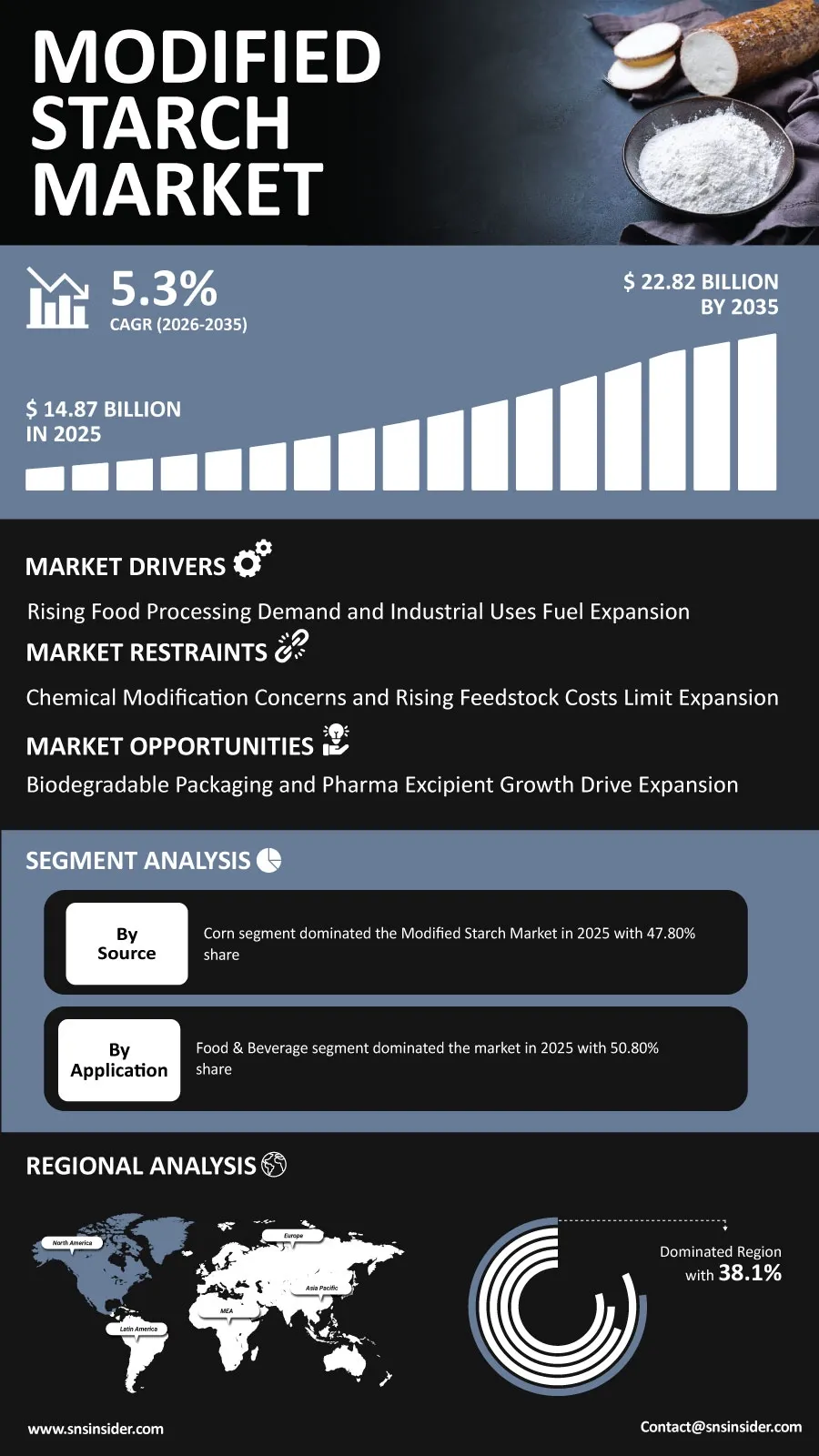
“According to a recent study by SNS Insider, the global Modified Starch Market size valued at USD 14.87 billion in 2025, is anticipated to grow to USD 22.82 billion by 2035, registering a CAGR of 5.3% over the 2026-2035 forecast period.”
Modified starch rarely gets much credit for what it actually does, quietly holding together sauces, soups, and processed foods through heat, freezing, and acidic conditions that would break down native starch entirely. That functional reliability has made it close to indispensable across packaged food manufacturing, even as the ingredient itself stays largely invisible to the consumers who benefit from it.
Clean-label pressure is reshaping which modification methods manufacturers actually use, more than any single new application is, as physically and enzymatically modified starches gain ground over traditional chemical modification in response to consumer scrutiny of ingredient lists.
To Get Detailed Insights on the Modified Starch Market – Request a Sample Report
Industrial Applications Open a New Growth Frontier
Where modified starch has traditionally been a food and beverage ingredient first, industrial applications, particularly paper sizing, textile finishing, and increasingly biodegradable packaging coatings, are emerging as a genuinely significant growth category in their own right.
This shift is partly regulatory, as tightening restrictions on PFAS and other synthetic barrier chemicals in food-contact packaging push manufacturers toward starch-based coating alternatives that can deliver comparable performance.
Ingredient suppliers investing in starch-based packaging coating technology are positioning themselves to capture a meaningfully different customer base than the food and beverage manufacturers that have traditionally defined this market.
Key Market Findings Highlight High-Growth Segments
Corn held the largest share of the Modified Starch Market in 2025, at 47.80%, reflecting its extensive, well-established global supply chain and cost efficiency relative to other starch sources.
Cassava is the fastest-growing source, expanding at a 5.12% CAGR, pulled forward by its superior paste clarity and stability in confectionery and beverage applications.
By application, food & beverage led with 50.80% share in 2025, while industrial applications are growing fastest, at a 5.62% CAGR, as starch-based coatings substitute for synthetic chemicals in packaging.
Physically modified starch remained the largest modification type at 52.10% share, but enzymatically modified starch is climbing fastest, also at a 5.62% CAGR, as manufacturers seek clean-label alternatives to chemical modification.
Clean-Label Credibility and Functional Performance Anchor Competitive Positioning
Manufacturers are increasingly being evaluated on clean-label credibility and functional performance simultaneously, a combination that used to be treated as a trade-off rather than something achievable together.
Investment in enzymatic and physical modification technology is becoming a genuine competitive differentiator among larger ingredient suppliers, while smaller players without that investment increasingly compete only in commodity, chemically modified segments.
This trend is expected to accelerate further as clean-label expectations continue spreading from premium food products into mainstream packaged food formulation.
North America Leads as Asia Pacific Grows Fastest
North America holds the largest share of global market revenue, anchored by a deeply established processed food manufacturing base and substantial corn wet-milling infrastructure. Asia Pacific, meanwhile, is growing fastest, propelled by rapid urbanization and a surge in processed and convenience food consumption across China and India.
Europe holds a meaningful, mature share as well, shaped by strong food safety regulation and growing interest in enzyme-modified and resistant starch solutions.
Leading Companies Drive Innovation and Competition
Competition in this market centers on modification technology, clean-label formulation capability, and regional production capacity nearly as much as on price, with significant capacity investment reshaping the competitive landscape among larger ingredient suppliers.
Some of the major companies that operate in the global modified starch market are Ingredion Incorporated, Cargill, Incorporated, Roquette Frères, Tate & Lyle plc, Archer Daniels Midland Company, Royal Avebe U.A., Emsland Group, Grain Processing Corporation.
An SNS Insider Analyst Parry Kardani commented, “Modified starch has earned its place as one of the food industry's more quietly essential ingredients, and the suppliers capturing the fastest-growing parts of this market are the ones investing in enzymatic and physical modification technology that delivers clean-label credibility without sacrificing functional performance. As industrial applications like biodegradable packaging coatings continue opening up, manufacturers with strong technical formulation capability are best positioned to lead.”
About the Author

Get in touch