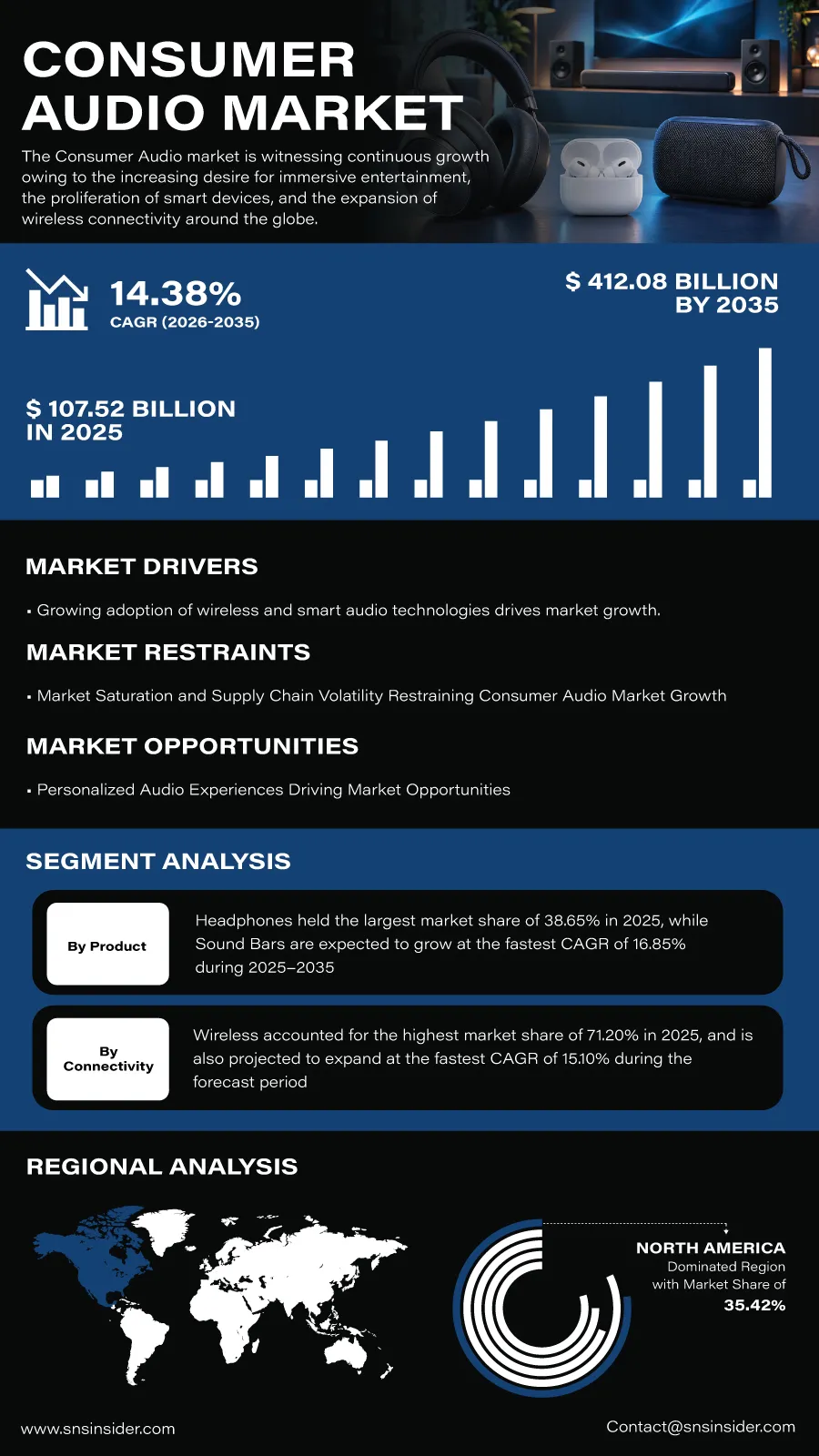
The global Consumer Audio Market is experiencing substantial growth as consumers increasingly invest in wireless entertainment devices, smart audio systems, and premium sound technologies that enhance personal and home entertainment experiences. “According to a recent study by SNS Insider, the global Consumer Audio Market size, valued at USD 107.52 billion in 2025, is anticipated to reach USD 412.08 billion by 2035, registering a CAGR of 14.38% over the forecast period.”
The increasing use of wireless headphones, true wireless stereo (TWS) earbuds, smart speakers, and advanced home entertainment systems is changing the way listeners prefer to listen to music in the international market. The increasing penetration of smartphones, availability of more streaming platforms, and improvements in Bluetooth technology are motivating consumers to opt for portable audio solutions. The incorporation of technologies such as active noise cancellation, spatial audio, and high-quality audio are contributing to the rise in demand for premium products.
With the increasing involvement of digital entertainment in everyday tasks, the audio consumer products are no longer limited to playing music. The gaming industry, the remote work industry, fitness training, and home automation have opened up avenues for the manufacturers to design products that serve multiple purposes. Furthermore, the increasing interest in AI-based audio processing, integration with voice assistants, and immersive entertainment technologies have inspired the manufacturers to innovate products.
To Get Detailed Insights on the Consumer Audio Market – Request a Sample Report
Wireless Audio Adoption and Smart Entertainment Technologies Create New Growth Opportunities
The swift transition from wire-based devices to wireless ones is emerging as one of the key growth catalysts for the consumer audio industry, with consumers valuing the aspect of convenience and connectivity. With advancements in Bluetooth technology, such as Bluetooth 5.3 and LE Audio, better connections, reduced power consumption, and enhanced audio capabilities are made possible. TWS earbuds and wireless headphones have turned into necessary peripherals for smartphone owners, while the usage of smart speakers and sound systems has been gaining momentum.
The growing popularity of immersive audio technologies is opening up further possibilities in the fields of gaming, entertainment at home, and professional communication. The increasing preference among consumers for high-quality headphones and soundbars incorporating spatial audio, Dolby Atmos, and noise cancellation features is a major factor. Increased investment in gaming gear, as well as in video streaming platforms, is driving the demand for low latency audio gadgets and home cinema systems. Hotels, restaurants, and other businesses are also making investments in audio technology to facilitate communication.
On the other hand, growing market saturation and price competition pose problems for manufacturers in the already existing product categories. The high market penetration of inexpensive headphones and loudspeakers in the developed countries has pushed companies to distinguish their products using software options and better sound quality. The availability of components, batteries, and semiconductors can also have an impact on manufacturing costs. As a result, manufacturers are focusing on product development, energy efficiency, sustainability and expanding their product range in various price segments.
Key Market Insights Highlight Shifting Demand Patterns
By product, Headphones accounted for approximately 38.65% of global Consumer Audio Market revenue in 2025, reflecting widespread adoption across personal entertainment, gaming, professional communication, and fitness applications. The segment is set to continue enjoying robust demand for TWS earphones, wireless over-ear headphones, and noise-cancelling headphones due to their convenience and better listening experience. Product improvements, along with increasing consumer interest in audio performance, have been driving the replacement demand. The Sound Bars are expected to grow the fastest at a CAGR of about 16.85% till 2035 owing to upgrading of traditional TV speakers to compact home theaters providing an immersive sound experience.
Based on connectivity, the Wireless segment dominated the market with approximately 71.20% of revenue in 2025, supported by the growing preference for cable-free listening and seamless integration with smartphones, tablets, televisions, and smart home devices. Improvements in Bluetooth connection, low latency, and battery efficiency have enhanced the attractiveness of wireless audio products for various uses. Growth of the Wireless segment will be the fastest, with an estimated CAGR of 15.10%. This growth is drive by the continued development of audio products that incorporate high connectivity capabilities.
By application, the Commercial segment captured approximately 28.45% of market revenue in 2025, driven by increasing deployment of audio equipment across corporate offices, conference rooms, retail establishments, and professional communication environments. With hybrid work becoming the norm and the rising requirement for video conferencing solutions, there is a push for organizations to adopt quality microphones, speakers, and headsets. In addition, the hospitality sector is expected to record the highest growth rate at a CAGR of about 17.25%, as more hotels, resorts, restaurants, and entertainment destinations adopt quality distributed audio solutions.
Immersive Entertainment and AI-Powered Audio Technologies Strengthen Market Demand
Rising demands by consumers on personalized and high-end entertainment experience are prompting manufacturers to introduce innovative sound processing technologies in everyday audio gadgets. Adaptive noise cancellation, active sound optimization, spatial sound, and high-resolution audio wireless codecs have become essential features of premium headphones, earphones, and even home entertainment systems. Digital music streaming, video entertainment, and gaming platforms are having their effects on buying choices made by consumers looking for audio equipment capable of maintaining performance consistency across various formats of media content and platforms.
Moreover, artificial intelligence and voice assistance capabilities have further diversified functions available on consumer audio gadgets. Devices that adjust sound characteristics based on the level of noise in surroundings, personal preferences of users, and other factors are now appearing in the market. Smart speakers become a part of home automation system and enable people to control appliances and access digital services using voice commands. In addition, fitness-oriented earbuds and other audio gadgets offer new product differentiation opportunities. These innovations are expected to strengthen consumer engagement and support continued demand for advanced audio technologies.
North America Leads Consumer Audio Market with 35.42% Share as Asia Pacific Registers Fastest Growth at 16.55% CAGR
North America retained its leading share in the world Consumer Audio Market, representing around 35.42% share of the global market revenue in 2025. This market leadership was facilitated by the region's high purchasing power among consumers, high demands for luxury entertainment equipment, and early adaptation to wireless and smart audio equipment. Presence of well-known audio brands, efficient electronic commerce and retail distribution network, along with rising investments in the gaming and home entertainment systems will further enhance the regional demand. US is the dominant market in the region, which has Consumer Audio Market worth around USD 32.85 billion in 2025 and will be growing at a CAGR of around 13.40%, to reach USD 115.52 billion by 2035. Increasing demand for premium wireless headphones, smart speakers, soundbars, and connected home entertainment solutions is expected to sustain market expansion across the country.
The highest regional growth rate is expected from Asia Pacific with a forecasted CAGR of around 16.55% during 2035, driven by the high penetration rate of smartphones, rising disposable income levels, and higher consumption of digital entertainment content. China, India, Japan, and South Korea are turning out to be major markets for wireless earphones, portable speakers, gaming headphones, and smart home audio systems. China is accounting for almost 52% of Asia Pacific's consumer audio demand owing to the presence of a well-developed electronics manufacturing industry in the country and an active presence of audio technology companies. Growing access to affordable wireless devices, expanding online distribution channels, and increasing interest in premium sound experiences are creating substantial growth opportunities across the region.
Industry Participants Focus on Premium Audio Innovation and Connected Ecosystems
Innovation in the consumer audio industry has become synonymous with the competition for the best sound quality, connectivity features, intelligence and integration into the digital world. Top brands are focusing on creating superior noise cancellation, spatial audio solutions, personalized audio technologies and enhanced battery life of their audio devices. Additionally, the firms have been growing their footprint in the categories of premium headphones, true wireless earbuds, smart speakers, sound bars and gaming audio accessories.
Apple is still working to enhance its audio ecosystem via the innovations of AirPods technologies, adaptive sound capabilities, and integration with other connected devices. Sony, on the other hand, will continue to focus on premium headphones, high resolution audio, entertainment systems, and noise cancellation technology. Meanwhile, Samsung Electronics continues to invest in Galaxy Buds, in addition to audio products that cater to the home entertainment market. This includes integration of products with smartphones, televisions, and connected home platform technologies. The company Bose has been known for premium listening solutions via its QuietComfort product line.
Key companies operating in the global Consumer Audio Market include Apple Inc., Sony Corporation, Samsung Electronics Co., Ltd., Bose Corporation, Sennheiser Electronic GmbH & Co. KG, Harman International, Google LLC, Amazon.com, Inc., JBL, Shure Incorporated, LG Electronics, Sonos, Inc., Vizio Holdings Corp., Logitech International S.A., Skullcandy, Inc., V-Moda, Master & Dynamic, Audio-Technica Corporation, Panasonic Holdings Corporation, and Xiaomi Corporation.
An SNS Insider analyst, Sushant Kadam, commented, “The increasing adoption of wireless audio devices, rising demand for immersive entertainment, and growing integration of artificial intelligence into consumer electronics are reshaping the global consumer audio industry. As consumers seek greater convenience, personalized sound experiences, and seamless connectivity across digital ecosystems, manufacturers that prioritize advanced audio technologies, product differentiation, and affordable premium features will be well positioned to capture emerging opportunities across personal entertainment, smart homes, gaming, and commercial applications.”
About the Author

Get in touch