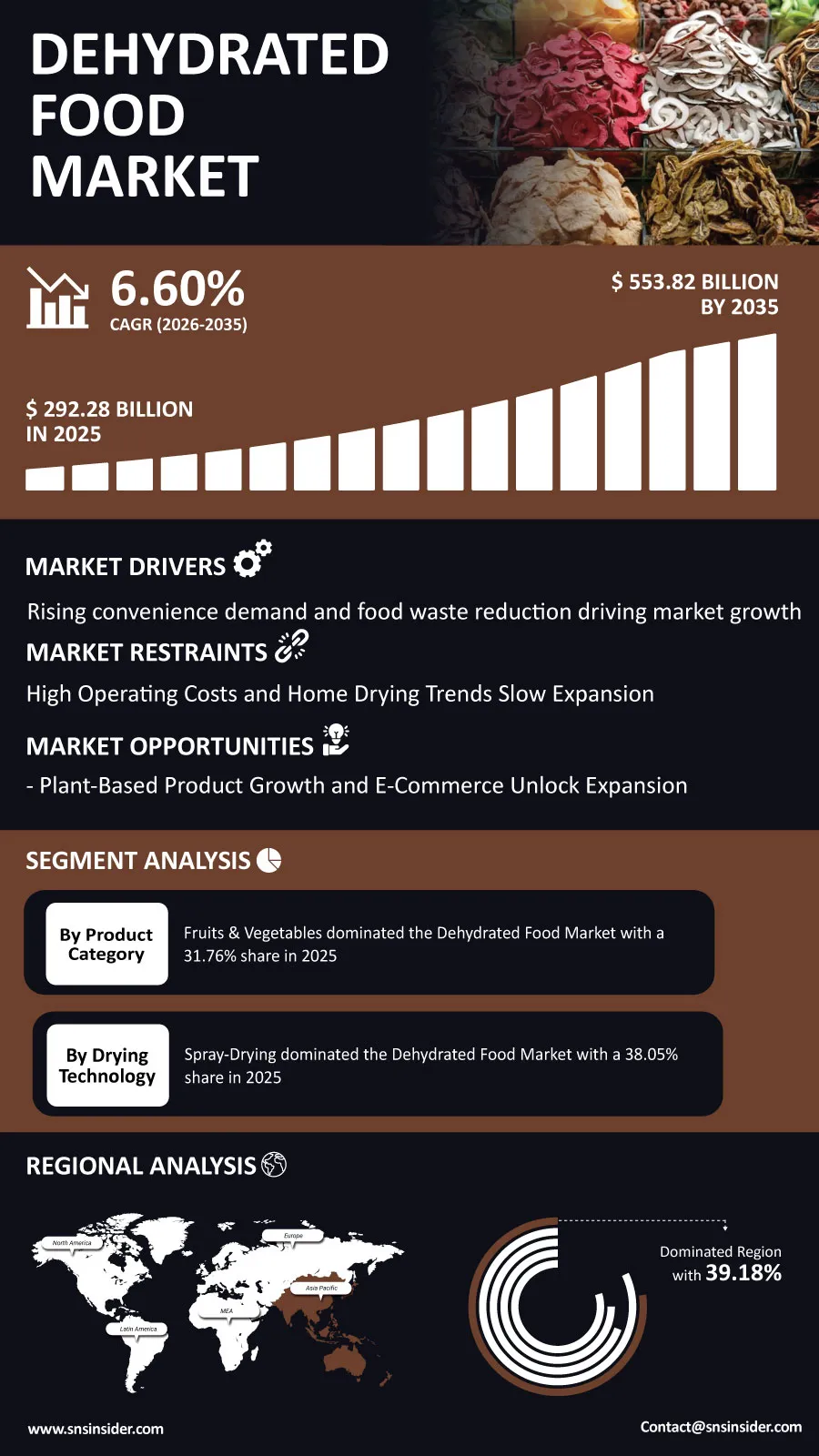
The global Dehydrated Food Market is set for significant expansion as convenience demand and food waste reduction priorities continue to reshape shelf-stable food consumption worldwide. “According to a recent study by SNS Insider, the global Dehydrated Food Market size valued at USD 292.28 billion in 2025, is anticipated to grow to USD 553.82 billion by 2035, registering a CAGR of 6.60% over the 2026–2035 forecast period.”
There have been notable changes within food dehydration technology over time, due to which many manufacturers who aim at improving nutrient retention and product quality can take advantage of this trend. This includes the need for more advanced drying techniques that will provide food companies with the ability to deliver shelf-stable products without compromising flavor and nutrition. This applies in situations where dehydrated food supports snacks, ready-to-eat meals, and industrial food manufacturing applications. Manufacturers are constantly working hard to ensure that their dehydrated food products perform better than before in order to meet various convenience and nutritional preservation requirements.
To Get Detailed Insights on the Dehydrated Food Market – Request a Sample Report
Freeze-Drying and Nutraceutical Powder Innovation Creates New Demand
The dehydrated food market has evolved from basic moisture-removal preservation to increasingly sophisticated, nutrient-retentive processing technology. The growing investment in freeze-drying capability, hybrid drying systems, and nutraceutical powder development across manufacturers of all sizes has required the development of more advanced and versatile dehydrated food products.
New drying and formulation techniques can increase nutrient retention, improve flavor preservation, and allow for expansion into increasingly diverse functional, organic, and premium dehydrated product categories. This gives manufacturers the possibility to meet growing consumer demand for convenient, shelf-stable, and nutritionally preserved food options.
Dehydrated food manufacturers, ingredient suppliers, and retailers are increasingly cooperating thanks to the growing interest in developing future solutions for convenient, nutrient-dense dehydrated food products.
Key Market Findings Highlight High-Growth Segments
The fruits and vegetables segment dominated all categories in the dehydrated food market share with 31.76% of total revenue in 2025 due to long shelf life and versatility across food applications. The fastest growing category is expected to be nutraceutical and functional powders which will grow at an 8.74% CAGR through 2031, owing to growing demand for concentrated, health-positioned products.
By drying technology, spray-drying commanded 38.05% of market share due to its cost, quality, and throughput balance. Freeze-drying will see the fastest growth in revenue generation at a 7.12% CAGR, driven by its superior ability to preserve aroma, flavor, and heat-sensitive nutrients.
Based on nature, the conventional segment captured 85.60% of market revenue owing to cost-effectiveness and widespread availability. On the other hand, organic products will be the segment recording the fastest revenue growth at a 15.05% CAGR, supported by growing clean-label and premium positioning demand.
Distributive end-use trends are changing as well. Industrial applications accounted for 49.22% of market revenue owing to dehydrated food's role as a raw material input for downstream food manufacturing. But retail will turn out to be the fastest-growing end-use category through 2031, on the back of growing direct-to-consumer convenience and outdoor recreation demand.
Nutrient Retention, Convenience, and Clean-Label Positioning Gain Importance
In this regard, food manufacturers and consumers have been looking at dehydrated food products that would deliver more nutrient retention while requiring less preparation time and offering greater shelf stability.
Innovation in freeze-drying capability, hybrid drying systems, and nutraceutical powder formulation has been making it possible for companies to come up with products that appeal to increasingly health-conscious and convenience-focused consumers. In addition to that, increasing emphasis on organic and clean-label positioning is also making it possible for manufacturers to find solutions that meet evolving premium consumer expectations. Such trends are likely to become even more prominent in the future.
Asia Pacific Emerges as the Largest and Fastest-Growing Market with 39.18% Regional Revenue Share
The Asia Pacific region represented the largest share of regional market revenue in 2025 at 39.18%, and is also forecast to advance at the fastest 7.42% CAGR through 2031, helped by vast raw-material bases and rising disposable incomes across the region's major economies.
Leading Companies Drive Innovation and Competition
The environment continues to stay very dynamic since players continue innovating on drying technology and nutrient retention as well as forming partnerships in order to enhance their position in the industry. Some of the major companies that operate in the global dehydrated food market are Nestlé, Unilever, Ajinomoto, European Freeze Dry, OFD Foods, Olam International, Conagra Brands, McCormick & Company, The Kraft Heinz Company, and General Mills.
An SNS Insider analyst Santosh Bhul commented, "The growing consumer demand for convenient, shelf-stable, and nutritionally preserved foods is creating sustained opportunities across industrial and retail dehydrated food segments. Manufacturers that successfully combine drying technology innovation, nutrient retention capability, and organic positioning will be best positioned to capitalize on emerging opportunities across conventional and specialty dehydrated food categories."
About the Author

Get in touch