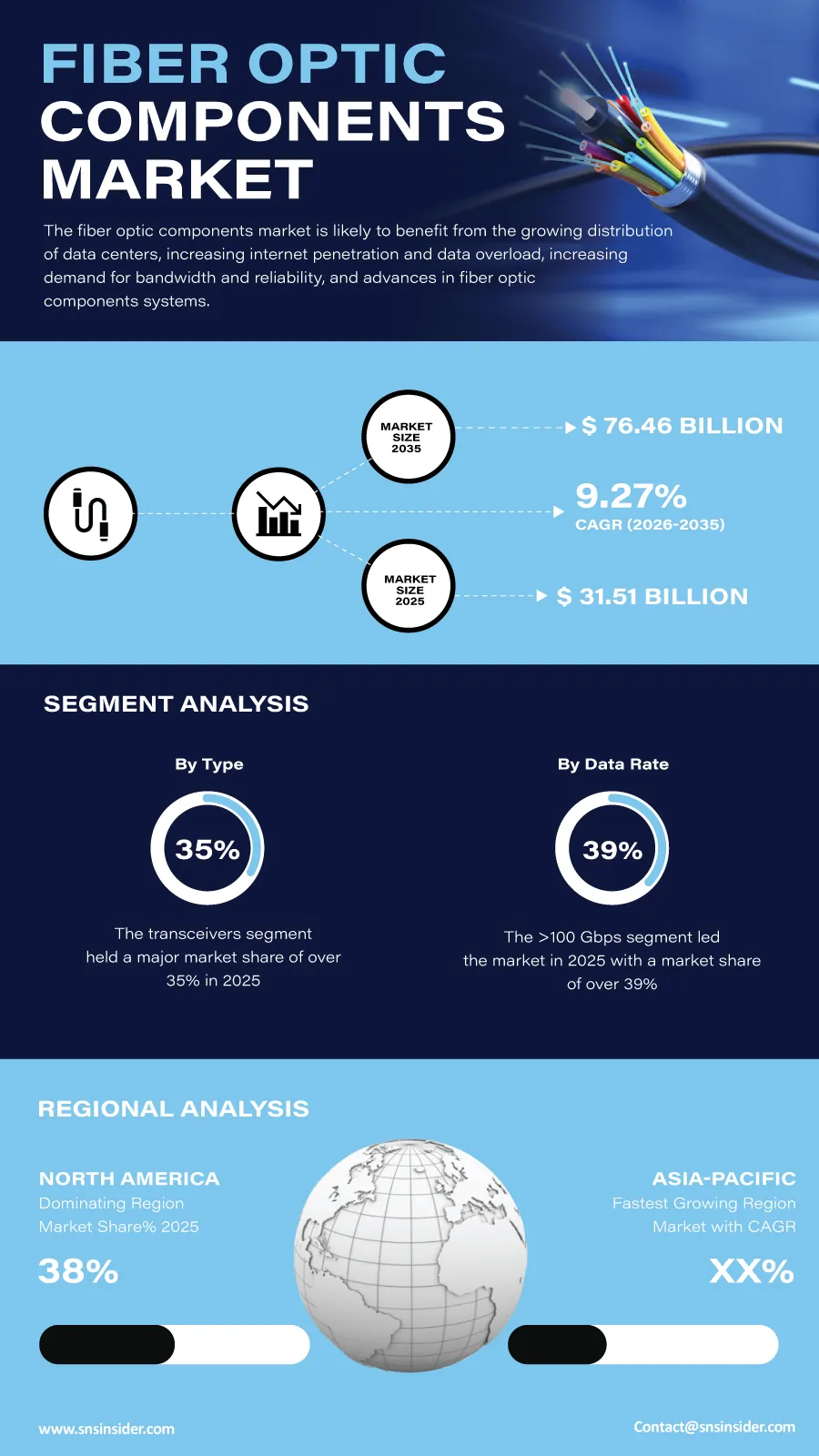
The global Fiber Optic Components Market is positioned for sustained growth as expanding data center capacity, rising internet traffic, and next-generation communication networks increase demand for high-performance optical connectivity. “According to a recent study by SNS Insider, the global Fiber Optic Components Market size valued at USD 31.51 billion in 2025, is anticipated to grow to USD 76.46 billion by 2035, registering a CAGR of 9.27% over the 2026–2035 forecast period.”
The quick adoption of AI, cloud computing, and 5G technology is transforming the demand for network infrastructure among industries. Telecom providers and tech firms are developing optical systems that will be able to handle increased amounts of data, fast transmission rates, and dependable connections on geographically dispersed networks.
Components made from fiber optic technology have become more important in densely packed computer setups where data transmission is critical for cloud computing, corporate applications, and digital platforms. This has been encouraging manufacturers to increase their product line.
To Get Detailed Insights on the Fiber Optic Components Market – Request a Sample Report
Data Center Expansion Creates New Growth Opportunities
The emerging trend toward the use of hyperscale data centers and AI-computing platforms is offering ample room for component manufacturers in the optical industry. With the growing need for high-speed interconnects, companies are expected to invest in transceivers and optical switches, which will facilitate bandwidth-hungry applications.
Another notable growth driver will be the upgrading of telecommunications infrastructure. Fiber-based networks will be installed by network operators to ensure faster Internet access, better mobile backhaul capacity, and rising consumption of digital services. Besides, fiber-based networks are being established in developing countries to facilitate urbanization, industrial digitalization, and broadband access.
Meanwhile, advances in optical integration and high-speed transmission technologies are helping improve network scalability and energy efficiency, strengthening the market's long-term growth prospects.
Key Market Insights Highlight Shifting Demand Patterns
By type, transceivers held around 35% of market revenue in 2025, supported by their essential role in converting electrical and optical signals across telecommunications networks and data centers. Demand is increasing as operators upgrade infrastructure to accommodate 100G, 400G, and higher-speed connections.
Based on data rate, components supporting speeds above 100 Gbps captured more than 39% of market revenue in 2025. Their adoption is supported by AI workloads, high-performance computing, and data-intensive cloud applications. The 10–40 Gbps segment is projected to grow at the fastest rate during 2026–2035 as enterprise networks, metropolitan infrastructure, and data centers continue upgrading their connectivity capabilities.
By application, analytical and medical equipment accounted for more than 40% of market revenue in 2025, reflecting the importance of optical technologies in diagnostic instruments and precision measurement systems. Distributed sensing is expected to experience faster growth through 2035 as infrastructure monitoring, environmental assessment, and industrial applications increasingly use fiber-based sensors to measure temperature, strain, and pressure across extensive areas.
AI Networking and Advanced Optical Technologies Transform Connectivity
In addition, the introduction of optical components in future computing infrastructures is presenting new chances for manufacturers of optics. The co-packaged optics, optical interconnects, and high-bandwidth transceivers have gained prominence as technology firms look to enhance bandwidth density and power utilization in AI data centers.
Moreover, the growth in smart manufacturing, smart infrastructures, and industrial automation is driving the need for optical communication networks. The optical fiber technology provides benefits such as long-distance capability and immunity to electromagnetic interference.
North America Maintains 38% Market Share as Asia Pacific Advances 5G and Data Center Investments
North America was a share of approximately 38% of market revenue in 2023, as per the provided market statistics, owing to the presence of robust telecommunications infrastructure, well-developed technology ecosystem, and significant investments in data centers.
The Asia Pacific region is expected to witness the highest regional market growth rate from 2026 to 2035. Telecommunications infrastructure development, digitalization of manufacturing, 5G technology implementation, and data center infrastructure development in China, India, Japan, and other regional countries are anticipated to drive adoption.
Broadband programs implemented by the government and increased demand for cloud services are adding momentum to the importance of this region as a growth hub for optical connectivity technologies.
Industry Participants Focus on Optical Innovation
Increasing competition in the fiber optics components industry will be defined by innovations in areas, such as transmission capabilities, energy consumption, miniaturization, and integration. Companies are creating technologies that will help to achieve high-density networks and increasing connectivity needs due to artificial intelligence.
Key companies operating in the global Fiber Optic Components Market include Lumentum Holdings Inc., Sumitomo Electric Industries, Ltd., II-VI Incorporated, Broadcom Inc., Accelink Technologies Co., Ltd., Acacia Communications, Inc., Fujitsu Optical Components, Oclaro, EMCORE Corporation, Furukawa Electric Co., Ltd., Corning Incorporated, Coherent Corp., Hexatronic Group, O-Net Technologies (Shenzhen) Group Co., Ltd., Smiths Interconnect, Source Photonics, Amphenol Corporation, TE Connectivity Plc, Huber+Suhner, and Clearfield Inc.
An SNS Insider analyst Sushant Kadam commented, “Rising AI infrastructure investment, increasing network traffic, and the transition toward higher-speed optical connectivity are creating significant opportunities for fiber optic component manufacturers. Companies that advance high-bandwidth transceivers, efficient optical interconnects, and scalable networking technologies are well positioned to benefit from continued investment in digital infrastructure.”
About the Author

Get in touch