
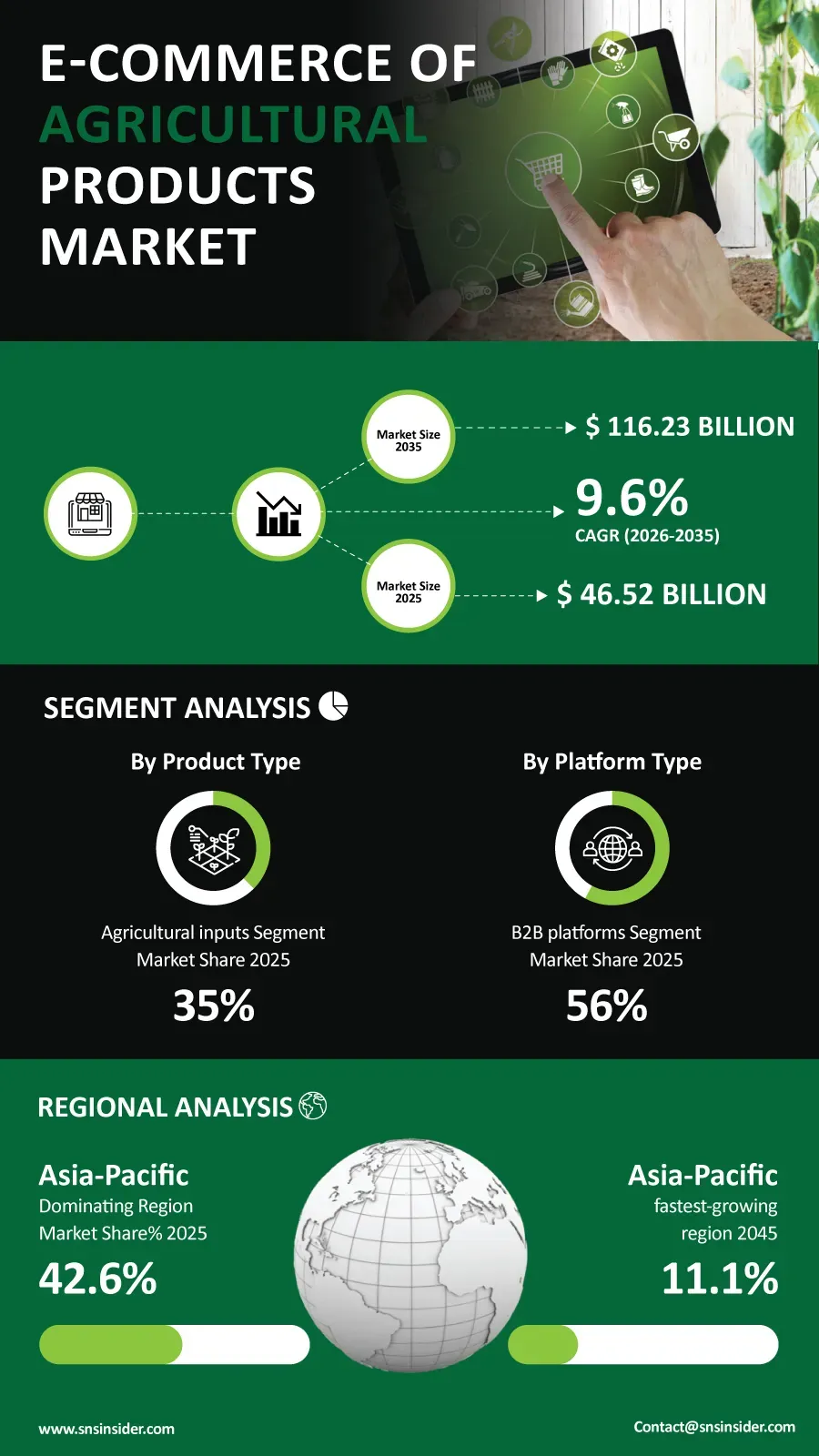
The global E-commerce of Agricultural Products Market is expected to witness robust expansion as digital technologies continue transforming agricultural trade and supply chain operations worldwide. “According to a recent study by SNS Insider, the global E-commerce of Agricultural Products Market size valued at USD 46.52 billion in 2025, is anticipated to grow to USD 116.23 billion by 2035, registering a CAGR of 9.6% over the 2026–2035 forecast period.”
The agricultural business transactions are moving fast towards digitalization as suppliers, intermediaries, retailers, and customers are adopting more online platforms to buy and sell their produce in the agricultural sector. Internet availability, increased smartphone usage, and development of the digital payment system have made it easier for farmers to participate in the modern agriculture markets and increase market transparency.
Demand for good quality agricultural produce has resulted in the increasing adoption of digital purchasing processes. Businesses are developing smart logistic systems and digital supply chain management systems to ensure the quality of products and minimize losses after harvest.
To Get Detailed Insights on the E-commerce of Agricultural Products Market – Request a Sample Report
Digital Agriculture and Marketplace Expansion Create Long-Term Growth Opportunities
Governments, agribusiness, and technologists are putting a lot of effort into developing digital agriculture projects aimed at transforming the process of food delivery and improving the agricultural value chain. The development of online agricultural marketplaces makes it possible for farmers to reach out to wider customer groups without being too dependent on the conventional intermediaries.
The fast-growing trend of B2B and farm-to-consumer sales gives new chances for agricultural companies to boost their performance and build commercial connections. Digital technologies make procurement more efficient by improving inventory management and providing better payment and finance tools.
At the same time, the development of artificial intelligence, data analytics, and supply chain management technologies helps the managers of online marketplaces to enhance the process of demand forecasting and improve the transparency of agricultural deals.
Key Market Insights Highlight Shifting Demand Patterns
Based on product type, agricultural inputs are estimated to account for 35% of global market revenue in 2025 owing to consistent demand for seeds, fertilizers, pesticides, and other essential farming materials purchased through digital platforms. The fresh fruits and vegetables segment is projected to experience the highest growth through 2035 as consumers increasingly prefer farm-fresh, traceable produce supported by expanding cold-chain logistics and direct delivery services.
By platform type, B2B platforms are expected to contribute 56% of total market revenue in 2025 due to their ability to facilitate large-scale procurement between farmers, distributors, wholesalers, and retailers while improving supply chain coordination. B2C platforms are anticipated to record the fastest growth during the forecast period as digital marketplaces enable producers to establish direct relationships with consumers through mobile applications and online commerce channels.
In terms of end users, farmers held approximately 42% market share in 2025 because of growing adoption of digital platforms for purchasing agricultural inputs and marketing harvested produce. Retailers are forecast to witness the fastest expansion through 2035 as businesses increasingly utilize online sourcing platforms to improve procurement efficiency and meet rising consumer demand for fresh agricultural products.
Among business models, the marketplace-based model represented 63% of total market revenue in 2025, while the hybrid model is expected to emerge as the fastest-growing segment owing to its ability to combine marketplace scalability with greater inventory control and enhanced customer experience.
Advanced Digital Technologies Accelerate Agricultural Commerce Transformation
The agricultural e-commerce ecosystem is fast changing with technology advancements being utilized to boost efficiency in the entire supply chain system. Artificial Intelligence, traceability with use of blockchains, cloud-based inventory management systems, digital payments and predictive analytics have made it easier for businesses to become efficient and ensure greater transparency in agriculture deals.
There have been developments in logistics, automation systems, and financial services by marketplace owners, which make it easy for both farmers and agribusiness to manage their procurement, distribution, and interaction of customers within one digital ecosystem.
Asia Pacific Held 42.6% of the E-commerce of Agricultural Products Market Share in 2025; North America Projected to Witness Significant Growth Through 2035
It is estimated that Asia Pacific will hold the largest share of the market in 2025 at 42.6%. The region's dominance in the market can be attributed to large-scale agriculture production, high levels of digitization in most countries, increased smartphone penetration, and development of online agricultural markets in China, India, and Southeast Asia. Continuous efforts of the governments in supporting digitization of agriculture and development of logistical facilities continue to favor the region's leadership in the global market.
North America will be one of the leading regions in the future due to high levels of digitization, strong logistics networks, and use of precision agriculture technologies. Increased investment in farm management systems and traceability solutions will fuel regional market growth.
Europe will maintain a strong momentum of expansion in the market as the region experiences an increase in demand for quality agricultural products. Latin America and the Middle East & Africa are offering emerging trends in the market due to improved internet access and investments in digital payment systems and agricultural modernization to help farmers reach buyers locally and internationally.
Industry Participants Focus on Digital Innovation and Supply Chain Efficiency
The competitive landscape remains highly dynamic as leading technology companies, agricultural marketplaces, and agribusiness solution providers continue investing in digital platforms, intelligent logistics, traceability technologies, and integrated supply chain services. Continuous innovation in marketplace functionality, financial solutions, and customer experience is enabling companies to strengthen their competitive position while supporting the digital transformation of global agricultural commerce.
Key companies operating in the global E-commerce of Agricultural Products Market include Alibaba Group, Amazon, JD.com, Walmart, Flipkart, BigBasket, Ninjacart, AgroStar, DeHaat, Udaan, Tridge, Farmers Business Network, Corteva Agriscience, BASF Digital Farming Solutions, Bayer CropScience, Rivigo Agri Marketplace, ProducePay, Agrofy, Zalando Fresh, and Olam Group.
An SNS Insider analyst Sakshi Kale commented, "The accelerating digitalization of agriculture is reshaping how producers, businesses, and consumers interact across the food value chain. Companies investing in intelligent digital marketplaces, advanced logistics infrastructure, and data-driven supply chain solutions will be well positioned to capitalize on the growing demand for transparent, efficient, and technology-enabled agricultural commerce worldwide."
About the Author

Get in touch




