
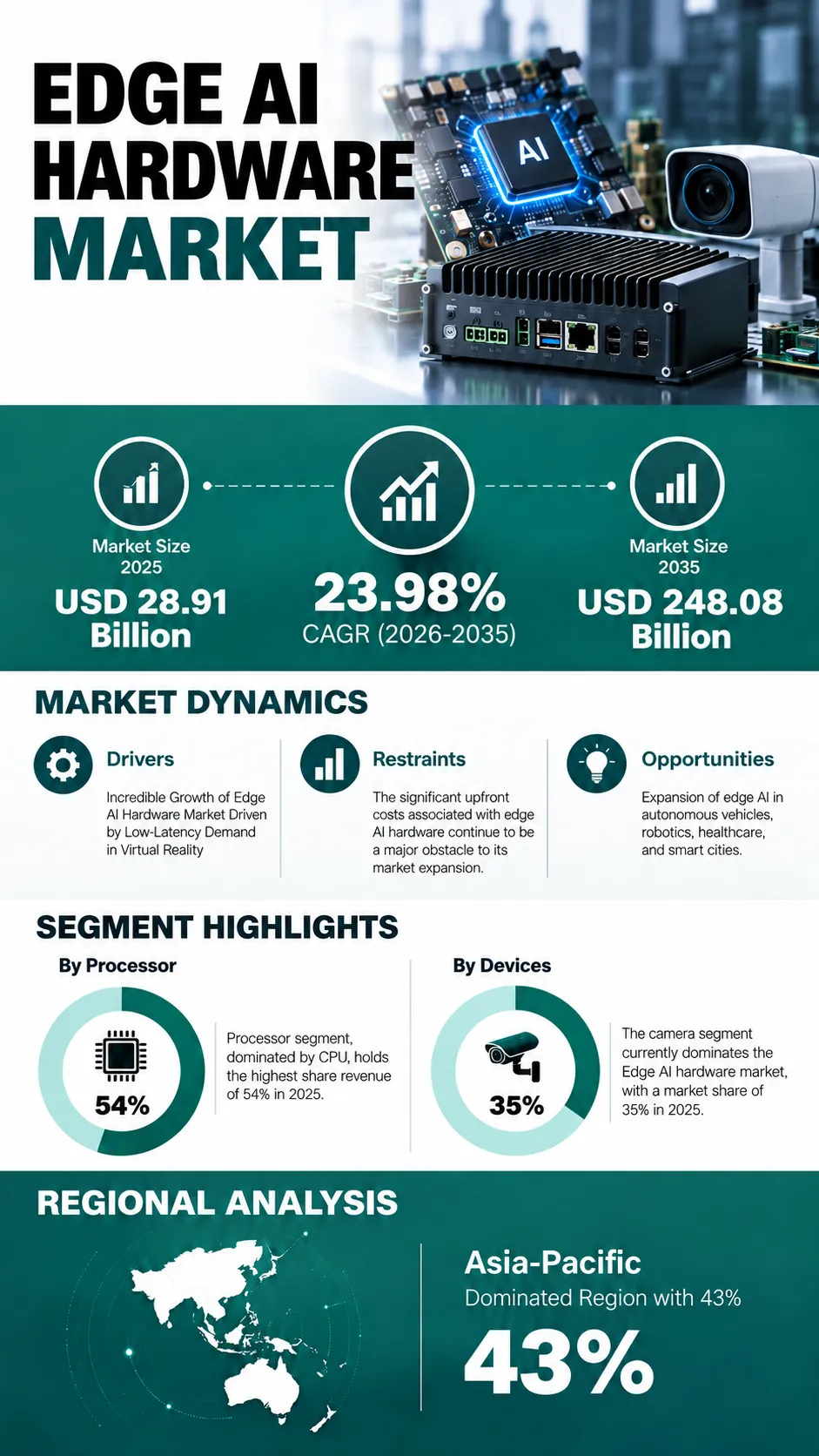
The Edge AI Hardware Market will experience a period of rapid growth, as more companies move their artificial intelligence processes closer to the edge. “According to a recent study by SNS Insider, the global Edge AI Hardware Market size valued at USD 28.91 billion in 2025, is anticipated to grow to USD 248.08 billion by 2035, registering a CAGR of 23.98% over the 2026–2035 forecast period.”
With the quick expansion of connectivity across manufacturing, health care, automotive, agriculture, and consumer electronics, the need for on-site AI processing is increasing rapidly. There is a desire for increased speed, less reliance on cloud services, and increased responsiveness in use cases where timely processing and decisions are necessary.
Progress in AI accelerators, processors, GPUs, and neural processors is making possible more advanced uses of edge devices. This is facilitated by integration with IoT and 5G networks, which allows for intelligent camera work, robotics, autonomous operations, and even immersive experiences.
To Get Detailed Insights on the Edge AI Hardware Market – Request a Sample Report
Demand for Real-Time AI Processing Creates New Growth Opportunities
Ultra-low-latency computing needs are increasingly acting as an important driver of edge AI hardware implementations. Virtual reality, games, simulations, training and interactive processes need fast computations for ensuring smooth performance, thus pushing the developers towards executing AI processes at the device level.
Moreover, media and entertainment firms have begun considering the possibilities of using the edge for performing video enhancement, video compression, optimization of video content and low latency delivery. Within businesses, local AI computations can lead to quicker decision making while cutting down the volume of information transferred to remote data centers.
The expensive cost of advanced GPUs, TPUs, edge servers and other special processors can serve as a stumbling block for the adoption of edge AI. In addition, power requirements, maintenance costs and non-standardized pricing can affect investment decisions.
Key Market Insights Highlight Shifting Demand Patterns
By processor, the CPUs are anticipated to contribute 54% of global market revenue by 2025 based on the wide range of application of CPUs in the fields of smartphones, industry equipment, IoT devices, and other edge computing platforms. The GPUs will grow at a faster rate among all the processors till 2035 due to its capacity to perform parallel processing.
Based on devices, cameras are forecasted to be the market leaders with a revenue share of 35% in 2025. AI cameras are gaining significance for their use in surveillance applications, advanced driver assistance systems, robotics, and real-time visual analytics. The segment with the highest growth potential will be that of smartphones, as more functions are added to the smartphones such as speech recognition and image processing.
AI-Enabled Devices Strengthen the Shift Toward Local Computing
Edge AI hardware has been widely adopted in applications that could be impacted by any delays or reliance on the cloud. Smart factories could use local intelligence to monitor and control machinery, and healthcare providers could process information from the medical devices connected to the network.
One more promising direction in the development of Edge AI includes the automotive industry as AI solutions at the Edge could help in making autonomous driving, driver assist, car monitoring, and transportation networks smart. The development of energy-efficient processors will enable the application of complex AI inference at the Edge.
Asia Pacific Leads with 43% Revenue Share as North America Drives Edge AI Market Growth
Asia Pacific will generate nearly 43% of global revenue shares in 2025, thus being the largest market geographically. The high capital investments into artificial intelligence, semiconductor development, robotics, IoT, and advanced manufacturing technologies in China, Japan, South Korea, and India are contributing to the wide adoption. The vast electronics manufacturing sector is further stimulating the creation of edge AI devices.
North America is forecast to exhibit the highest growth rate up to 2035 due to huge investments into AI infrastructure, as well as presence of large technology firms and semiconductor manufacturers. The increasing implementation of edge AI in the automotive, enterprise computing, smart cities, and industrial sectors is driving the regional demand.
Industry Participants Focus on AI Acceleration and Energy Efficiency
The competitive landscape is characterized by rapid innovation in processors, AI accelerators, embedded computing platforms, and specialized hardware. Leading companies are focusing on improving computational performance while reducing power requirements and enabling developers to deploy increasingly complex AI models directly on edge devices.
Key companies operating in the global Edge AI Hardware Market include NVIDIA Corporation, Google (Alphabet Inc.), Intel Corporation, Huawei Technologies Co., Ltd., Apple Inc., Qualcomm Incorporated, Samsung Electronics Co., Ltd., IBM Corporation, Dell Technologies Inc., Microsoft Corporation, ARM, Hailo, MediaTek Inc., Xilinx Inc., Micron Technology, Marvell Technology, Inc., Baidu, Inc., Ambarella, Inc., Advanced Micro Devices (AMD), and Cambricon Technologies.
An SNS Insider analyst Sushant Kadam commented, “The rapid expansion of connected devices and the growing need for immediate AI-driven decisions are accelerating the transition toward localized computing. Hardware providers that combine high-performance AI acceleration, energy efficiency, and flexible deployment capabilities will be well positioned to capture opportunities as edge intelligence becomes increasingly embedded across enterprise and consumer applications.”
About the Author

Get in touch




