
Endometriosis Treatment Market is experiencing renewed interest within the global healthcare industry owing to rapid innovations being made by pharma companies in the area of women’s health care and the focus of healthcare practitioners on early diagnosis and management of the disease. Clinical studies and awareness campaigns coupled with the development of better treatment options are helping transform the approach to endometriosis treatment.
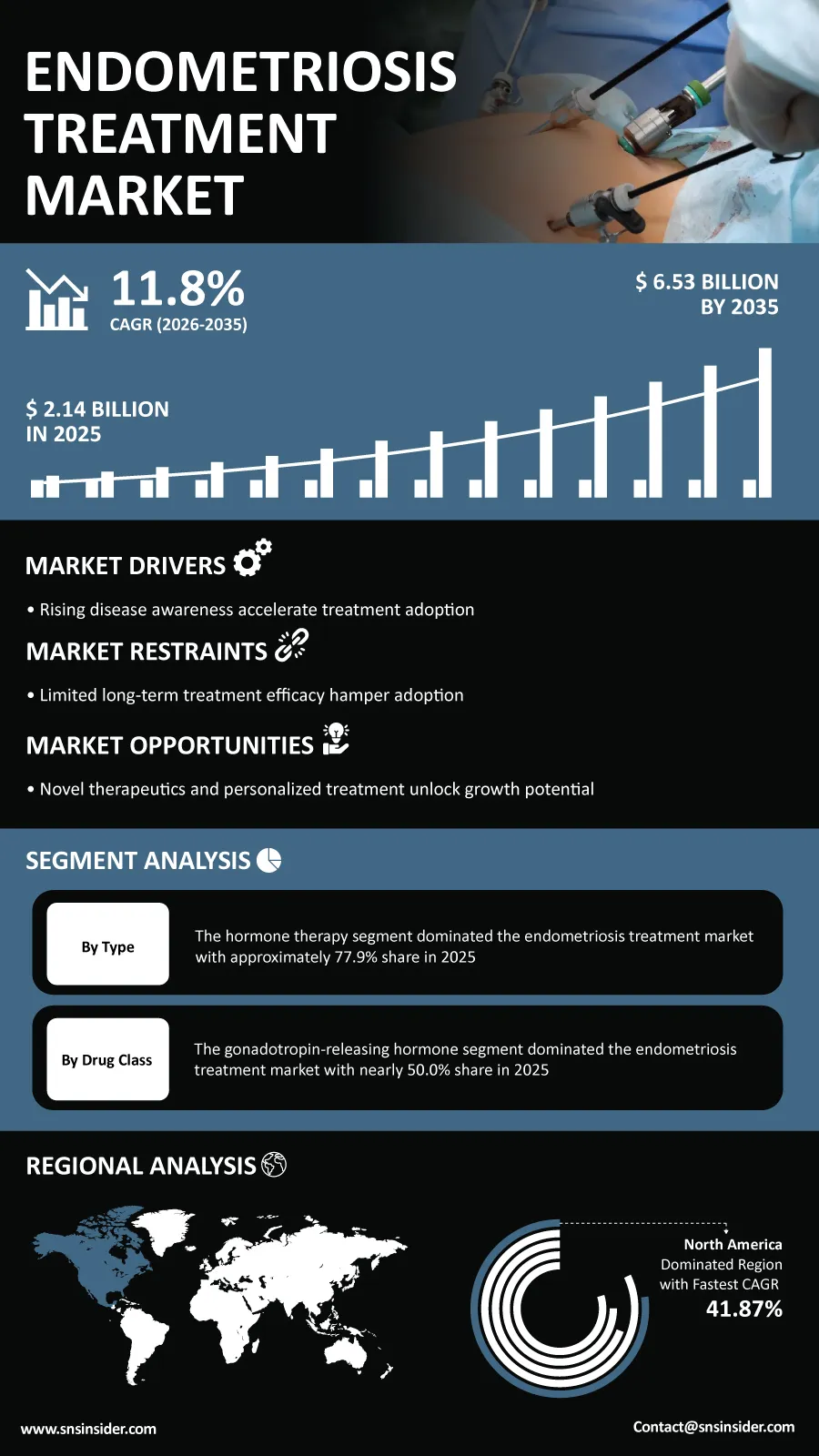
According to a recent study by SNS Insider, the global Endometriosis Treatment Market size valued at USD 2.14 billion in 2025, is anticipated to grow to USD 6.53 billion by 2035, registering a CAGR of 11.8% over the 2026–2035 forecast period. Growing recognition of reproductive health disorders, broader access to specialized gynecological care, and continuous improvements in pharmaceutical innovation are expected to support sustained market expansion worldwide.
It is becoming more common for healthcare systems to place greater emphasis on early intervention since late diagnosis has historically compromised the effectiveness of treatments. On the other hand, the development of hormonal medications, non-invasive surgery, and novel non-hormonal medications offers healthcare professionals greater options for improving their patients' health.
To Get Detailed Insights on the Endometriosis Treatment Market – Request a Sample Report
Clinical Innovation Reshapes Women's Health Treatment Landscape
Treatment options are being further diversified with the advent of treatments which are aimed at providing better symptom control along with reducing the side-effects caused by the drugs. With the advancements in the delivery of drugs, personalization of treatment as well as minimal invasive surgeries, there has been an improvement in the management of the disease.
There is also a buildup of clinical evidence from 2024 that has enhanced faith in early treatment of the condition. Clinical findings have brought a realization that patients who receive hormonal therapy on time have better chances of surviving the condition, and as such, physicians are now treating the disease earlier.
Beyond conventional hormonal approaches, manufacturers are investing in next-generation non-hormonal candidates and precision medicine programs designed to address unmet patient needs while expanding future treatment opportunities.
Market Segments Highlight Evolving Treatment Preferences
By treatment type, hormone therapy dominated the global market with approximately 77.9% of revenue in 2025, reflecting its established role in controlling disease progression and reducing symptoms. Pain medication is projected to expand at a CAGR of 9.6% through 2035 as supportive therapies remain important in comprehensive disease management.
Among drug classes, gonadotropin-releasing hormone (GnRH) therapies accounted for nearly 50.0% of market revenue in 2025 due to their effectiveness in managing moderate-to-severe disease. Oral contraceptives are forecast to grow steadily at a CAGR of 11.1%, supported by their accessibility and routine use in early-stage treatment. NSAIDs represented 15.9% of the market, while emerging therapies contributed the remaining 5.6%.
The oral route of administration generated approximately 49.1% of total market revenue in 2025, supported by patient convenience and broad availability of oral medications. Injectable therapies are expected to record the fastest growth, advancing at a 12.2% CAGR throughout the forecast period.
Across distribution channels, retail pharmacies captured approximately 52.3% of global revenue during 2025, while hospital pharmacies represented 29.9% and other channels, including online pharmacies, accounted for 17.8%. Retail pharmacies are expected to maintain the strongest growth trajectory with a 12.9% CAGR.
Regional Markets Continue Expanding Healthcare Access
The North American region emerged as the largest regional market in 2025 with a share of 41.87% in the overall market revenue, driven by the presence of developed healthcare infrastructure, awareness among women regarding their health, and availability of advanced treatment options. In the region, the U.S. held about 78.0% share of regional revenue. The U.S. Endometriosis Treatment Market was valued at USD 0.89 billion in 2025 and is estimated to grow to USD 2.71 billion by 2035, registering a CAGR of around 11.9%.
The Asia Pacific region is projected to be the fastest growing regional market during the forecast period on account of developments in government initiatives for providing better healthcare services, advancements in diagnostic facilities, and expansion in gynecology services. China held about 36.0% share of regional revenue in 2025.
Across other major regions, Germany represented approximately 24.0% of European revenue, Brazil accounted for approximately 35.0% of Latin America's market, while Saudi Arabia contributed approximately 25.0% of the Middle East & Africa revenue, reflecting ongoing investment in healthcare infrastructure and reproductive health services.
Leading Companies Strengthen Women's Health Portfolios
Competition within the market continues to intensify as pharmaceutical companies expand product pipelines, advance clinical research, and strengthen regional partnerships. During June 2024, Pfizer Inc. introduced an enhanced hormone therapy regimen designed to improve symptom management. Bayer AG expanded its hormonal therapy portfolio across Asia Pacific in October 2024, improving access to advanced treatment options in Japan and Australia. In January 2025, AbbVie Inc. broadened the clinical application of its oral GnRH antagonist therapy with enhanced dosing flexibility aimed at supporting long-term patient adherence.
Major companies operating in the global endometriosis treatment market include AbbVie Inc., Pfizer Inc., Bayer AG, Takeda Pharmaceutical Company Limited, Ferring Pharmaceuticals, Teva Pharmaceutical Industries Ltd., Merck & Co., Inc., ObsEva SA, Theramex, Sanofi S.A., Gedeon Richter Plc., Lupin Limited, Zydus Lifesciences Ltd., Dr. Reddy's Laboratories Ltd., Sun Pharmaceutical Industries Ltd., Viatris Inc., Organon & Co., Myovant Sciences GmbH, Sumitomo Pharma Co., Ltd., and Astellas Pharma Inc.
An SNS Insider analyst Parry Kardani commented, "The growing emphasis on earlier diagnosis, patient-centered treatment strategies, and continued pharmaceutical innovation is transforming the management of endometriosis worldwide. Companies investing in next-generation therapies and personalized care solutions are expected to shape the future of this rapidly evolving women's healthcare market."
About the Author

Get in touch




