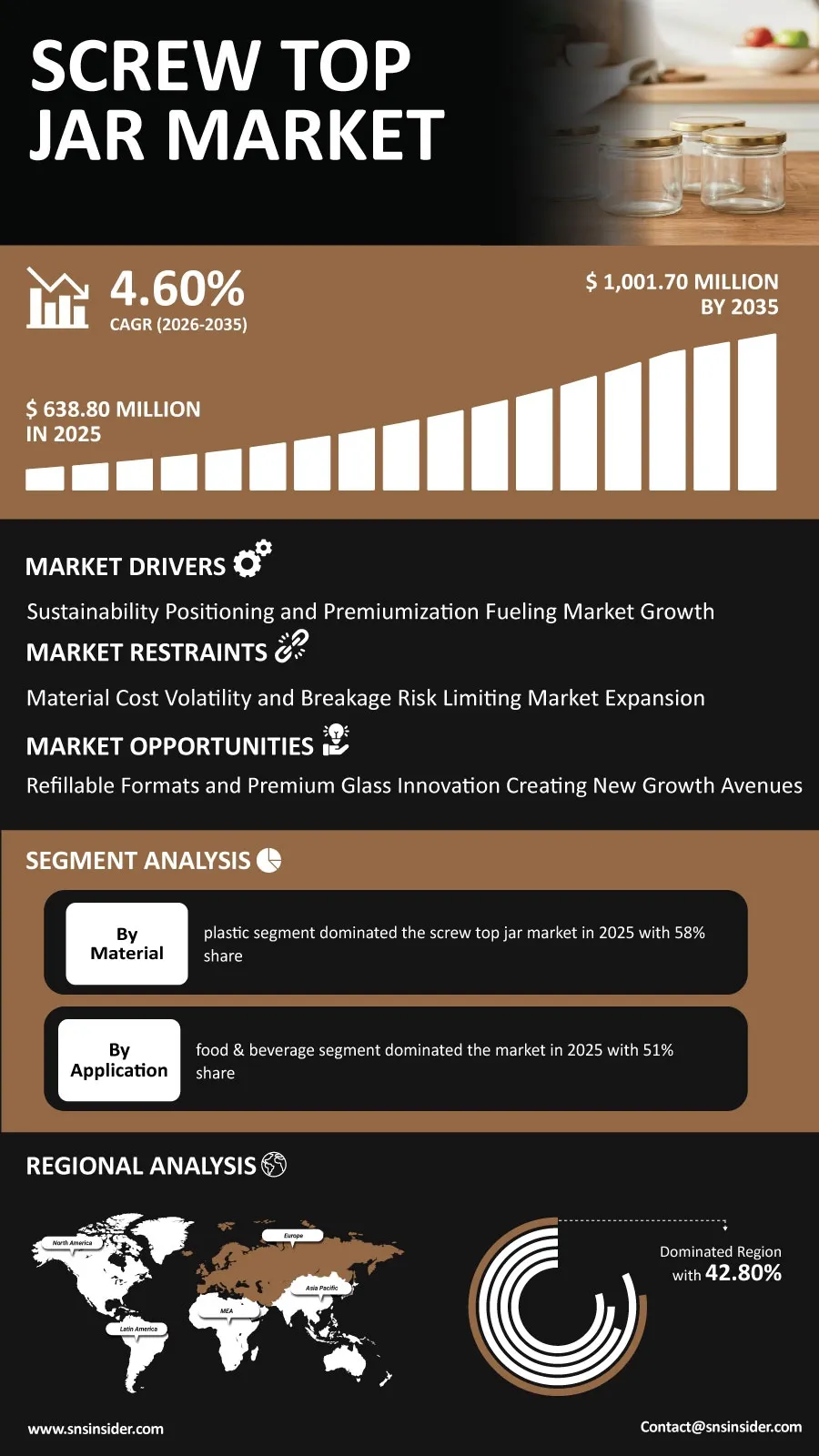
The global Screw Top Jar Market is on a steady growth path through 2035, as sustainability positioning and premiumization continue reshaping packaging choices across food, cosmetics, and pharmaceutical categories. “According to a recent study by SNS Insider, the global Screw Top Jar Market size valued at USD 638.80 million in 2025, is anticipated to grow to USD 1,001.70 million by 2035, registering a CAGR of 4.60% over the 2026-2035 forecast period.”
A screw top jar has to do something that sounds simple but genuinely is not, seal reliably, reseal just as well after opening, and look good enough on a shelf to justify its place next to flashier packaging formats. That combination has kept the format relevant for generations, even as flexible pouches and other newer formats compete for the same shelf space.
Material choice, more than any single trend, is what is reshaping this market right now, as brands weigh plastic's cost advantage against glass's premium, sustainability-forward appeal in a market where consumers increasingly notice and reward the difference.
To Get Detailed Insights on the Screw Top Jar Market – Request a Sample Report
Glass Gains Ground as Sustainability Becomes a Purchase Driver
Where plastic has long dominated the category on cost alone, glass jars are increasingly winning share among brands that want their packaging to visibly signal sustainability and quality credentials.
This shift is reshaping how brands think about packaging investment, since a glass jar increasingly needs to justify itself through both functional performance and brand positioning rather than cost efficiency alone.
Glass manufacturers investing in lightweighting and recycled-content technology are positioning themselves to capture this shift without pricing their products entirely out of reach for cost-conscious brand customers.
Key Market Findings Highlight High-Growth Segments
Plastic held the largest share of the Screw Top Jar Market in 2025, at 58%, reflecting its cost advantage and lower breakage risk relative to glass.
Glass is the fastest-growing material, expanding at a 6.20% CAGR, pulled forward by brands chasing sustainability and premium positioning.
By application, food & beverage led with 51% share in 2025, while cosmetics is growing fastest, at a 6.80% CAGR, as skin care and beauty brands favor jars for products where visual appeal matters.
Supermarkets & hypermarkets remained the largest distribution channel at 46% share, but online retail is climbing fastest, at a 7.60% CAGR, as direct-to-consumer brands scale.
Sustainability Credentials and Shelf Appeal Anchor Competitive Positioning
Brands are increasingly evaluating jar suppliers on sustainability credentials and shelf appeal nearly as much as on cost, particularly among premium food and cosmetics categories.
Investment in lightweighting, recycled content, and refillable format design is becoming a genuine competitive differentiator among larger glass manufacturers, while suppliers without that investment increasingly compete only in commodity, price-sensitive plastic segments.
This trend is expected to accelerate further as packaging waste regulation continues tightening across major markets.
Europe Leads as Asia Pacific Grows Fastest
Europe holds the largest share of global market revenue, anchored by a deep glass jar heritage and strong consumer preference for sustainable packaging reinforced by comprehensive regulation. Asia Pacific, meanwhile, is growing fastest, propelled by urbanization, middle-class expansion, and evolving packaging standards across China, India, and Southeast Asia.
North America holds a steady, mature share as well, anchored by deeply established food, cosmetics, and household product industries.
Leading Companies Drive Innovation and Competition
Competition in this market centers on sustainability credentials, material innovation, and premium design capability nearly as much as on price, with major glass manufacturers investing heavily in lightweighting and recycled-content technology.
Some of the major companies that operate in the global screw top jar market are Rayware Limited, Verallia SA, Ardagh Group S.A., Gerresheimer AG, Vidrala, S.A., Amcor plc, AptarGroup, Inc., Silgan Holdings Inc.
An SNS Insider Analyst Santosh Bhul commented, “Screw top jars have moved well past being a simple functional packaging format, brands now need genuine sustainability credentials and shelf appeal to compete, and the manufacturers capturing the fastest-growing parts of this market are the ones treating glass innovation as a real differentiator rather than a premium afterthought. As sustainability regulation and consumer expectations keep tightening globally, glass jar capability is becoming a genuine competitive advantage.”
About the Author

Get in touch