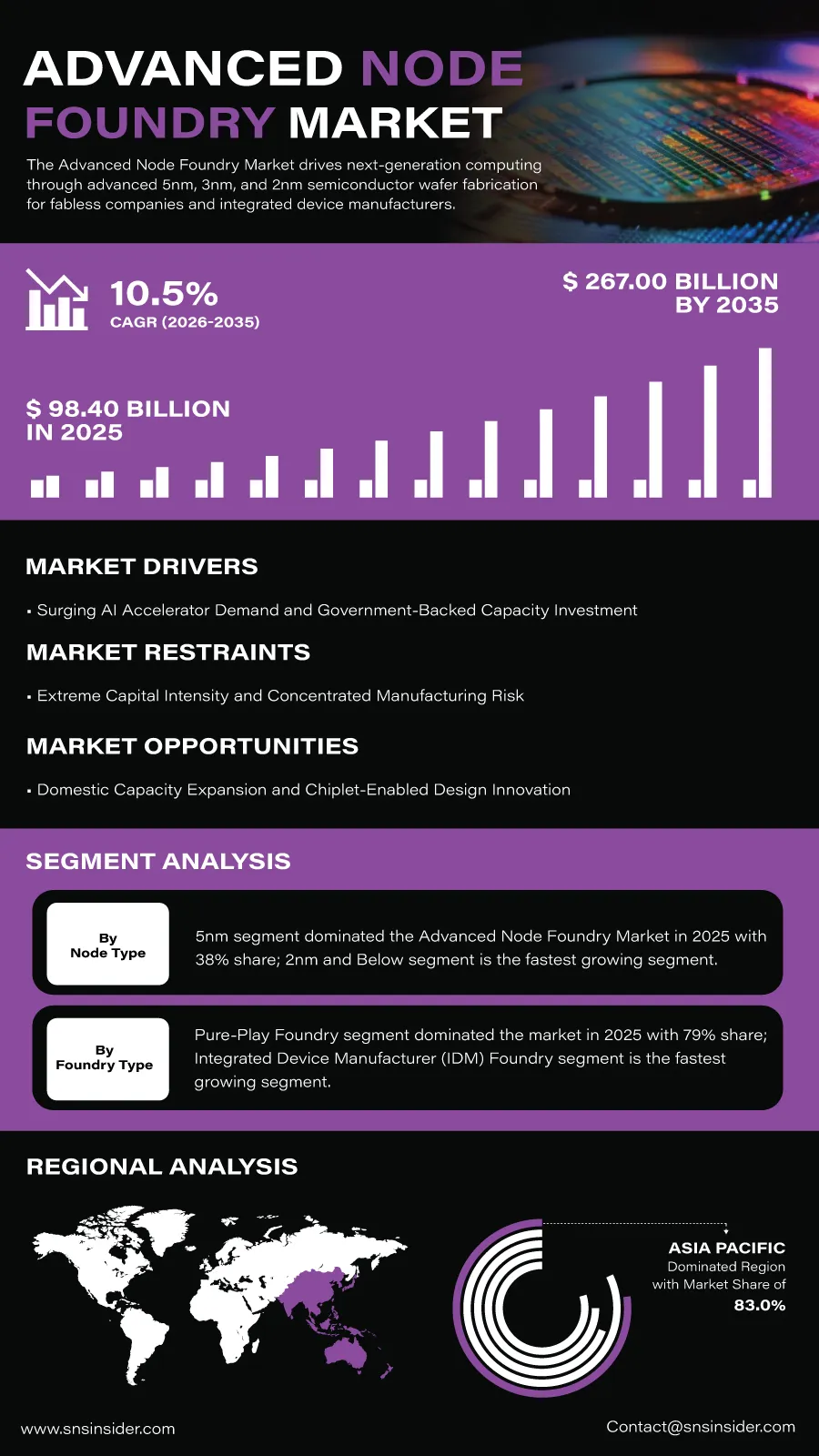
The global Advanced Node Foundry Market is witnessing significant growth as semiconductor manufacturers expand leading-edge fabrication capacity to support artificial intelligence, high-performance computing, and next-generation consumer electronics. “According to a recent study by SNS Insider, the global Advanced Node Foundry Market size, valued at USD 98.40 billion in 2025, is anticipated to reach USD 267.00 billion by 2035, registering a CAGR of 10.5% over the forecast period 2026–2035.”
The rising usage of AI accelerators, high-end phone processors, and computing technology innovations is creating a considerable need for semiconductors to be manufactured at 5 nanometers, 3 nanometers, and 2 nanometers process nodes. The designers of semiconductor chips and technology firms are increasingly becoming dependent on advanced foundries for the manufacturing of high-performance chips that have the ability to provide increased processing speed, energy efficiency, and transistor density.
As the global industrial sector continues to rely on state-of-the-art semiconductor technology, advanced node manufacturing has begun to prove itself as a key factor in the growth of digital infrastructure. Investments in AI data centers, self-driving car technology, cloud computing, and local semiconductor manufacturing have increased the need for advanced node foundry services. Government programs focused on semiconductor supply chain resilience also contribute to the trend.
To Get Detailed Insights on the Advanced Node Foundry Market – Request a Sample Report
AI Infrastructure Expansion and Advanced Semiconductor Technologies Create New Growth Opportunities
Rapid development of AI infrastructure presents a lot of prospects for advanced semiconductor foundries, as hyperscalers and IC manufacturers continue to invest in next-gen processors. In the context of AI training and inference, ever greater computational power is required to process massive amounts of data efficiently, so advanced processes allow semiconductor designers to increase transistor density and performance, which makes them crucial for HPC accelerators, GPUs, and cloud server processors.
Furthermore, increasing use of gate-all-around transistors technology continues to change the game in semiconductor manufacturing industry. Foundries are moving on to 2nm and below nodes to meet the needs of the next generation of semiconductor devices in terms of performance and power efficiency. However, at the same time, national semiconductor manufacturing projects in the US, Europe, and Asia motivate investments into domestic fabs. These developments are creating opportunities for foundry companies to expand their manufacturing footprints, strengthen customer partnerships, and develop more resilient supply chains.
However, the high amount of capital involved in the process of manufacturing state-of-the-art semiconductors is one of the most pressing issues for industry players. Creating an advanced manufacturing facility requires considerable financial costs in terms of purchasing advanced lithography tools, building clean room environments, conducting R&D activities and using specific manufacturing processes. The limited availability of advanced manufacturing capabilities is yet another risk factor for the industry that comes from having too few suppliers.
Key Market Insights Highlight Shifting Demand Patterns
By node type, the 5nm segment accounted for approximately 38% of global Advanced Node Foundry Market revenue in 2025, reflecting its established manufacturing maturity and widespread adoption across premium smartphones, AI processors, and high-performance computing applications. The existence of mature manufacturing processes and increasing manufacturing yields keeps reinforcing its position in the industry. At the same time, the 2nm and Below category is projected to experience the fastest growth until 2035 owing to the implementation of the gate-all-around transistors by the semiconductor companies to enhance process efficiency and power performance.
Based on foundry type, the Pure-Play Foundry segment dominated the market with approximately 79% of revenue in 2025. Its leadership is driven by the increasing use of fabless semiconductor firms in outsourcing their chip manufacturing to specialized third-party foundries. Pure-play foundries have an edge in terms of rich manufacturing experience, superior process technologies, and established partnerships with leading semiconductor design firms. The IDMS Foundry market segment is expected to witness the fastest growth as integrated semiconductor firms increase their external foundry business operations.
By application, Consumer Electronics captured approximately 34% of market revenue in 2025, driven by sustained demand for premium smartphones, wearable devices, and other advanced electronic products requiring efficient, high-performance processors. Leading smartphone brands will still use smaller process nodes in order to enhance performance, battery life, and computing abilities. The Data Center market segment will witness rapid growth over the forecasted period due to increased investment in AI infrastructure, cloud computing, and graphics processor/AI accelerators.
Next-Generation Computing and Domestic Semiconductor Manufacturing Strengthen Market Demand
As the need for advanced semiconductor technology becomes more critical in digital businesses, chip makers and designers are focusing on state-of-the-art fabrication techniques. AI solutions, self-driving cars, and high-performance computing environments need chips that can provide more processing power under power and heat restrictions. This change is increasing the demand for foundry services, especially as semiconductor firms develop customized chips for generative AI, cloud computing, and connected vehicles.
The integration of advanced process nodes, chiplets, and advanced packaging technology provides more opportunities for semiconductor manufacturers as well. Chiplets enable the combination of various semiconductors into one package and contribute to flexibility in design and optimization of system performance and cost of production. Foundries now make investments in advanced packaging technology, along with wafer manufacturing, to satisfy changing customer demands. The trends mentioned are likely to reinforce the position of advanced foundries in future architectures and promote cooperation between semiconductor designers, manufacturing firms, and technology infrastructure providers.
Asia Pacific Leads Advanced Node Foundry Market with 83% Share as North America Registers Fastest Growth at 14.5% CAGR
Asia Pacific will continue to dominate the Advanced Node Foundry Market and account for about 83.0% of the total global market revenue share in 2025. This is due to the region’s well-established semiconductor fabrication facilities, manufacturing prowess, and huge investment in process technology. In particular, Taiwan remains the major hub of advanced semiconductor manufacturing due to the presence of well-established foundry infrastructure and advanced fabrication facilities. South Korea is another significant contributor due to its advanced semiconductor manufacturing capabilities while Japan and China continue to invest in their respective semiconductor sectors. Asia Pacific will continue to grow at a CAGR of about 9.0% between 2026 and 2035, supported by sustained investments in advanced manufacturing technologies and semiconductor production capacity.
North America is expected to exhibit the fastest growth rate, recording a CAGR of roughly 14.5% between 2026 and 2035, driven by government incentives, investments in AI infrastructure, and growing focus on the security of the semiconductor supply chain. The United States constituted about 92% of the North American market's total revenue in 2025, with the value of its domestic Advanced Node Foundry Market being around USD 8.60 billion. The value of the U.S. market is forecasted to grow up to USD 31.90 billion by 2035. Incentives from the CHIPS and Science Act, investments in advanced fabrication capabilities, and increasing demand for domestically made AI and high-performance computing chips have been contributing to the positive manufacturing environment in the country.
Industry Participants Focus on Advanced Process Technology and Manufacturing Capacity Expansion
Competitiveness in the Advanced Node Foundry market is now defined by process technology superiority, yield improvement, production volume, and strategic customer relations. Major semiconductor producers are now pouring resources into developing 2nm and future transistor manufacturing processes. Manufacturers are also developing production sites that are located away from major manufacturing hubs in order to increase resilience and meet the rising demand for semiconductors from customers. Advanced packaging, artificial intelligence-based chip manufacturing, and state-sponsored semiconductor fabrication projects are emerging strategic focuses.
In 2025, Taiwan Semiconductor Manufacturing Company (TSMC) advanced its N2 process technology toward volume production, strengthening its capabilities in 2-nanometer manufacturing for smartphone and high-performance computing applications. Intel Foundry also progressed with its 18A process technology and external customer engagements, reflecting growing competition in advanced logic manufacturing. Samsung Foundry continued developing its gate-all-around technology and expanding its advanced semiconductor manufacturing ambitions, including investments associated with its Taylor, Texas, facility. These initiatives highlight the industry's continued focus on technological innovation, production scalability, and securing long-term customer relationships.
Key companies operating in the broader global Advanced Node Foundry Market and semiconductor foundry ecosystem include Taiwan Semiconductor Manufacturing Company Limited (TSMC), Samsung Electronics Co., Ltd. (Samsung Foundry), Intel Corporation (Intel Foundry), GlobalFoundries Inc., Semiconductor Manufacturing International Corporation (SMIC), United Microelectronics Corporation (UMC), Powerchip Semiconductor Manufacturing Corporation (PSMC), Vanguard International Semiconductor Corporation (VIS), Tower Semiconductor Ltd., Hua Hong Semiconductor Limited, Rapidus Corporation, DB HiTek Co., Ltd., Nexchip Semiconductor Corporation, Shanghai Huali Microelectronics Corporation, X-FAB Silicon Foundries SE, SkyWater Technology, Inc., SK Keyfoundry Inc., Sony Semiconductor Manufacturing Corporation, Infineon Technologies AG, and STMicroelectronics N.V.
An SNS Insider analyst, Sushant Kadam, commented, “The rapid expansion of artificial intelligence infrastructure, growing demand for high-performance processors, and increasing government investment in semiconductor manufacturing are transforming the advanced node foundry industry. As chip designers prioritize computational efficiency, manufacturing reliability, and secure access to leading-edge fabrication capacity, foundry operators capable of delivering advanced process technologies, scalable production, and geographically diversified manufacturing services will be well positioned to capitalize on the industry's long-term growth opportunities.”
About the Author

Get in touch