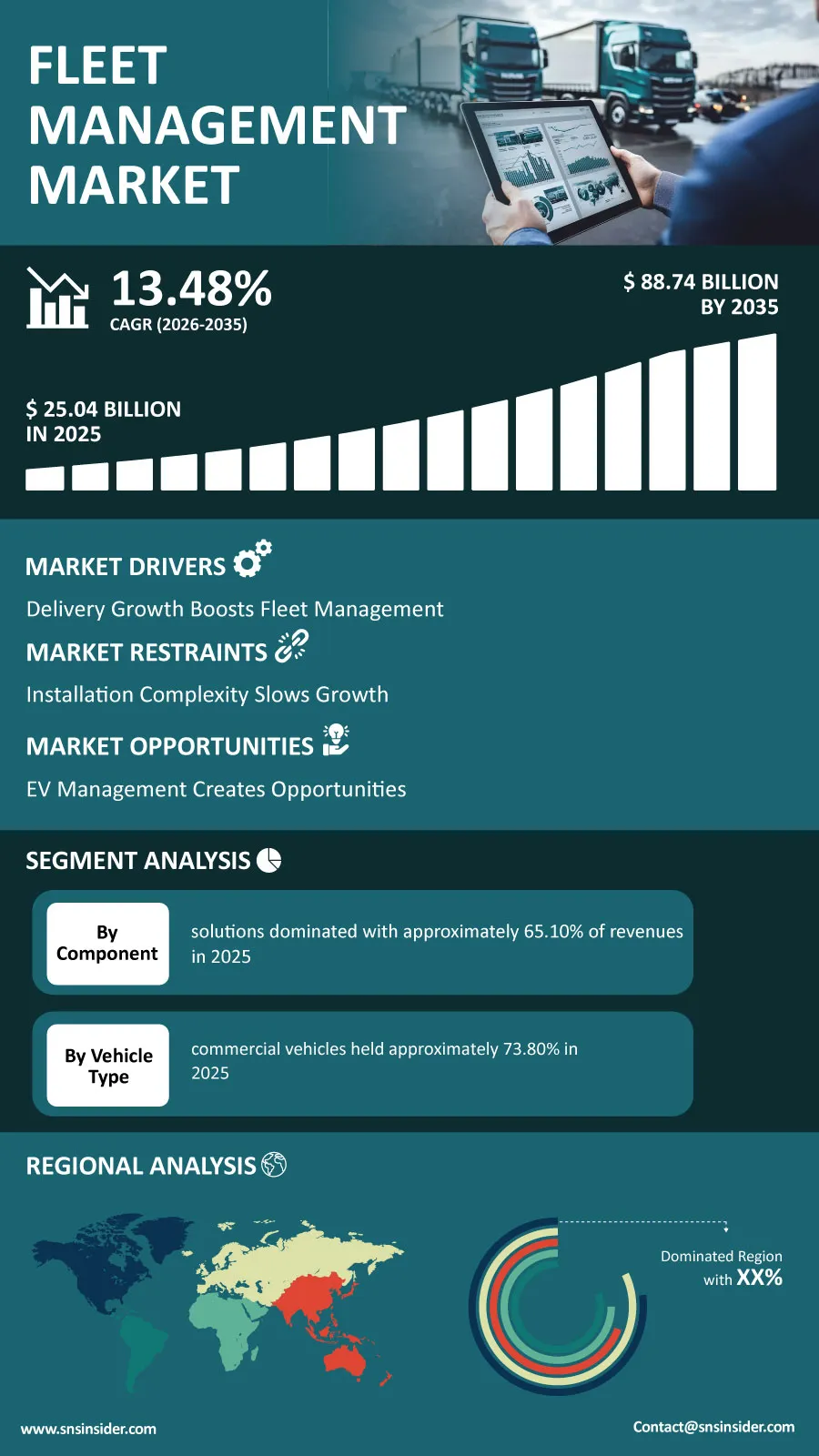
The global Fleet Management Market is entering a new phase of digital transformation as businesses prioritize operational efficiency, vehicle connectivity, and intelligent mobility solutions. “According to a recent study by SNS Insider, the Fleet Management Market size valued at USD 25.04 billion in 2025, is anticipated to grow to USD 88.74 billion by 2035, registering a CAGR of 13.48% over the 2026–2035 forecast period.”
Commercial transport activities, rising logistics needs, and increased digitalization in fleet operations are transforming the industry’s competitive environment. Organizations are embracing fleet management systems in order to ensure efficient utilization of vehicles, lower operating costs, compliance with regulations, and driver safety via consistent decision-making processes based on data.
The fast-paced development of connected cars, cloud technologies, IoT-based telematics, and AI is allowing companies to track their vehicles in real-time while optimizing the maintenance process and route planning. Another factor that is prompting investment in software solutions is the move towards electric commercial vehicles.
To Get Detailed Insights on the Fleet Management Market – Request a Sample Report
Intelligent Mobility Investments Unlock New Growth Opportunities
Businesses operating in transport, retail, construction, utilities, and public sector domains are making quick strides in deploying intelligent mobility solutions to enhance efficiency of their fleets. Ecosystems integrating predictive analytics, telematics, and automatic scheduling have proven useful for businesses to enhance fleet efficiency by maximizing their availability without experiencing any sudden downtime.
The increasing use of last-mile delivery services is creating the need for intelligent routing solutions, which can adapt and alter the schedule of deliveries according to the traffic, weather conditions, and customer needs. Businesses now recognize that intelligent fleet management is a crucial factor for their success and profitability.
With the increasing deployment of electric commercial vehicles, the software vendors are developing specific fleet management capabilities, such as optimizing the time of charging, analysis of battery life cycle, accounting of energy expenses, and range forecasting. This trend will create numerous opportunities for technology vendors in the forecast period.
Key Market Insights Highlight Shifting Demand Patterns
Based on component, solutions accounted for approximately 65.10% of global market revenue in 2025 owing to widespread adoption of integrated fleet software platforms. The services segment is expected to register the fastest growth through 2035 as organizations increasingly seek implementation, integration, consulting, and managed services.
By vehicle type, commercial vehicles represented nearly 73.80% of market revenue in 2025 due to extensive deployment across freight transportation and logistics operations. Passenger vehicles are projected to witness the highest growth as connected mobility solutions expand across corporate and government fleets.
In terms of deployment, cloud-based platforms held around 63.40% of market revenue during 2025 while also emerging as the fastest-growing deployment model because of scalability, remote accessibility, and continuous software updates. Transportation & logistics remained the leading industry vertical with 41.08% market share, while the oil & gas sector is anticipated to expand at the fastest pace over the forecast period.
AI and Connected Technologies Accelerate Fleet Modernization
Innovation in technology is transforming fleet operations with increasing use of artificial intelligence. Analytics tools are now available for predicting maintenance requirements, evaluating driver performance, automatic compliance reporting and smart dispatching, thus ensuring efficient operation and minimizing operational risks.
Fleet operators are now using video telematics, Internet of Things sensors, cloud-based analytics and digital maps within their management platforms for real-time visibility of operations. With growing connected car ecosystems, software vendors are enhancing the features of the platforms to cater to autonomous vehicle technologies and smart infrastructures.
North America Held the Largest Fleet Management Market Share in 2025; Asia Pacific Projected to Register the Fastest CAGR Through 2035
North America continued to be the dominating region within the Global Fleet Management Market throughout 2025 due to the high adoption of telematics, well-established transportation sector, and regulatory focus on digital fleets compliance. The U.S. remains the leading regional player due to increased use of intelligent solutions in logistics, utilities, construction, and governmental transportation by corporations.
Asia Pacific will experience the fastest growth rate until 2035 due to increased activities in e-commerce, rapid urbanization process, rise in commercial vehicles number, and increased investments into digital logistics infrastructure in China, India, and Southeast Asia. Growing adoption of technology within the fleet management sector will positively affect the regional market growth.
Europe will continue to benefit from transportation legislation changes and sustainability initiatives that drive connected fleets adoption, while Latin America and Middle East and Africa will see increasing investments into fleet visibility and vehicle security.
Industry Participants Focus on AI, Cloud Platforms, and Connected Fleet Innovation
Competition within the Fleet Management Market remains strong as leading technology providers expand cloud-native platforms, artificial intelligence capabilities, and connected mobility solutions. Companies are investing heavily in predictive analytics, vehicle connectivity, fleet automation, and electric vehicle management technologies to address evolving customer requirements across global transportation networks.
Key companies operating in the global Fleet Management Market include Samsara Inc., Geotab Inc., Verizon Connect, Trimble Inc., Omnitracs, Webfleet Solutions, Teletrac Navman, Motive, Lytx Inc., Spireon, Azuga, Fleetio, Mix Telematics, Actia Group, Masternaut, Daimler FleetBoard, Microlise Group plc, Transics International, Trackunit A/S, and G7 Networks.
An SNS Insider analyst Sakshi Kale commented, "Digital transformation across commercial transportation is making fleet intelligence a strategic business priority. Organizations investing in AI-powered analytics, cloud-based fleet platforms, connected vehicle technologies, and electric fleet optimization are expected to strengthen operational resilience while improving long-term efficiency and sustainability."
About the Author

Get in touch