
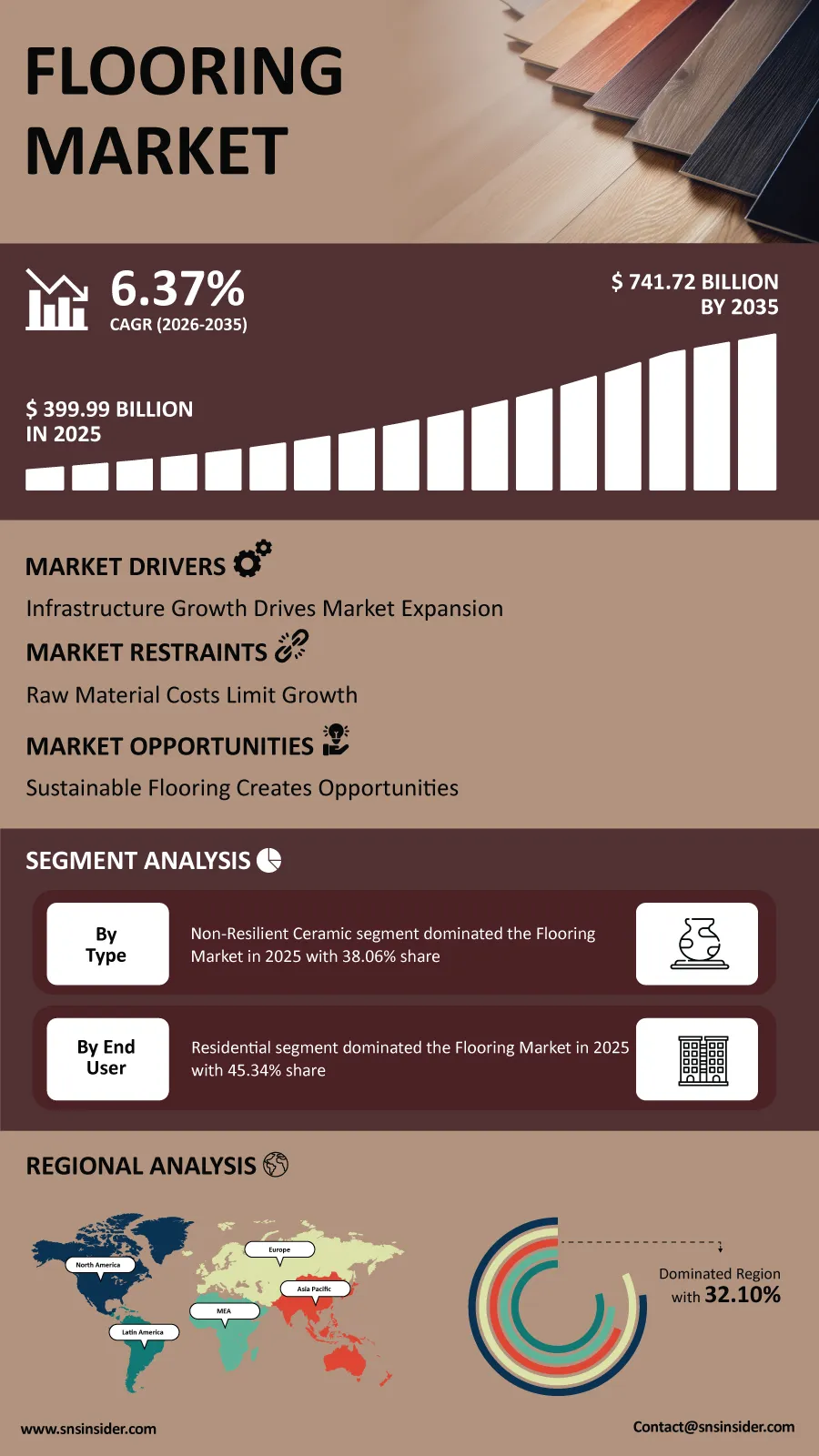
The Flooring Market will continue to expand at a maintained rate as long as investment into residential building, commercial landscape and contemporary interior remodels are made around the globe. “According to a recent study by SNS Insider, the global Flooring Market size valued at USD 399.99 Billion in 2025, is anticipated to grow to USD 741.72 Billion by 2035, registering a CAGR of 6.37% over the 2026–2035 forecast period.”
The growing urban population, rising infrastructural constructions and consistent investments in surrogate and commercial construction are providing a conducive environment for flooring manufacturers across the global marketplaces. Property owners are continuously focusing on flooring options that balance longevity, aesthetics, and maintenance in accordance with the long-term performance of buildings.
Manufacturers are also launching new and innovative products that provide answers to changing customer demands for improved sustainability, moisture resistance, acoustical performance, and ease of installation. Premium flooring species such as engineered wood, luxury vinyl tiles and high-tech ceramics keep gaining traction in both developed and developing economies.
To Get Detailed Insights on the Flooring Market – Request a Sample Report
Sustainable Construction and Smart Buildings Generate Long-Term Market Opportunities
As the global construction industry makes the shift towards sustainability, there is a lot of growth potential ahead for flooring suppliers More builders and developers have been opting for recyclable materials, low-emission products, and flooring systems that help achieve green building certifications or improved indoor environmental quality.
The market is also benefiting from large hotel projects, commercial complexes, healthcare infrastructure, hospitality plans and educational key projects. Companies are capitalizing on this by leveraging digital manufacturing technologies and product customization capabilities to deliver flooring solutions that satisfy functional utility and design aspects across applications.
Simultaneously, circular economy initiatives, material recycling programs and manufacturing process innovations are reinforcing supply chain resiliency sustainability strategies across the flooring value chain as organizations strive to improve resource efficiencies while minimizing environmental impact.
Key Market Insights Highlight Shifting Demand Patterns
On the basis of type, by 2025, Non-Resilient Ceramic segment captured around 38.06% share in revenue generation all over the world due to its durability & moisture resistant properties with increased adoption in residential and commercial building sector. Resilient Flooring segment anticipated remains of creating rate through 2035 growing demand for lightweight, waterproof, and straightforward to put in flooring merchandise.
As per material source, the Synthetic& Engineered segment accounted for over 65.14% of total market revenue in 2025 due to economical benefits and design complexity along with high usage across various construction segments. Over the projection period, Natural Flooring segment is anticipated to be the fastest growing.
By end user, the Residential segment held around 45.34% market revenue share in 2025 and is anticipated to witness high growth over the forthcoming years owing to a rise in housing developments and home improvement projects. Owing to the rapidly expanding retail, healthcare and hospitality along with rising investment in educational institutions and office infrastructure, the Commercial segment is estimated to register maximum growth through 2035.
Product Innovation and Sustainable Manufacturing Reshape Industry Development
Flooring manufacturers are still spending big to put advanced production technologies in place that we hope will make products perform better, go down faster and last longer, both in use and out of it. Global product portfolios are being expanded with developments in luxury vinyl flooring, engineered wood, antimicrobial surfaces and use of recycled materials.
Companies are also bolstering advantages in digital design expertise, the production of made-to-order flooring solutions and eco-friendly manufacturing to address changing regulatory requirements as well as consumer demands. These innovations assist in enhancing operational efficiency while fostering long-term sustainability goals for the entire construction sector.
Asia Pacific Captured 32.10% Market Revenue in 2025, While U.S. Accounted for 82.5% of North America
The Asia Pacific dominated the global market revenue held over 32.10% in 2025 and is expected to be the largest as well as fastest growing regional market during the forecast period. Demand across the region is still being supported by rapid urbanization, rising residential construction, greater infrastructure modernization, and very capable manufacturing capacity. China, with its much construction activity and as the world's largest producer of flooring, made up roughly 54.6% of Asia Pacific revenue.
The improvement in North America remains sizeable, due to strong activity in residential renovation and investment, commercial building as well as elevated household spending on home improvements. We expect that the share of regional revenue from United States in 2025 will account for nearly 82.5%, propelled by its strong domestic construction industry and a large, mature home improvement market.
The rapid adoption of sustainable building materials and awareness of circular economy initiatives are continue to favour Europe, while the Middle East & Africa and Latin America providing immense possibilities on account of infrastructure developments, commercial real estate investment, and growing urban populations.
Industry Participants Focus on Sustainable Innovation and Capacity Expansion
The global flooring market continues to be competitive in nature as leading flooring manufacturers are enhancing production facilities, developing sustainable and eco-friendly products, and increasing recycling efforts to keep pace with changing customer demand. Long-term competitive positioning is still shaped by key strategic investments in premium flooring technologies, digital manufacturing, and the development of sustainable products.
Key companies operating in the global Flooring Market include Mohawk Industries, Inc., Shaw Industries Group, Inc., Tarkett S.A., Armstrong Flooring, Inc., Forbo Holding AG, Gerflor Group, Interface, Inc., Beaulieu International Group, Mannington Mills, Inc., Karndean Designflooring, LG Hausys, RAK Ceramics, Kajaria Ceramics Limited, Asian Granito India Ltd., Atlas Concorde S.p.A., Porcelanosa Group, Polyflor Ltd., Congoleum Corporation, James Halstead PLC, and The Dixie Group.
An SNS Insider analyst Himanshu Sharma commented, "Growing investments in sustainable construction, smart infrastructure, and premium interior solutions are transforming the global flooring industry. Companies focusing on product innovation, circular manufacturing practices, and advanced flooring technologies will be well positioned to capitalize on long-term opportunities across residential and commercial construction markets."
About the Author

Get in touch




