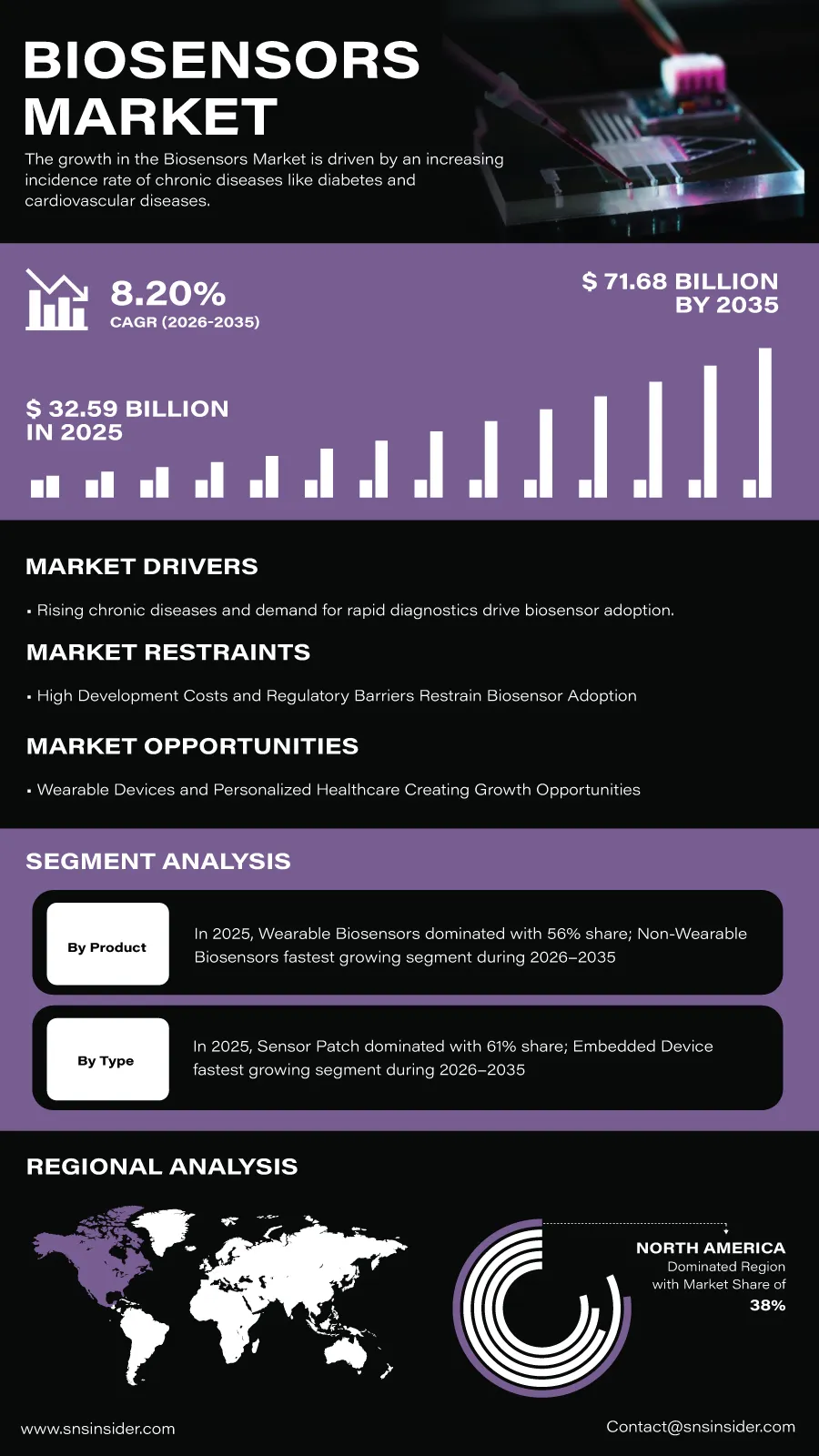
The global Biosensors market growth on a global scale has been tremendous because more people are showing interest in investing in sophisticated diagnostic and monitoring technologies. “According to a recent study by SNS Insider, the global Biosensors Market size, valued at USD 32.59 billion in 2025, is anticipated to reach USD 71.68 billion by 2035, registering a CAGR of 8.20% over the forecast period 2026–2035.”
Rise in chronic diseases such as diabetes and heart diseases has brought about a high demand for reliable and convenient diagnostic systems. Biosensor devices are being embraced by healthcare practitioners and patients due to their ability to measure physiological parameters, identify changes in health status, and provide opportunities for medical intervention. Developments in wearable biosensors, electrochemical biosensors, and miniature biosensors have brought about an increased use of biosensors in hospitals, diagnostic laboratories, and at home.
In view of the growing importance of preventive medicine and customized treatment, the biosensors have become significant in diagnostics and disease management in the field of medicine. Development in point-of-care testing, remote patient monitoring, and digital healthcare infrastructure has boosted demand for portable and connected biosensors. Applications in the fields of environmental monitoring, food safety, biotechnology, and industrial testing have also added value to the biosensors industry.
To Get Detailed Insights on the Biosensors Market – Request a Sample Report
Rising Chronic Disease Prevalence and Point-of-Care Diagnostics Create New Growth Opportunities
The rise in the incidence of chronic diseases is leading to the increasing adoption of biosensors by healthcare providers, owing to their ability to provide real-time diagnosis and monitoring of patients' health status. Glucose biosensors have played an important role in diabetes treatment, as they facilitate the frequent testing of blood glucose level. Monitoring of the heart and disease identification are other key areas where there is scope for biosensors. The need for disease identification and quick results has made hospitals and healthcare professionals use biosensors.
Increasing use of wearable health care devices and personalized medicine has been generating new possibilities for biosensors producers. The use of wearable sensors, monitoring systems and intelligent diagnostic devices provides an opportunity for both patients and health care specialists to monitor selected health parameters beyond traditional clinical environments. Smartphones, digital health systems and IoT applications have made it easier to get access to monitoring data and use remote health care services. In the meantime, developments in nanotechnology and microelectronic field make it possible for companies to design smaller and more efficient devices for various purposes.
However, higher development costs, compliance issues, and measurement accuracy problems remain some of the major challenges for the biosensor market participants. The development of biosensors that are able to ensure reliable operation in varying conditions is expensive due to the high cost of research, testing, production, and quality control measures. Additionally, medical biosensors have to comply with the respective safety and performance standards prior to their commercialization. Issues of calibration, reliability of the devices, and data integration problems may also affect their use. Companies are addressing these issues through investments in novel sensing materials and technologies.
Key Market Insights Highlight Shifting Demand Patterns
By product, Wearable Biosensors accounted for approximately 56% of global Biosensors Market revenue in 2025, reflecting increasing adoption of continuous health monitoring systems, fitness devices, and connected medical technologies. Biosensors are extensively used for blood sugar monitoring and physiological measurements, among others where health-related data can be easily accessed. Increasing consumer awareness about preventive medicine, along with increasing demand for remote solutions, is expected to keep driving this category. Non-Wearable Biosensors category is anticipated to witness the fastest growth until 2035 due to increasing applications in hospitals, diagnostic centers, industrial tests, and research laboratories.
Based on type, the Sensor Patch segment dominated the market with approximately 61% of revenue in 2025, supported by growing preference for compact, user-friendly, and minimally invasive monitoring devices. Increasing use of sensors patches in continuous physiology monitoring is seen in diabetes care as well as many other areas requiring regular measurements. Portable nature and compatibility with connected healthcare systems have increased their demand. The Embedded Device segment is expected to witness the highest growth rate during the forecast period as biosensors are being increasingly used by medical equipment manufacturers in smart diagnostic and monitoring devices.
By technology, Electrochemical Biosensors captured approximately 48% of market revenue in 2025, reflecting their established use in glucose monitoring, clinical diagnostics, and biochemical testing. Due to their relatively low production cost and portability, there have been many commercial opportunities for optical biosensors. It is projected that optical biosensors will see the highest growth until 2035 due to rising demand for quick diagnosis, label-free sensing, and analytical use. Optical sensing technology has also found increasing usage in the fields of biotechnology, environment monitoring, and food safety testing.
By application, Medical Testing accounted for approximately 46% of global market revenue in 2025, driven by the increasing need for disease diagnosis, patient monitoring, and accurate clinical testing. Biosensor technology is increasingly being implemented in hospitals, diagnostic centers, and laboratories associated with the healthcare industry to make testing more efficient and make appropriate decisions. Home diagnostics is expected to be the most rapidly growing segment in the forecast period due to the growing consumer preference for self-diagnostic devices, preventive healthcare, and increasing availability of connected diagnostic devices.
Wearable Health Monitoring and Personalized Diagnostics Strengthen Biosensors Market Demand
There is more focus on preventative medicine and continual management of diseases, which is making the inclusion of biosensors into consumer devices and medical devices more relevant. Wearable glucose monitors, physiological sensor patches, and interconnected diagnostic devices are providing consumers and health care providers with more opportunities to collect health information than conventional periodic measurement tools. They will help detect any changes in the monitored parameters earlier and provide better communication between the consumer and the health care provider. Telemedicine and remote patient monitoring services are also increasing the need for biosensors that can provide consistent results in non-clinical settings.
A combination of cutting-edge sensing materials, miniaturized electronics, and digital connectivity is helping to broaden the applications of biosensors in various industries. Tech companies involved in health care applications are looking at developing intelligent sensing systems that can integrate biosensor readings with analytics to help develop personalized care solutions. Outside of the health care field, food processing companies are increasingly using biosensors for detecting contaminants and monitoring quality. Environmental monitoring organizations are investigating ways of implementing quick detection of pollutants and biological threats. Collaboration between medical devices manufacturers, research institutes, and tech companies will help speed up innovations in this field.
North America Leads Biosensors Market with 38% Share as Asia Pacific Registers Fastest Growth at 9.4% CAGR
North America continued to be the dominant region in the Biosensors Market, contributing to nearly 38% of total revenue of the global market in 2025. This is due to the region's advanced healthcare infrastructure, high rate of chronic disease prevalence, well-established medical technologies sector, and increased use of advanced diagnostic equipment. Increased demand for continuous glucose monitoring systems, point-of-care diagnostics, and health technologies has spurred investments in biosensor products. The US continued to be the main demand driver in the region, where the Biosensors Market was estimated to have a value of around USD 11.0 billion in 2025 and is projected to reach USD 25.1 billion by 2035, exhibiting a CAGR of about 8.60% during 2026-2035. Continued investment in digital health, personalized medicine, and remote patient monitoring is expected to support the country's market expansion.
Asia Pacific is expected to witness the highest growth rate at a CAGR of approximately 9.4% between 2026 and 2035, thanks to enhanced healthcare infrastructure, high incidences of chronic disorders, and increased investment in healthcare technology. There has been an increased demand for wearable biosensors, portable devices, and point-of-care testing systems in nations, such as China, India, and Japan where healthcare infrastructure is increasingly shifting towards accessibility and early diagnosis of diseases. Increased investment in healthcare, adoption of digital healthcare technology, and preventive healthcare awareness among others are creating favorable conditions for both domestic and international biosensor companies. The region's expanding electronics manufacturing capabilities and medical device industries are also supporting the development and commercialization of advanced biosensor technologies.
Industry Participants Focus on Sensor Innovation and Connected Healthcare Solutions
Competition within the Biosensors Industry is progressively becoming based on sensing precision, miniaturization of devices, patient convenience, and digital health care integration. The leading players are working on enhancing their electrochemical and optical sensing capabilities to increase their diagnostic effectiveness while at the same time making the devices smaller and easier to use. In addition, the manufacturers are working on creating systems that will enable health care practitioners and patients to obtain physiological data using mobile phones and remote monitoring systems.
Abbott Laboratories continues to establish its presence in the area of biosensor diagnostics by means of its FreeStyle Libre continuous glucose monitoring product line. It allows for easy glucose detection and integration with the diabetes management system. Medtronic continues developing diabetes technologies and monitoring systems that use the sensor technology and medical devices to help patients. Bio-Rad Laboratories participates in the overall industry as a provider of clinical laboratory instrumentation, research technology, and quality control products. Other players in the market concentrate on special sensing materials, portable diagnostic systems, and advanced medical monitoring technologies due to high demand in the field. These developments highlight the industry's continued emphasis on reliable detection technologies, improved user experiences, and wider access to diagnostic information.
Key companies operating in the global Biosensors Market and its broader diagnostic technology ecosystem include Bio-Rad Laboratories Inc., Medtronic plc, Abbott Laboratories, Biosensors International Group, Ltd., Pinnacle Technologies Inc., Ercon, Inc., DuPont, Johnson & Johnson, Koninklijke Philips N.V., LifeScan, Inc., QTL Biodetection LLC, Molecular Devices Corporation, Nova Biomedical, Molex LLC, TDK Corporation, Zimmer & Peacock AS, and Siemens Healthineers AG.
An SNS Insider analyst, Sushant Kadam, commented, “The rising prevalence of chronic diseases, increasing demand for point-of-care diagnostics, and expanding adoption of wearable health monitoring technologies are creating substantial opportunities in the global biosensors market. As healthcare systems prioritize early diagnosis, personalized treatment, and continuous patient monitoring, manufacturers that deliver accurate, cost-effective, and digitally connected biosensor solutions will be well positioned to benefit from the growing demand for accessible healthcare technologies. Continued advances in sensor miniaturization, biotechnology, and real-time monitoring capabilities are expected to further strengthen the role of biosensors across medical diagnostics, environmental testing, and preventive healthcare applications.”
About the Author

Get in touch