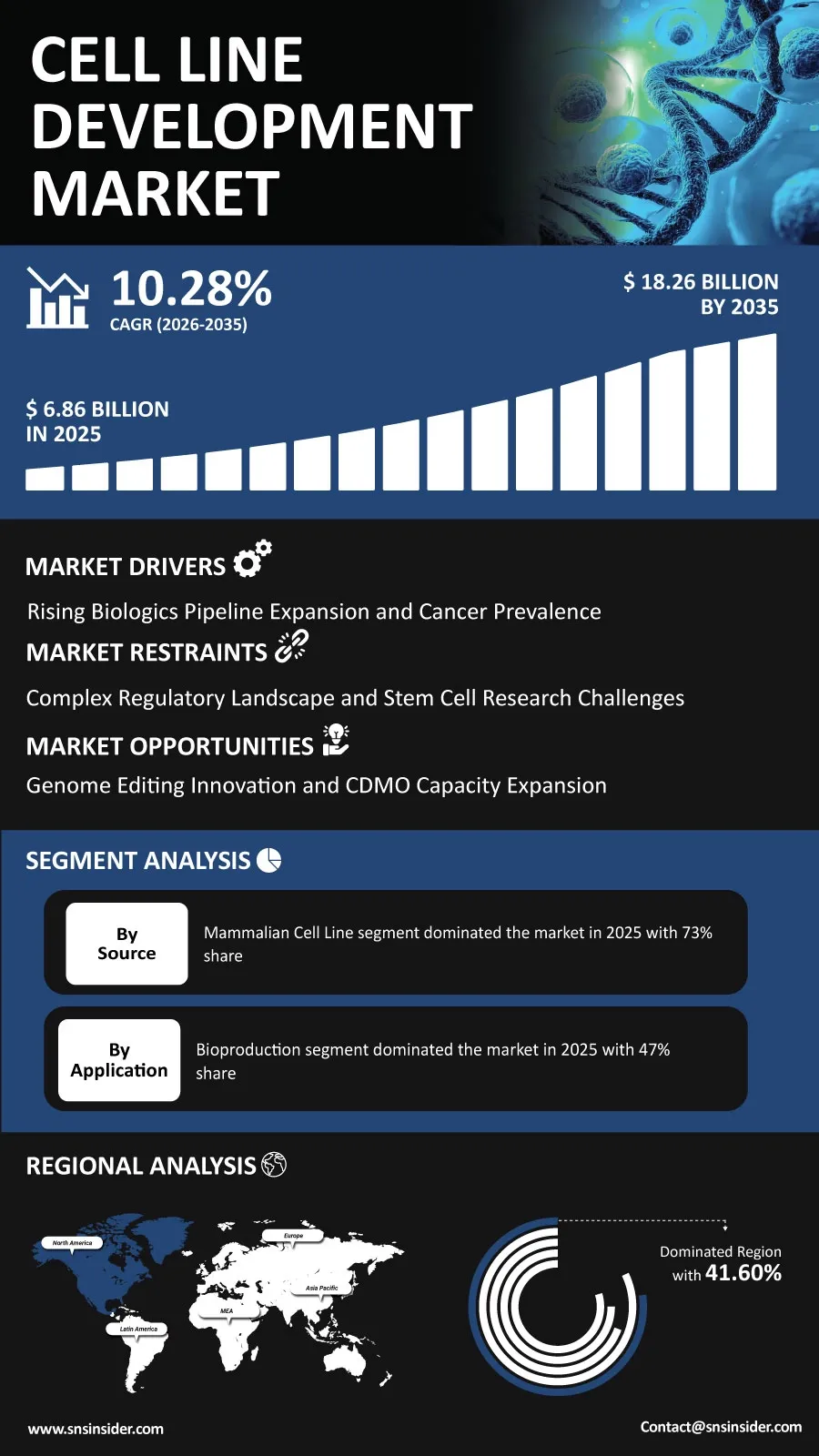
Biopharmaceutical companies around the world continue to invest in increasingly sophisticated cell line engineering capability as biologics pipelines expand. "According to a recent study by SNS Insider, the global Cell Line Development Market valued at USD 6.86 billion in 2025, is projected to reach USD 18.26 billion by 2035, registering a CAGR of 10.28% across the 2026-2035 forecast period."
This sustained expansion reflects the continued convergence of rising cancer prevalence and genuine advancement in cell engineering technology. Companies are no longer satisfied with standard mammalian expression systems alone; they increasingly require platforms capable of supporting increasingly complex biologic modalities, from bispecific antibodies through cell and gene therapies. Manufacturers are responding accordingly, developing genome editing tools and expanding contract development capacity that extends well beyond the traditional monoclonal antibody manufacturing that has long defined this market.
To Get Detailed Insights on the Cell Line Development Market – Request a Sample Report
Rising Biologics Pipeline Fuels Sustained Demand
Growing global biologics and biosimilars pipeline, particularly for chronic conditions, continues to strengthen demand for advanced cell line development technologies. Rising cancer prevalence and an ageing population continue to widen the patient base requiring monoclonal antibody and targeted biologic treatment, reinforcing sustained demand across established and emerging biopharmaceutical markets alike.
Manufacturers are responding by prioritising genome editing capability and outsourced services development ahead of legacy in-house-only models, positioning themselves to serve both large pharmaceutical companies and smaller biotechnology developers.
Segment Findings Point to a Market in Transition
Reagents and Media dominated the Cell Line Development Market in 2025 owing to their critical importance in cell line development and optimization, whereas Services emerged as the most rapidly-growing segment owing to the outsourcing of various development services by pharmaceutical and biotechnology companies.
Mammalian Cell Lines accounted for the largest market share because of their well-established applications in biologics and protein production, whereas Mammalian Cell Lines emerged as the fastest-growing segment owing to rising demand for biologics and advanced therapies.
Recombinant Cell Lines led the market in terms of market share owing to their wide applications in therapeutic proteins and monoclonal antibodies, whereas Hybridomas accounted for the highest growth rate owing to rising demand for antibody-based research and development.
Bioproduction accounted for the highest share because of rising manufacturing of biologics and therapeutic proteins, whereas Tissue Engineering accounted for the fastest-growing segment.
North America Leads, Asia Pacific Set to Grow Fastest
North America held the maximum share in terms of revenue globally in 2025, with a share of 41.60%, attributed to high healthcare infrastructure and adoption of modern biologics. United States held a large part of North America owing to the size of biopharma investments and cell line engineering hub in the region.
Asia Pacific holds the highest growth rate among all regions up to 2035, with a CAGR of 12.60% due to growing investments in biomanufacturing and biotech facilities from countries like China, South Korea, and India. Europe continues to be an important region with contributions from Germany in the form of pharma manufacturing industry.
Capacity Expansion and Genome Editing Reshape Competitive Dynamics
Competition within this market increasingly centers on which providers can pair proprietary expression platforms with sufficient biomanufacturing capacity to support sponsors from early development through commercial-scale production. Companies pursuing large-scale facility expansion continue positioning themselves favourably for the next phase of industry growth.
Some of the major companies operating in the global cell line development market include Thermo Fisher Scientific Inc., Lonza Group AG, Sartorius AG, Danaher Corporation, Merck KGaA, Corning Incorporated, WuXi Biologics (Cayman) Inc., Charles River Laboratories International, Inc., Samsung Biologics Co., Ltd., and FUJIFILM Diosynth Biotechnologies.
An SNS Insider Analyst Parry Kardani, commented, "This market continues to benefit from a genuine convergence of rising biologics pipeline expansion and maturing cell engineering technology. Providers that can pair proven expression platforms with sufficient biomanufacturing capacity are best positioned to capture the next phase of demand, particularly across Asia Pacific's fast-growing biotechnology infrastructure investment."
About the Author

Get in touch