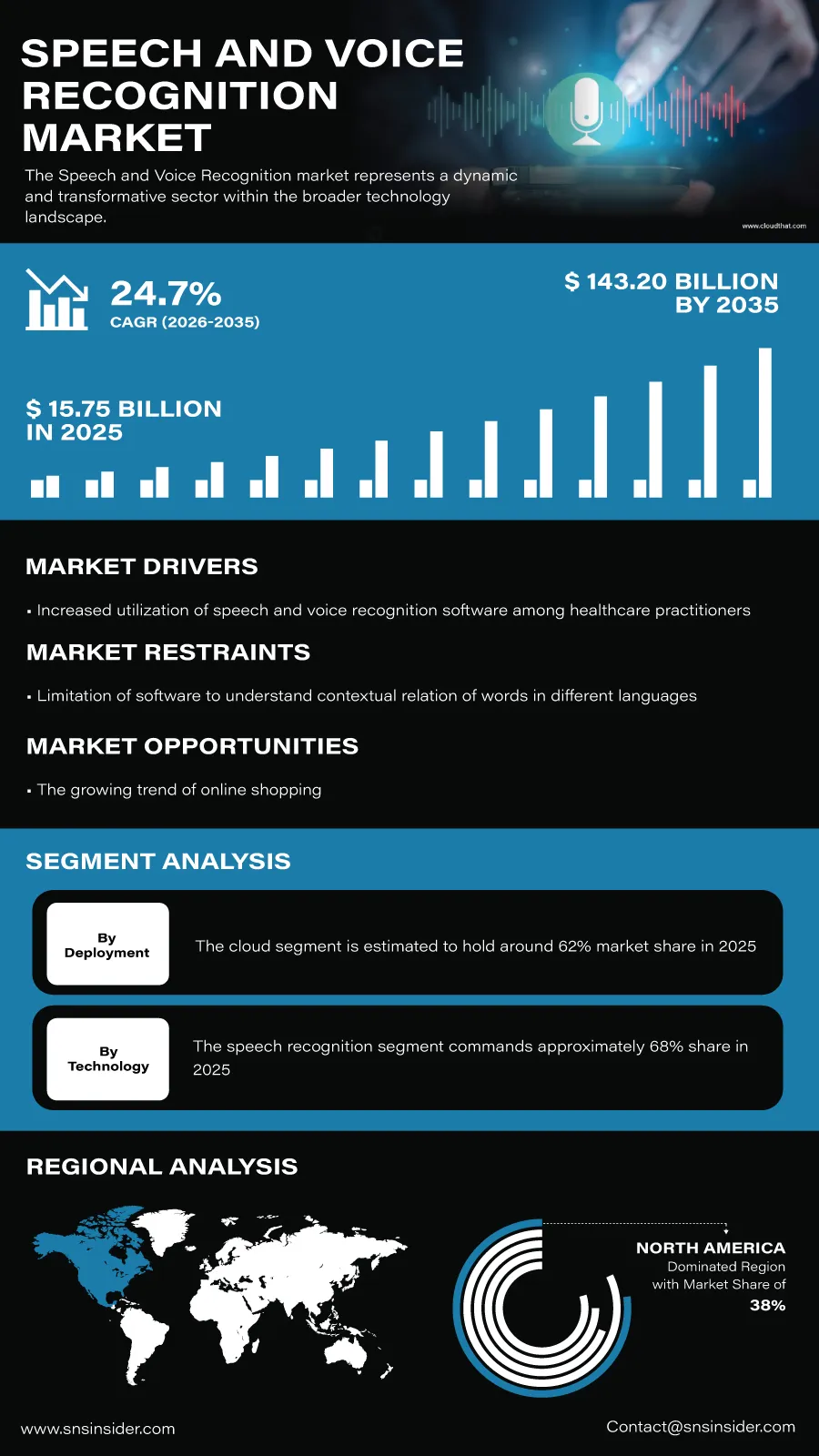
The Speech and Voice Recognition Market globally is witnessing tremendous growth due to adoption of voice recognition technology enabled by artificial intelligence, which will improve communication and increase efficiency through automation. “According to a recent study by SNS Insider, the global Speech and Voice Recognition Market size, valued at USD 15.75 billion in 2025, is anticipated to reach USD 143.20 billion by 2035, registering a CAGR of 24.7% over the forecast period 2026–2035.”
The widespread integration of voice-enabled devices in consumer electronics, health care, banking, automotive, and enterprise applications is driving high demand for speech processing and voice authentication technologies. Enterprises are implementing speech recognition software to convert speech into text, automate customer interactions, and increase business efficiency. Improved natural language processing, machine learning, and deep learning techniques are helping enhance the precision of speech recognition algorithms in diverse languages and operating conditions.
With enterprises rapidly adopting digitalization, speech and voice recognition systems have become an important part of intelligent communications platforms. Widespread adoption of virtual assistants, smart speakers, connected vehicles, and voice-based enterprise applications will drive market growth. High investment in biometric-based authentication, hands-free interfaces, and automation using AI will be another factor encouraging vendors to create highly scalable solutions for delivering personalized user experiences.
To Get Detailed Insights on the Speech and Voice Recognition Market – Request a Sample Report
AI-Powered Automation and Healthcare Digitalization Create New Growth Opportunities
The increased use of artificial intelligence and natural language processing is pushing enterprises to deploy speech and voice recognition technologies that ease human interaction. Speech recognition through AI helps businesses automate their communication processes, improve customer experience services, and transcribe audio data into valuable digital documents. Intelligent virtual assistants, automatic transcriptions, and conversational AI systems are being increasingly used in enterprise communication, finance services, and consumer technology sectors, thus enhancing the demand for these solutions.
The increasing use of speech recognition software by healthcare practitioners provides substantial growth opportunities for market players. Hospitals and other healthcare facilities are integrating voice-enabled medical document systems to relieve the administrative burden and streamline the process of managing electronic health records. Physicians may rely on speech recognition software to document patients' symptoms, make clinical notes, and enter medical data while remaining focused on patient care. The integration of speech processing with healthcare information systems and AI-assisted documentation platforms is supporting workflow efficiency and encouraging wider adoption across hospitals, clinics, and telemedicine services.
However, limitations associated with the comprehension of contextual language, accent recognition, and data protection remain challenges for the developers of the technology. The speech recognition technology may face obstacles in dealing with homophones, jargon language, regional accents, or speech made in noisy areas. Voice data security issues associated with the gathering of data and biometric identification could affect the implementation of speech technology in regulated industries. Developers of the technology are working towards enhancing multilingual language models, developing domain-specific training, and providing privacy-oriented speech processing on device.
Key Market Insights Highlight Shifting Demand Patterns
By deployment, the Cloud segment accounted for approximately 62% of global Speech and Voice Recognition Market revenue in 2025, supported by increasing demand for scalable, cost-efficient, and easily accessible speech processing solutions. The use of cloud-based solutions helps companies to incorporate advanced capabilities of speech recognition technology into their AI tools, customer service systems, and business analytics with minimum investments into infrastructural resources. It is the Cloud segment that is anticipated to demonstrate the most dynamic development over the forecast period 2026 to 2035, growing at the CAGR of about 27%, owing to more companies opting for flexible cloud-based services of artificial intelligence.
Based on technology, the Speech Recognition segment dominated the market with approximately 68% of revenue in 2025, reflecting widespread adoption across smartphones, smart speakers, automotive infotainment systems, healthcare documentation, and enterprise software. Automatic speech recognition, deep learning, and natural language processing are contributing towards better transcription efficiency and enhancing natural interaction between the user and digital platforms. The Voice Recognition market segment, generating around 32% of revenues of the industry, will see the highest rate of growth at a CAGR of about 26.5% in the forecast period. This growth is being driven by increasing use of voice biometric systems in sectors, such as banks, healthcare, and government organizations.
By industry vertical, Healthcare and BFSI collectively captured approximately 45% of market revenue in 2025, supported by growing requirements for secure digital interactions, automated documentation, and efficient customer communication. Speech recognition technology is being employed in healthcare establishments to ease the clinical reporting and EHR management processes, whereas the financial services industry is deploying voice biometrics for customer authentication and fraud detection. These industries are projected to witness a compound annual growth rate higher than 25.8%. In addition, automotive, retail, government, and enterprise sectors will contribute significantly to the growth in voice recognition technology market through their deployment across connected platforms and customer-oriented services.
Conversational AI and Secure Voice Authentication Strengthen Market Demand
Increasing use of digital communication media has led to the adoption of speech and voice recognition software by businesses during their normal operations. Automated speech analytics and conversational AI software solutions are being widely adopted in contact centers to ensure improved customer interactions, monitoring of services rendered and elimination of mundane administrative processes. In the automotive industry, there is increased integration of speech recognition and voice control for entertainment and navigation purposes, whereas in consumer electronics, there is increased use of voice assistants in smartphones, wearables, TVs, and smart home devices.
Technological progress in AI processing on the edge and in voice biometrics security is increasing the functionality of speech recognition software even more. On-device processing allows selected voice features to be used with minimized latency and minimized reliance on the cloud, providing solutions for applications where privacy, reliability, and quickness are necessary. Financial institutions and online services providers are also exploring the use of voice authentication technologies to enhance identity verification and the experience of their customers. At the same time, the growing popularity of online shopping and voice commerce opens the door for conversational interfaces to allow customers to perform a variety of actions by speech.
North America Leads Speech and Voice Recognition Market with 38% Share as Asia Pacific Registers Fastest Growth at 28.5% CAGR
North America was the largest geographical region dominating the global Speech and Voice Recognition Market with about 38% of total revenue generated from the market in 2025. Some of the key factors responsible for regional dominance include the widespread use of artificial intelligence technologies, robust digital infrastructure, and rising use of voice-enabled applications in the healthcare, financial services, consumer electronics, and enterprise communications industries. Presence of big tech developers and continuous investments in the development of conversational AI, cloud computing, and intelligent automation have been driving regional market growth. The U.S. continues to be the biggest contributor to the regional market. North America's Speech and Voice Recognition Market was worth approximately USD 5.60 billion in 2025 and is estimated to grow up to USD 41.50 billion by 2035.
Asia Pacific is set to exhibit the highest rate of regional growth at a CAGR of around 28.5% between 2026 to 2035 due to the fast proliferation of smartphones, investments in artificial intelligence, and digital transformations. China, India, Japan, and South Korea are gaining prominence as new markets for intelligent voice assistants, speech-enabling consumer electronics, and enterprise automation solutions. The significance of China in the market is attributed to its existing artificial intelligence technology ecosystem, growing development of local language speech models, and increasing usage of voice recognition in banking, mobility, and public sector operations. Digital commerce, multilingual voice applications, and government-led technology initiatives are set to offer lucrative prospects for players operating in the speech and voice recognition market.
Industry Participants Focus on Conversational AI Innovation and Multilingual Voice Technologies
In the Competition within the Speech and Voice Recognition Industry, accuracy of recognition, language processing ability, data security, and compatibility with enterprise and consumer AI ecosystems are becoming key factors. Top players within the industry are making significant investments in machine learning models, generative AI, and natural language processing to create even more interactive voice experiences. They are improving multilingual abilities, developing specific applications for the healthcare and finance sectors, as well as implementing on-device processing to enhance privacy. Forming strategic partnerships with cloud computing companies, car manufacturers, and enterprise software developers has become one of the key strategies.
The development of voice interaction based on artificial intelligence by Google takes place in the environment of Gemini, Android, and cloud speech technologies. The company Apple improves voice interactions on its devices via Siri, on-device intelligence, and privacy-focused processing features. Amazon extends the functionality of conversational AI by Alexa and connected devices ecosystems to support voice smart home and digital interactions. The company Microsoft continues developing speech recognition technologies for enterprises through Azure AI and AI-enhanced productivity apps. At the same time, some specialists provide conversational AI, automotive voice assistants, transcription, and voice authentication solutions, such as SoundHound AI, Cerence, Speechmatics, and Pindrop. These developments reflect growing competition to deliver accurate, adaptable, and secure speech technologies across multiple industries.
Key companies operating in the global Speech and Voice Recognition Market include Google LLC, Apple Inc., Amazon.com, Inc., Microsoft Corporation, International Business Machines Corporation (IBM), Nuance Communications, Baidu, Inc., iFLYTEK Co., Ltd., SoundHound AI, Inc., Cerence Inc., Sensory, Inc., Speechmatics, Verint Systems Inc., Pindrop Security, Inc., Twilio Inc., Qualcomm Incorporated, Alibaba Cloud, Huawei Technologies Co., Ltd., Oracle Corporation, and Cisco Systems, Inc.
An SNS Insider analyst, Sushant Kadam, commented, “The accelerating adoption of artificial intelligence, growing demand for automated communication, and increasing integration of voice-enabled technologies across healthcare, financial services, and consumer electronics are creating substantial opportunities in the global speech and voice recognition market. As organizations prioritize operational efficiency, secure authentication, and more natural digital interactions, technology providers that deliver accurate multilingual recognition, privacy-focused processing, and scalable conversational AI solutions will be well positioned to benefit from the continued expansion of intelligent voice technologies.”
About the Author

Get in touch