The global Packaging Printing Market is on a steady growth path through 2035, as SKU proliferation and e-commerce expansion continue reshaping how brands approach printed packaging worldwide.
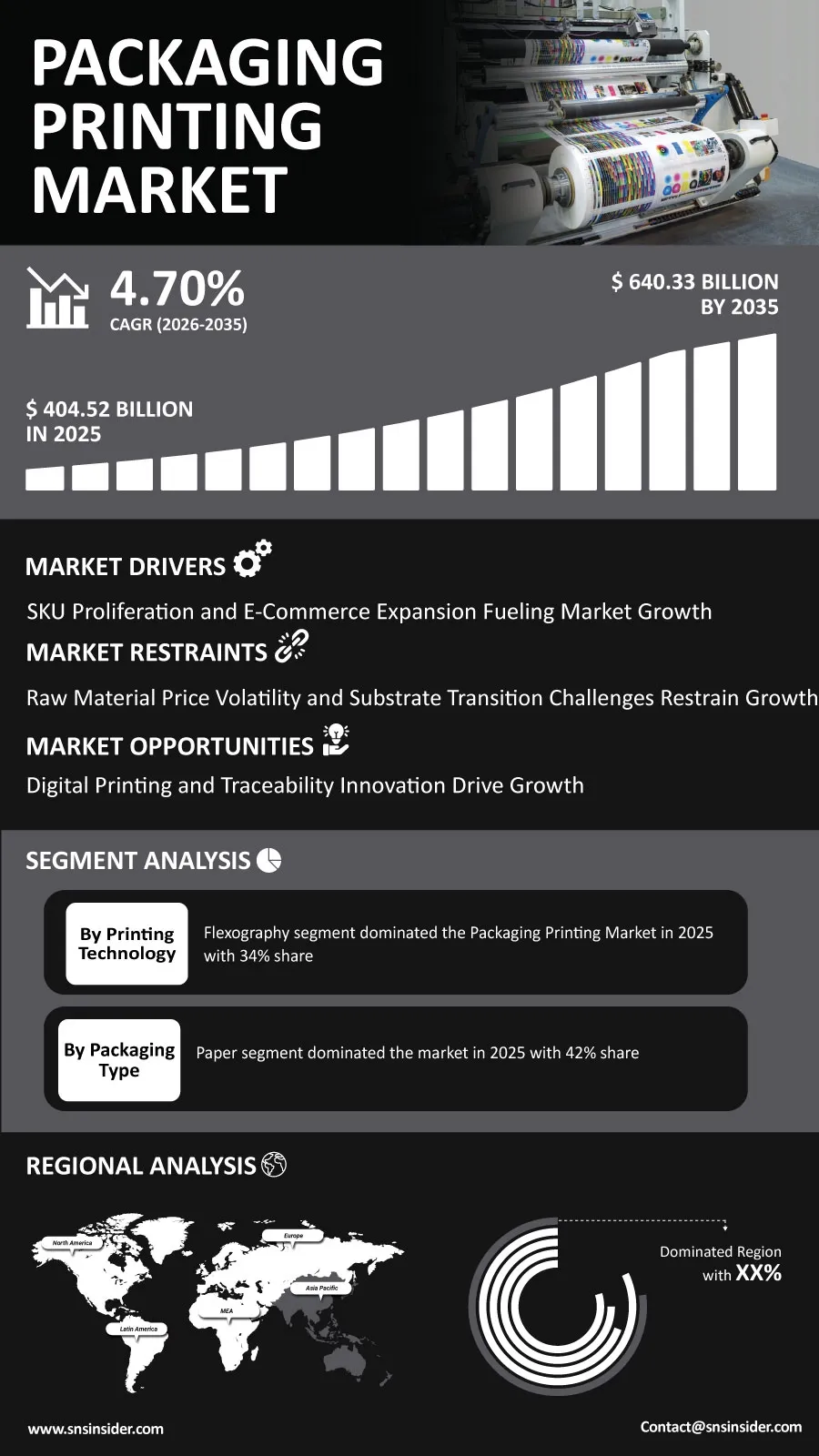
“According to a recent study by SNS Insider, the global Packaging Printing Market size valued at USD 404.52 billion in 2025, is anticipated to grow to USD 640.33 billion by 2035, registering a CAGR of 4.70% over the 2026-2035 forecast period.”
Printed packaging carries more responsibility than most consumers ever consciously register, selling a product on a crowded shelf, meeting legally required labeling standards, and increasingly proving authenticity, all within the same limited surface area. Brands running far more product variants than they did a decade ago are pushing converters to rethink how they balance cost, speed, and quality across increasingly fragmented production runs.
Digital printing, more than any single sustainability initiative, is what's reshaping converter investment priorities right now, as brands demand shorter runs and faster turnaround that traditional plate-based printing methods were never designed to support economically.
To Get Detailed Insights on the Packaging Printing Market – Request a Sample Report
Digital Printing Reshapes Converter Investment Priorities
Where flexography and other traditional printing methods once dominated by default, digital printing is increasingly capturing converter investment as brands demand shorter runs, faster turnaround, and greater customization without the plate-making costs traditional methods require.
This shift is changing how converters compete, since flexibility and turnaround speed are becoming as important a competitive factor as raw per-unit printing cost used to be on its own.
Converters investing early in digital printing capability are positioning themselves to win brand relationships built around SKU proliferation and shorter product lifecycles rather than competing purely on long-run cost efficiency.
Key Market Findings Highlight High-Growth Segments
Flexography held the largest share of the Packaging Printing Market in 2025, at 34%, reflecting its cost efficiency and compatibility with the long print runs most packaged goods manufacturers still require.
Digital printing is the fastest-growing technology, expanding at a 9.20% CAGR, pulled forward by rising SKU proliferation and demand for shorter, more customized production runs.
By packaging type, paper led with 42% share in 2025, while plastic is growing fastest, at a 6.40% CAGR, as flexible packaging expands across food and pharmaceutical applications.
Food & beverage remained the largest end-use industry at 23.40% share, but pharmaceutical is climbing fastest, at a 7.20% CAGR, driven by tightening serialization and anti-counterfeiting regulation.
Turnaround Speed and Traceability Capability Anchor Competitive Positioning
Brand owners are increasingly evaluating printing converters on turnaround speed and traceability capability nearly as much as on unit cost, particularly for pharmaceutical and premium consumer goods categories.
Investment in digital printing infrastructure and serialized coding technology is becoming a genuine competitive differentiator among larger converters, while smaller regional players without that investment increasingly compete only on price for commodity, long-run print jobs.
This divide is expected to sharpen further as SKU proliferation and regulatory traceability requirements both continue intensifying across major markets.
Asia Pacific Leads on Both Scale and Growth
Asia Pacific holds both the largest share of global market revenue and the fastest growth rate, driven by increasing urbanization and the region's massive manufacturing and export-oriented economy across China and India. North America holds a steady, mature share as well, anchored by robust consumer demand and advanced manufacturing capabilities.
Europe's share is shaped heavily by sustainability regulation, which is accelerating the region's transition toward recyclable substrates and lower-impact ink formulations faster than almost anywhere else in the world.
Leading Companies Drive Innovation and Competition
Competition in this market centers on printing technology capability, substrate innovation, and traceability solutions nearly as much as on unit pricing, with the top five players controlling a substantial share of global revenue.
Some of the major companies that operate in the global packaging printing market are Amcor plc, Avery Dennison Corporation, CCL Industries Inc., Smurfit Westrock plc, International Paper Company, Quad/Graphics, Inc., HP Inc., Eastman Kodak Company.
An SNS Insider Analyst Himanshu Sharma commented, “Packaging printing has moved well past being a simple functional finishing step, brands now need converters who can deliver speed, sustainability, and traceability all at once, and the companies capturing the fastest-growing parts of this market are the ones investing in digital printing and serialized coding technology rather than relying on long-run cost efficiency alone. As SKU proliferation and e-commerce keep reshaping packaging requirements, converters with strong technology and substrate flexibility are best positioned to lead.”
About the Author

Get in touch